
Catalogue Search | MBRL


Are you sure you want to remove the book from the shelf?

{{itemTitle}}
126
result(s) for
"Cat family (Mammals)"
Sort by:


Tails from the Exotic Feline Rescue Center, 25th Anniversary Edition
Meet Sahib, Sampson, Zulu, Rouge, Blaze-just a few of the 200 big cats that await visitors at the Exotic Feline Rescue Center. The EFRC, in Center Point, Indiana, is a nationally recognized leader in big cat rescue, conservation, and care. Almost all of these cats-tigers, bobcats, lions, pumas, and servals-are survivors of abuse and neglect. In this follow-up to Saving the Big Cats and Real Stories of Big Cat Rescues, photographer Stephen D. McCloud showcases the newest residents of this lush 108-acre sanctuary, now celebrating its 25th anniversary. Readers will be fascinated by the stories of these incredible feline predators in this anniversary edition, which includes a foreword by Tigers of America founder Bill Nimmo.
eBook

Big cats
Describes the physical characteristics, habits, and natural environment of various species of big cats.
Book

Small wild cats : the animal answer guide
Did you know that most wild cat species are small and that lions, tigers, and other large cats are the exception? That adult bobcats, clouded leopards, and other small wild cats are completely asocial? And that they fight only as a last resort? This entertaining and informative book reveals these and hundreds of other facts about the behavior, biology, and conservation of the more than 30 small wild cat species. From bobcats to servals, small cats are spread across the globe. They range in size from the rusty-spotted cat and African black-footed cat, each of which weighs around 5 pounds when fully grown, to the Eurasian lynx, which can reach an adult weight of 60 pounds. These felids are elusive, some are nocturnal, others are arboreal, and all are rare and secretive, making them especially difficult to study. James G. Sanderson, the world's leading field expert on small wild cats, and naturalist and wildlife artist Patrick Watson provide informative and entertaining answers to common and unexpected questions about these animals. The authors explain why some small cats live on the ground while others inhabit trees, discuss the form and function of their coat types and colors, offer scientifically sound information on human–small wild cat interactions, and even review the role that small wild cats have played in literature, religion, and mythology. The world of cats is as fascinating as it is diverse. Small Wild Cats: The Animal Answer Guide shows just how important and interesting the littlest of the nondomesticated feline family are.
eBook

Crazy about cats
Shares information on different types of cats, including lions, jaguars, and tigers.
Book
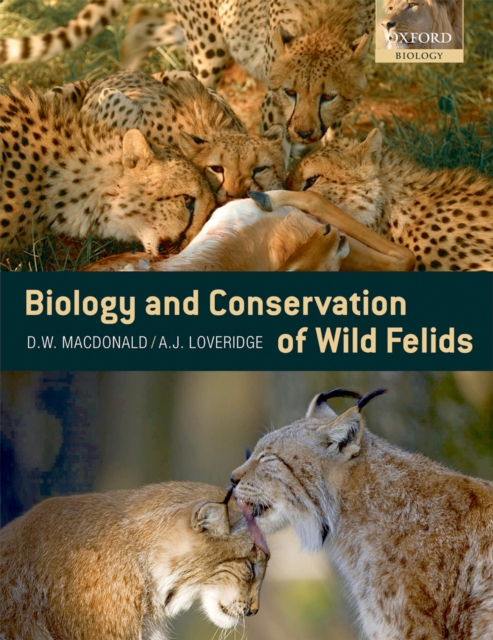
Biology and conservation of wild felids
This advanced textbook brings together a unique network of the world's most respected and knowledgeable experts to provide a review of the biology and conservation of wild felids, and detailed case-studies from species investigations worldwide.
eBook

Big cats
\"Set off on an exciting safari to discover the furry kings of the jungle. See lounging leopards, prowling pumas, and speeding cheetahs! Watch a jaguar hunt for prey, spot a rare Bengal tiger, and meet the mighty lion. Test your knowledge and have hours of fun with eight pages of awesome activities!\"--Page 4 of cover.
Book

Domestic cats and dogs create a landscape of fear for pest rodents around rural homesteads
Using domestic predators such as cats to control rodent pest problems around farms and homesteads is common across the world. However, practical scientific evidence on the impact of such biological control in agricultural settings is often lacking. We tested whether the presence of domestic cats and/or dogs in rural homesteads would affect the foraging behaviour of pest rodents. We estimated giving up densities (GUDs) from established feeding patches and estimated relative rodent activity using tracking tiles at 40 homesteads across four agricultural communities. We found that the presence of cats and dogs at the same homestead significantly reduced activity and increased GUDs (i.e. increased perception of foraging cost) of pest rodent species. However, if only cats or dogs alone were present at the homestead there was no observed difference in rodent foraging activity in comparison to homesteads with no cats or dogs. Our results suggest that pest rodent activity can be discouraged through the presence of domestic predators. When different types of predator are present together they likely create a heightened landscape of fear for foraging rodents.
Journal Article

Wild cats
Introduces the world's big cats, including lions, tigers, cheetahs, leopards, jaguars, and some more unusual varieties.
Book

Comparison of carnivore, omnivore, and herbivore mammalian genomes with a new leopard assembly
Background
There are three main dietary groups in mammals: carnivores, omnivores, and herbivores. Currently, there is limited comparative genomics insight into the evolution of dietary specializations in mammals. Due to recent advances in sequencing technologies, we were able to perform in-depth whole genome analyses of representatives of these three dietary groups.
Results
We investigated the evolution of carnivory by comparing 18 representative genomes from across Mammalia with carnivorous, omnivorous, and herbivorous dietary specializations, focusing on Felidae (domestic cat, tiger, lion, cheetah, and leopard), Hominidae, and Bovidae genomes. We generated a new high-quality leopard genome assembly, as well as two wild Amur leopard whole genomes. In addition to a clear contraction in gene families for starch and sucrose metabolism, the carnivore genomes showed evidence of shared evolutionary adaptations in genes associated with diet, muscle strength, agility, and other traits responsible for successful hunting and meat consumption. Additionally, an analysis of highly conserved regions at the family level revealed molecular signatures of dietary adaptation in each of Felidae, Hominidae, and Bovidae. However, unlike carnivores, omnivores and herbivores showed fewer shared adaptive signatures, indicating that carnivores are under strong selective pressure related to diet. Finally, felids showed recent reductions in genetic diversity associated with decreased population sizes, which may be due to the inflexible nature of their strict diet, highlighting their vulnerability and critical conservation status.
Conclusions
Our study provides a large-scale family level comparative genomic analysis to address genomic changes associated with dietary specialization. Our genomic analyses also provide useful resources for diet-related genetic and health research.
Journal Article