
Catalogue Search | MBRL


Are you sure you want to remove the book from the shelf?

{{itemTitle}}
578
result(s) for
"Cat owners."
Sort by:

Rupert can dance
Although Rupert liked watching his owner Mandy dance during the day, he secretly enjoyed dancing at night while Mandy slept.
Book

Audience segmentation of New Zealand cat owners : understanding the barriers and drivers of cat containment behavior
Aims to identify what factors act as barriers and drivers of NZ cat owners’ participation in cat containment and whether NZ owners can be segmented into unique audiences based on the factors predicting their cat containment behaviour. Tests the hypotheses that cat owners with increased capability, opportunity, and motivation to contain will have greater cat containment intentions and behaviour, and that at least three segments of cat owners will exist in NZ which differ significantly in the set of factors predicting their cat containment behaviour. Source: National Library of New Zealand Te Puna Matauranga o Aotearoa, licensed by the Department of Internal Affairs for re-use under the Creative Commons Attribution 3.0 New Zealand Licence.
Journal Article

A tale of two kitties
\"In this charming mystery from the bestselling author of Paws and Effect, two magical cats have powers of detection that prove indispensable to librarian Kathleen Paulson\"-- Provided by publisher.
Book

Pet–Human Relationships: Dogs versus Cats
The study of human–animal interactions has increased, focusing on the dog–owner relationship, leaving a lag in research on the cat–owner relationship and practically a total absence of studies that compare the dog–owner relationship with the cat-owner relationship. Therefore, the objective of the present study was to make this comparison based on the perception of people living with both dogs and cats, considering interaction, emotional closeness, and perceived cost of the relationship. A total of 132 residents in Mexico participated. To evaluate the pet–human relationship, the dog and cat versions of the Monash dog owner relationship scale were used, thus obtaining comparable scores for the relationship with dogs and cats. Based on what the owners reported, significant differences were found. Relationships with cats were better than relationships with dogs, a finding that was confirmed when comparing male dogs and cats and when comparing female dogs and cats. It was concluded that relationships with cats are better because the perceived cost of such a relationship is lower. However, emotional closeness is greater with dogs than with cats.
Journal Article


Cat–Owner Relationship and Cat Behaviour: Effects of the COVID-19 Confinement and Implications for Feline Management
The restrictive measures implemented to stem the spread of COVID-19 abruptly changed the lives of many cats and their owners. This study explored whether the lockdown in Italy affected the cat–owner relationship, as well as cat behaviour and welfare. A survey that included questions on owner and cat’s demographics, living environment, cat behaviour and a modified version of the Cat/Dog Relationship Scale (C/DORS) was distributed online during the lockdown and was completed by 548 cat owners, mainly women (81.6%). With regard to the C/DORS subscales, both emotional closeness and cat–owner interactions increased during confinement, as opposed to a reduction in perceived costs. The effect of the type of job, family role and owner’s age on the C/DORS scores suggests that the relationship improved for those owners that, due to the lockdown, increased the time spent with their cats. For 58.8% of respondents, their cat’s general behaviour did not change, but when changes occurred, they were mostly positive (20.4%). Attention-seeking and demanding behaviours were the most increased during lockdown (25.7%). Cats with pre-existing problematic behaviours tended to either remain stable or improve during confinement. The overall positive effects of lockdown-related environmental changes on a cat’s behaviour suggest that some aspects of commonly implemented cat management practices should be revised to improve cat welfare in normal circumstances.
Journal Article


Fred in Love
In the early 1970s, when he was still an aspiring, unpublished writer, Felice Picano began a remarkable relationship with an extraordinary animal: a days-old kitten slated for euthanasia who refused to perish. Rescued, named, and trained, Fred became an extraordinarily intelligent companion, ally, teacher, and constant wonder to the author as he began his ascent through the Bohemian circles of Greenwich Village, among musicians, actors, curious characters, and even the famous British actress in hiding right next door. But when an acquaintance brought his female cat to be serviced by Fred, an entire new set of experiences opened up for the cat-and for Picano, who'd never had the nerve to befriend her owner, his ideal man. The course of love seldom runs straight for cats or for men, and this time would prove (hilariously) no different. This is another of Picano's distinguished portraits of a vanished era, when a new gay domain was solidifying only a few years after the Stonewall Riots, and the still nascent gay literary world that Picano would help invent was just a conception.
Fred in Love is a charming, nostalgic, funny, gossipy, involving, and ultimately enlightening story about how we learn and grow, and how we love-whether the object of our affection is a cat or another human being. It's sure to take its place next to Picano's now classic literary memoirs
Ambidextrous ,
Men Who Loved Me , and
A House on the Ocean, a House on the Bay .
eBook
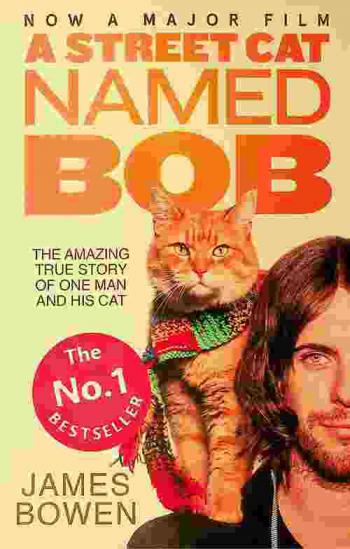
A street cat named Bob
When James Bowen found an injured, ginger street cat curled up in the hallway of his sheltered accommodation, he had no idea just how much his life was about to change. James was living hand to mouth on the streets of London and the last thing he needed was a pet. Yet James couldn't resist helping the strikingly intelligent tom cat, whom he quickly christened Bob. He slowly nursed Bob back to health and then sent the cat on his way, imagining he would never see him again. But Bob had other ideas. Soon the two were inseparable and their diverse, comic and occasionally dangerous adventures would transform both their lives, slowly healing the scars of each other's troubled pasts. A Street Cat Named Bob is a moving and uplifting story that will touch the heart of anyone who reads it.

‘I want you to want me’: How owners value cats' choices has implications for cat containment
Globally, cats are a common companion animal. Allowing companion cats to roam away from home can have negative impacts on native wildlife and cat welfare. A more contained cat lifestyle can limit the detrimental impacts of roaming; however, this continues to be an uncommon choice for cat owners in many countries. Communication strategies that focus on welfare benefits for cats have successfully motivated some owners to prevent their cats from roaming. However, little is known about other factors influencing owners' decisions about roaming, such as the owner–cat relationship and their cat's membership in the local community. We conducted five focus groups with 31 cat owners in Aotearoa New Zealand to understand these factors. Using thematic analysis, we identified three major themes that describe how owners view the impacts of cat containment on their relationship with their cat/s. First, finding a balance between enabling and restricting choices to ensure the cat's welfare is at the heart of the owner–cat relationship. Critically, the cat's choice to repeatedly return home reaffirms the owner–cat relationship. Second, striking the right balance in the provision of choice and ensuring welfare are contingent on the cat's characteristics. Owners providing their cat/s with the choice to leave home are perceived to be positively associated with enabling their freedom, independence and curiosity. Third, owners perceived cats to belong in many spaces occupied by humans outside of their property, despite most participants living near populations of significant threatened species. The choice to allow a cat to roam from home impacts cat welfare, the owner–cat relationship and membership in the local cat, human and wildlife community. Efforts to facilitate the shift to a contained cat lifestyle need to help owners provide choices for their cats that will meet their welfare needs and foster the owner–cat relationship. Locally relevant strategies that consider the owners' views as members of their community will likely be more successful. Read the free Plain Language Summary for this article on the Journal blog. Read the free Plain Language Summary for this article on the Journal blog.
Journal Article