
Catalogue Search | MBRL


Are you sure you want to remove the book from the shelf?

{{itemTitle}}
1,388
result(s) for
"Causes of conflicts"
Sort by:

Overreach : the inside story of Putin's war against Ukraine
\"The Russo-Ukrainian War is the most serious geopolitical crisis since the Second World War--and yet at the heart of the conflict is a mystery. Vladimir Putin apparently lurched from a calculating, subtle master of opportunity to a reckless gambler, putting his regime--and Russia itself--at risk of destruction. Why? Drawing on over 25 years' experience as a correspondent in Moscow, as well as his own family ties to Russia and Ukraine, journalist Owen Matthews takes us through the poisoned historical roots of the conflict, into the COVID bubble where Putin conceived his invasion plans in a fog of paranoia about Western threats, and finally into the inner circle around Ukrainian president and unexpected war hero Volodimir Zelensky. Using the accounts of current and former insiders from the Kremlin and its propaganda machine, the testimony of captured Russian soldiers and on-the-ground reporting from Russia and Ukraine, Overreach tells the story not only of the war's causes but how the first six months unfolded\"-- Provided by publisher.
BOOK

Conflicts Among Councillors in the Local Government Authorities: A Tale of Msalala District Council
This paper focused on conflicts among councillors in Tanzania's Local Government Authorities, where qualitative approaches were employed in data collection and analysis. The study focused on understanding the causes and effects of conflicts in the Local Government Authorities where Msalala District Council in Shinyanga Region was used as a case study. A sample of 22 participants was interviewed through mobile calls. Various local government documents, including the minutes of meetings and reports, were reviewed. The study found three types of conflicts at Msalala District Council. The conflict between the elected councillors themselves, conflicts between the District Council Chairperson and other councillors and conflicts between elected (Ward) councillors and special seat councillors. It was further found that the conflicts were contributed by the low level of education among councillors, personal interest and selfishness, poor communication, conflicting roles and unequal distribution of resources. The study found that the conflicts among the councillors affected the implementation of projects in the council, reduced the morale of the special seat councillors and increased unnecessary costs to the council. Different mechanisms have been adopted to resolve conflicts, like collective bargaining and cooperativeness, which are emphasized for the growth of local government authorities, and this reduces the rate of biased decisions. This study recommends training for councillors immediately after being elected to provide awareness of their roles and duties in the local government authority.
Journal Article
The challenge of stability and security in West Africa
This book seeks to critically examine the challenges of fragility and security in West Africa, along with the factors of resilience. It seeks to investigate key drivers of conflict and violence, and the way in which they impact the countries of the subregion. Along with emerging threats and challenges, these include the challenge of youth inclusion; migration; regional imbalances; extractives; the fragility of political institutions and managing the competition for power; security; and land. The book explores how the subregion, under the auspices of the regional organization ECOWAS has become a pioneer on the continent in terms of addressing regional challenges. This book also seeks to identify key lessons in the dynamics of resilience against political violence and civil war, drawn from countries such as Sierra Leone, Liberia, and Cote d'Ivoire that can be useful for countries around the world in the midst of similar situations. Finally, it draws on knowledge and findings from a series background papers written by leading experts, and provides insights from the perspectives of academics and development practitioners.
eBook

Identity of organizational conflict framework: Evaluating model factors based on demographic characteristics in Iran
Purpose: The purpose of this study was to Identity of organizational conflict framework: Evaluating model factors based on demographic characteristics in Iran. Design/methodology/approach: Research method is descriptive - applied. The statistical population includes all of the employees in Iran's Azad Universites with 600 individuals at the time of the study and statistical sample included 234 individuals who were selected using Morgan table. Beside this study, descriptive and inferential statistics were used. Also, reliability approved through Cronbach alpha (0.87). Then, to detect the dimensions causes of organizational conflict, factor analysis in line with the main components was used. Through exploratory analysis, ten principal factors identified. Thereafter, confirmatory factor analysis reconfirmed these factors.Findings and originality/value: The results of study showed that there is no significant difference between the causes of organizational conflict based on the gender. Also, there are significant differences among the causes of organizational conflict based on the variables of age, education and work experience. Research limitations/implications: we adopt a cross sectional research design and as a result inferences regarding causality cannot be drawn. Future studies following a longitudinal design could provide a more dynamic perspective and contribute further to this stream of research. Originality/value: A lot of researches about the conflict management styles, organizational conflict's effects, etc. are conducted by different researchers, but a handful of researches have been conducted in the field of resources and causes of organizational conflict and this is one of the reasons that it is important for researchers to address this issue.
Journal Article

Modeling conflicts at work: The case of elementary school employees in Croatia
This paper aims to explore conflict as a process that includes antecedents, management strategy, and outcomes while examining the role of affective states in an elementary school working environment. After a theoretical overview and systematization of the conflict elements, a questionnaire was developed that satisfies internal reliability and construct validity. Conflicts at the workplace were modeled with Bayesian SEM, and the results point out the prominent role of affective states in conflicts. Findings confirmed that (1) affective states affect the conflict management strategy choice; (2) different conflict management strategies lead to different conflict consequences; and (3) different affective states lead to differently perceived conflict consequences/outcomes. In addition, we conclude that conflicts with dominantly positive and negative affective states behave structurally differently. The revealed role of affective states facilitates future intervention possibilities in education about conflict management strategies and control of emotions and affective states. Raising awareness about affective states' role in the conflict might increase mutual un-understanding and contribute to a healthy school social environment as a safe space for learning, sharing ideas, and joint actions toward a common goal.
Journal Article

Nations torn asunder : the challenge of civil war
Focusing on the explosion of civil wars since 1945, Bill Kissane asks what makes the contemporary challenge posed by civil wars different to that of past periods - and looks at what the insights from the historical literature, going back to the ancient Greeks, can add to our understanding of this tragic phenomenon.
eBook
The dark side of Zionism
The Dark Side of Zionism: Israel's Quest for Security through Dominance arises out of the scholarship of the \"new historians,\" a group of mostly Israeli scholars who have uncovered a history widely ignored in the popular media. Baylis Thomas argues that both the early Zionists and, later, the Israelis sought their security through the military domination of the indigenous Arab population of Palestine. This strategy required both avoiding negotiations with the Palestinian-Arabs and provoking the weak Arab states-opposed to the Israeli takeover of Palestine-into entering wars they would lose. The role of British imperial power was crucial in this early history, as was the later U.S. support of Israel, right or wrong. Thomas explores the larger context of this history in chapters on colonization, hegemony, weapons diplomacy, terrorism, nationalism, religion, Zionism, and prospects for resolution of the conflict. While students and scholars of Middle Eastern studies and international relations will find this book valuable, it is intended for the intelligent general reader who is curious about current events yet puzzled about the Palestinian-Israeli conflict. Israel's national identity, founded on the memory of being victims of the Holocaust, focuses on current events that seem consistent with the past, even as the nation uses force to thwart Palestinian national aspirations. The Dark Side of Zionism argues that peace for both Israelis and Palestinians can only come if Israel relinquishes military rule.
eBook
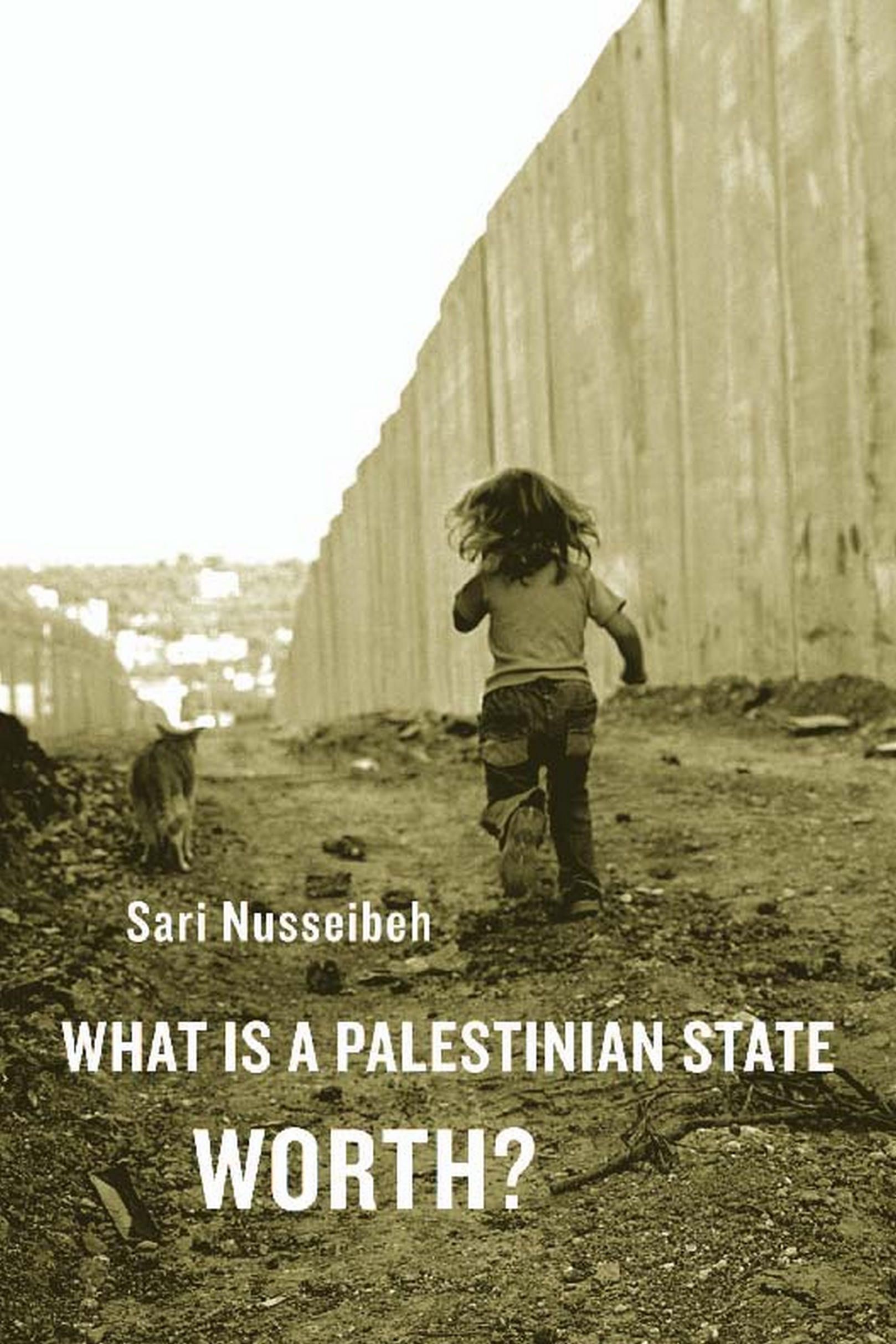
What is a Palestinian state worth?
\"In a display of rationality uncommon to discussions of the Israeli-Palestinian conflict, Nusseibeh takes an impartial vantage point, trying to sort out a mess largely generated by overblown and hyperactive political identities.\"—Boston Review
\"[This] philosophical and balanced book is unfailingly sensitive and empathetic to both sides.\"—Publishers Weekly
Can a devout Jew be a devout Jew and drop the belief in the rebuilding of the Temple? Can a devout Muslim be a devout Muslim and drop the belief in the sacredness of the Rock? Can one right (the right of return) be given up for another (the right to live in peace)? Can one claim Palestinian identity and still retain Israeli citizenship? What is a Palestinian state worth? For over sixty years, the Israeli-Palestinian conflict has been subjected to many solutions and offered many answers by diverse parties. Yet, answers are only as good as the questions that beget them. It is with this simple, but powerful idea, the idea of asking the basic questions anew, that the renowned Palestinian philosopher and activist Sari Nusseibeh begins his book.
What Is a Palestinian State Worth? poses questions about the history, meaning, future, and resolution of the Israel/Palestine conflict. Deeply informed by political philosophy and based on decades of personal involvement with politics and social activism, Nusseibeh's moderate voice—global in its outlook, yet truly grounded in his native city of Jerusalem—points us toward a future which, as George Lamming once put it, is colonized by our acts in this moment, but which must always remain open.
eBook


'Hunting ghosts of a difficult past': the International Crisis Group and the production of 'crisis knowledge' in the Mano River Basin wars
This article explores the relationship between the International Crisis Group's (icg) interpretation of the civil wars in Liberia and Sierra Leone and the main academic 'greed and grievance' debate at the time. It shows that the icg's early policy recommendations were basically in line with the interpretation of these wars as caused by 'opportunistic warlordism'. However, this supposed causal link is less evident in the analytical parts of its early reports, and in the policy recommendations of later reports. These contradictory findings point to both internal developments within the icg and to its 'two faces': it seeks to influence policy makers using detailed empirical analysis on the ground in countries in conflict or transition, but is also aware that policy makers do not generally read long reports, thus it produces executive summary and policy recommendations for this target audience. The article argues that policy recommendations cannot work without the analytical parts of the reports: the analysis sections' main function is to add legitimacy to policy recommendations and the organisation overall, contributing to its image as a genuine 'on-the-ground producer' of crisis knowledge and fostering its expert authority.
Journal Article