
Catalogue Search | MBRL


Are you sure you want to remove the book from the shelf?

{{itemTitle}}
933
result(s) for
"Cavalry"
Sort by:

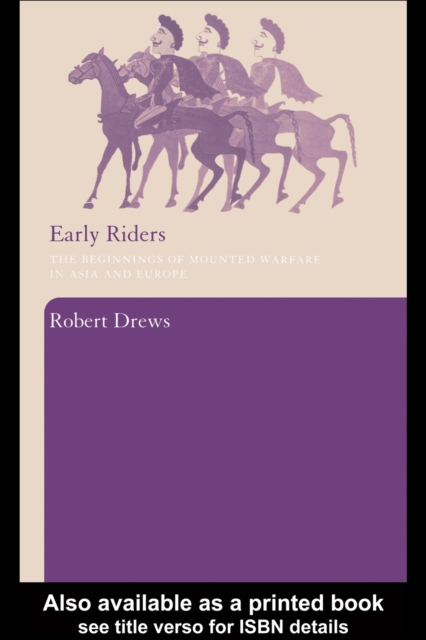
Early Riders
In this wide-ranging and often controversial book, Robert Drews examines the question of the origins of man's relations with the horse.
He questions the belief that on the Eurasian steppes men were riding in battle as early as 4000 BC, and suggests that it was not until around 900 BC that men anywhere - whether in the Near East and the Aegean or on the steppes of Asia - were proficient enough to handle a bow, sword or spear while on horseback. After establishing when, where, and most importantly why good riding began, Drews goes on to show how riding raiders terrorized the civilized world in the seventh century BC, and how central cavalry was to the success of the Median and Persian empires.
Drawing on archaeological, iconographic and textual evidence, this is the first book devoted to the question of when horseback riders became important in combat. Comprehensively illustrated, this book will be essential reading for anyone interested in the origins of civilization in Eurasia, and the development of man's military relationship with the horse.
Robert Drews is Professor of Classics and History at Vanderbilt University, where he has taught since 1961. One of his interests is the military history of the Near Eastern and Greek world during the Bronze Age, and his publications on that subject include Coming of the Greeks and The End of the Bronze Age.
eBook


Small but Important Riots
June 1863. The American Civil War was two years old, and the U.S.
Army in Virginia was in chaos. Reeling after the recent defeat at
Chancellorsville, the Federals, especially the Cavalry Corps,
scrambled to regroup. Confederate general Robert E. Lee seized the
moment to launch a second invasion of the North. As Lee slipped
away, frantic Federal leaders asked, \"Where are the Rebels?\" At
this critical moment, the much-maligned Federal cavalry stepped to
center stage. Small but Important Riots is a tactical
study of fighting from June 17 to 22, 1863, at Aldie, Middleburg,
and Upperville, placed within the strategic context of the
Gettysburg campaign. It is based on Robert O'Neill's thirty years
of research and access to previously unpublished documents, which
reveal startling new information. Since the fighting in Loudoun
Valley of Virginia ended in June 1863, one perspective has
prevailed-that Brigadier General Alfred Pleasonton, who commanded
the Cavalry Corps, Army of the Potomac, disobeyed orders. According
to published records, Pleasonton's superiors, including President
Abraham Lincoln, Secretary of War Edwin Stanton, and army commander
Joseph Hooker, ordered Pleasonton to search for General Robert E.
Lee's Army of Northern Virginia during a critical stage of the
Gettysburg campaign, and Pleasonton ignored their orders. Recently
discovered documents-discussed in this book-prove otherwise.
eBook


Spartan Band
In Spartan Band (coined from a chaplain’s eulogistic poem) author Thomas Reid traces the Civil War history of the 13th Texas Cavalry, a unit drawn from eleven counties in East Texas. The cavalry regiment organized in the spring of 1862 but was ordered to dismount once in Arkansas. The regiment gradually evolved into a tough, well-trained unit during action at Lake Providence, Fort De Russy, Mansfield, Pleasant Hill, and Jenkins' Ferry, as part of Maj. Gen. John G. Walker's Texas division in the Trans-Mississippi Department. Reid researched letters, documents, and diaries gleaned from more than one hundred descendants of the soldiers, answering many questions relating to their experiences and final resting places. He also includes detailed information on battle casualty figures, equipment issued to each company, slave ownership, wealth of officers, deaths due to disease, and the effects of conscription on the regiment’s composition. “The hard-marching, hard-fighting soldiers of the 13th Texas Cavalry helped make Walker’s Greyhound Division famous, and their story comes to life through Thomas Reid’s exhaustive research and entertaining writing style. This book should serve as a model for Civil War regimental histories.”—Terry L. Jones, author of Lee’s Tigers
eBook


James Riley Weaver’s Civil War
666 days of diary entries documenting the life of a Union officer held in Confederate prisons Captured on October 11, 1863, James Riley Weaver, a Union cavalry officer, spent nearly seventeen months in Confederate prisons. Remarkably, Weaver kept a diary that documents 666 consecutive days of his experience, including not only his life in a series of prisons throughout the South, but his precaptivity cavalry duties, and his eventual return to civilian life. It is an unparalleled eyewitness account of a crucial part of our history. Weaver's observations never veer into romanticized descriptions; instead, he describes the \"little world\" inside each prison and outdoor camp, describing men drawn from \"every class of society, high and low, righ and poor, from every country and clime.\" In addition, Weaver records details about life in the Confederacy that he gleans from visitors, guards, new arrivals, recaptured escapees, Southern newspapers, and even glimpses through windows. As the editors demonstrate, Weaver's diary-keeping provided an outlet for expressing suppressed emotions, ruminating on a seemingly endless confinement that tested his patriotism, religious faith, and will to survive. In the process, he provides not only historically important information but also keen insights into the human condition under adversity.
eBook
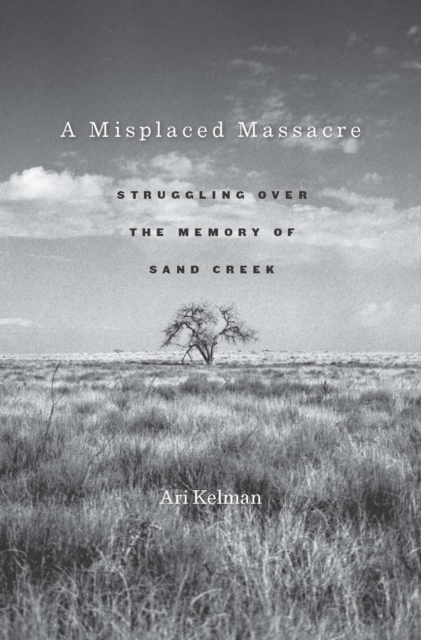
A misplaced massacre : struggling over the memory of Sand Creek
On November 29, 1864, over 150 Native Americans, mostly women, children, and elderly, were slaughtered in one of the most infamous cases of state-sponsored violence in U.S. history. Kelman examines how generations of Americans have struggled with the question of whether the nation's crimes, as well as its achievements, should be memorialized.
eBook