
Catalogue Search | MBRL


Are you sure you want to remove the book from the shelf?

{{itemTitle}}
610
result(s) for
"Celebrities France."
Sort by:

Place Vendمome, Paris
The author presents a fully illustrated history of the Place Vendمome in Paris, France, including a chronological listing of owners for each of the square's addresses.
Book

Stardom in postwar france
The 1950s and 1960s were a key moment in the development of postwar France. The period was one of rapid change, derived from post-World War II economic and social modernization; yet many traditional characteristics were retained. By analyzing the eruption of the new postwar world in the context of a France that was both modern and traditional, we can see how these worlds met and interacted, and how they set the scene for the turbulent 1960s and 70s. The examination of the development of mass culture in post-war France, undertaken in this volume, offers a valuable insight into the shifts that took place. By exploring stardom from the domain of cinema and other fields, represented here by famous figures such as Brigitte Bardot, Johnny Hallyday or Jean-Luc Godard, and less conventionally treated areas of enquiry (politics [de Gaulle], literary [Françoise Sagan], and intellectual culture [Lévi-Strauss]) the reader is provided with a broad understanding of the mechanisms of popularity and success, and their cultural, social, and political roles. The picture that emerges shows that many cultural articulations remained or became identifiably \"French,\" in spite of the American mass-culture origins of these social, economic, and cultural transformations.
eBook

Making Marie Curie : intellectual property and celebrity culture in an age of information
\"Making Marie Curie explores what went into the creation of this icon of science. It is not a traditional biography, or one that attempts to uncover the \"real\" Marie Curie. Rather, Eva Hemmungs Wirten, by tracing a career that spans two centuries and a world war, provides an innovative and historically grounded account of how modern science emerges in tandem with celebrity culture under the influence of intellectual property in a dawning age of information. She explores the emergence of the Curie persona, the information culture of the period that shaped its development, and the strategies Curie used to manage and exploit her intellectual property.\"--Provided by publisher.
Book
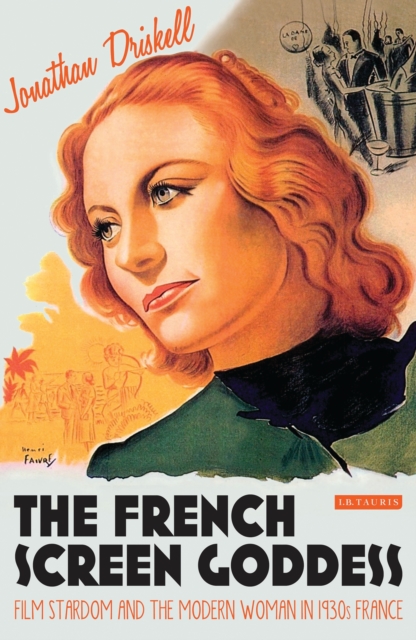
The French screen goddess : film stardom and the modern woman in 1930s France
Many years before Brigitte Bardot and Catherine Deneuve rose to fame, the French cinema produced a host of glamorous female stars designed to rival their Hollywood counterparts. Bathed in soft light, discussed adoringly in fan magazines and shown wearing the latest fashions, these 'cinematic stars' emerged in opposition to France's traditional stage-based stardom, while remaining, through the roles they played and the looks they sported, a distinctly French phenomenon. The French Screen Goddess examines how these stars influenced the narratives and look of their films, contributed to defining the period's new, emancipated femininity -, the 'modern woman' -, and related to the decade's politics, particularly the Popular Front of the mid-1930s. The book focuses on the three most important examples of this type of stardom, Annabella, Danielle Darrieux and Michele Morgan, while also considering many other key stars, such as Arletty, Viviane Romance and Jean Gabin.
Previously neglected films are considered and true classics of French cinema re-examined, with Rene Clair's Quatorze juillet, Julien Duvivier's La Bandera, and Marcel Carne's Le Quai des brumes and Hotel du Nord foremost among these.
eBook

The invention of celebrity : 1750-1850
\"Frequently perceived as a characteristic of modern culture, the phenomenon of celebrity has much older roots. In this illuminating new book cultural historian Antoine Lilti shows that the mechanisms of celebrity were developed in Europe during the Enlightenment, well before films, yellow journalism and television, and then flourished during the Romantic period on both sides of the Atlantic. Figures from across the arts like Voltaire, Garrick and Liszt were all veritable celebrities in their time, arousing curiosity and passionate loyalty from their \"fans.\" In Paris as in London, in Berlin as in New York, the rise of the press, new advertising techniques and the marketing of leisure brought a profound transformation in the visibility of celebrities: private lives were now very much on public show. Nor was politics spared this cultural upheaval: Marie-Antoinette, George Washington and Napoleon all experienced a political world transformed by the new demands of celebrity. And when the people suddenly appeared on the revolutionary scene, it was no longer enough to be legitimate, it was crucial to be popular too. Lilti retraces the profound social upheaval precipitated by the rise of celebrity and explores the ambivalence felt towards this new phenomenon. Jean Jacques Rousseau's career is an exemplary case. A celebrated and adulated writer, Rousseau ended up cursing the effects of his \"disastrous celebrity,\" marred by the feeling that he had become a public figure whom people everywhere could fashion as they wished. Both sought after and denounced, celebrity evolved as the modern form of personal prestige, assuming the role that glory played in the aristocratic world in a new age of democracy and evolving forms of media. To this day, it is of course a type of glory whose value is still disputed. Lilti's perceptive history uncovers the birth of celebrity in the 18th century, while at the same time shining valuable light on the continuing importance of celebrity in today?s world\"-- Provided by publisher.
Book


Berluti : at their feet
\"Published to celebrate the 120th anniversary of the renowned shoemaker and fashion house, Berluti celebrates the pinnacle of bespoke shoe design. This is the first book on the house of Berluti, which has been making shoes for the elegant man since 1895. From its earliest days, Berluti's exquisite craftsmanship has been embraced by an extraordinary list of clients from the worlds of art, music, and cinema. This celebration of the art of bespoke shoemaking showcases Berluti's most iconic shoes that were tailor-made for twenty-six of their renowned patrons, including Andy Warhol, Frank Sinatra, Robert De Niro, Harvey Keitel, Yves Saint Laurent, Marcel Proust, and Roman Polanski. New photographs of these celebrities' shoes accompany whimsical illustrations and handwritten quotes on the subject of shoes. Featuring some of the most beautiful loafers, moccasins, boots, and dress shoes ever made, and with writing by the ultimate style guru Glenn O'Brien, this oversize ode to bespoke shoemaking is the perfect gift for all discerning followers of men's fashion\"--Publisher's description.
Book

The impact of the live broadcast of Stromae’s song L’enfer on social media publications, calls to the national helpline, and suicide attempt rates in France
On January 9, 2022, Belgian pop singer Stromae performed his new hit “L’enfer” live on French TV. The song addresses his personal struggles with suicidal ideation. To evaluate the impact of Stromae’s performance, we modeled the evolution of hospital admission rates for suicide attempts (SAs) in France, calls to the national suicide prevention helpline (3114), and Twitter publications mentioning the singer or the helpline. We employed the Gombay test to identify change points within each time series. We identified a significant increase in mean SA rates among women aged 20–24 years 6 days after the singer’s performance. No similar effect was observed in the general population or other young age groups. The show was immediately followed by a peak in tweets referring to the singer, while Twitter activity related to the 3114 remained modest. We did not observe any increase in calls to the helpline. Celebrity testimonies about suicidal experiences can help alleviate stigma but should be accompanied by prevention messages to reduce the risk of contagion.
Journal Article

Christian Dior : designer of dreams
Christian Dior's first collection in 1947 heralded the birth of a new fashion silhouette for women. Here, seventy of the most memorable looks created by Christian Dior and his successors--Yves Saint Laurent, Marc Bohan, Gianfranco Ferrâe, John Galliano, Raf Simons, and Maria Grazia Chiuri--have been specially selected and photographed in intimate detail. This essential volume also features those designs in original sketches, runway shots, and fashion shoots by the world's greatest fashion photographers, including Irving Penn, Richard Avedon, Cecil Beaton, William Klein, and Helmut Newton. Exploring the classic elements of Dior in depth, the book covers the concept of line and architecture in fashion; the influence of history and art; the use of color; gardens and landscapes as sources of inspiration.
BOOK

Performing Presidents
The article explores the phenomenon of celebrity presidents being former actors, playwrights or showbusiness figures. Notable twentieth- and twenty-first-century presidents, including Ronald Reagan, Václav Havel, Donald Trump and Volodymyr Zelensky form the basis of this case study. Emphasis is given to the transformation from theatrical endeavors to the presidency, reframing political life as a theatrical event in terms of Yuri Lotman’s notion of theatricalization and Guy Debord’s perception of contemporary society as a spectacle.Utilizing Michael L. Quinn’s application of the Prague School’s writings on phenomenology and semiotics to the conundrum of celebrity in performance, the article scrutinizes how these presidents enact their presidential role, while also allowing their personal attributes to predominate. Consequently, these politicians alter political discourse by incorporating entertainment elements, modifying norms of political representation, the role of a popular leader and communication methods. In contrast to the Reagan and Havel era, modern technology permits Trump and Zelensky to embrace an innovative “distributed aesthetics” approach. Owing to its virtual nature, this method overcomes temporal and spatial limitations. This phenomenon concurrently renders celebrity presence ubiquitous and heightens the illusion of intimacy between ruler and populace when it all transpires within what Christopher Balme terms the global public sphere.
Journal Article