
Catalogue Search | MBRL


Are you sure you want to remove the book from the shelf?

{{itemTitle}}
808
result(s) for
"Central planning -- Soviet Union"
Sort by:
Rediscovering Fire
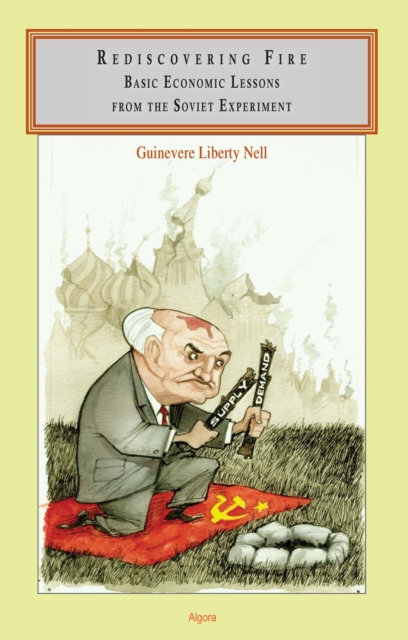
Marx promoted the idea that economic laws were universal, but the Soviet Union tested his ideas on the premise that by eliminating private property they could eliminate markets and prices?and they tested that proposition on a grand scale. However, in managing an economy based on public ownership, they discovered that they could not repeal economic laws. By managing the consequences of their policies, the Soviets unintentionally relearned the basics of economics from scratch?essentially, rediscovering fire.
eBook
Planning and Profits in Socialist Economies
This study of economic reforms throughout Eastern Europe covers the history of attempts at decentralization. The book: * Describes the centralized model and compares its requirements with the realities of socialist countries * Discusses the economic policies of the post-Stalinist period * Examines the origin of the reforms which began in 1956, culminating in the Soviet economic reform of 1965 and the rehabilitation of profit. Countries covered include the former USSR, the former East Germany and Hungary.
eBook
The Soviet Economy on the Brink of Reform
First Published in 1988. Routledge is an imprint of Taylor & Francis, an informa company.
eBook
Restructuring the Soviet Economy
Restructuring the Soviet Economy examines the Soviet leadership's most urgent question - how to revitalize the soviet economy. David Dyker argues that the current impasse can can only be understood in the context of the failure of 60 years of central planning. He analyses both the problems besetting the centrally planned system and those that have paralysed perestroika and assesses whether the most ambitious attempt ever to reform the Soviet economy will succeed.
eBook

Soviet Economic Management under Khrushchev
The Sovnarkhoz Reform of 1957 was designed by Khrushchev to improve efficiency in the Soviet economic system by decentralising economic decision making from all-Union branch ministries in Moscow to the governments of the individual republics and regional economic councils. Based on extensive original research, including unpublished archival material, this book examines the reform, discussing the motivations for it, which included Khrushchev's attempt to strengthen his own power base. The book explores how the process of reform was implemented, especially its impact on the republics, and analyses why the reform, which was reversed in 1959, failed. Overall, the book reveals a great deal about the workings, and the shortcomings, of the Soviet economic system at its height.
eBook

Soviet Economic Management Under Khrushchev
The Sovnarkhoz Reform of 1957 was designed by Khrushchev to improve efficiency in the Soviet economic system by decentralising economic decision making from all-Union branch ministries in Moscow to the governments of the individual republics and regional economic councils. Based on extensive original research, including unpublished archival material, this book examines the reform, discussing the motivations for it, which included Khrushchev's attempt to strengthen his own power base. The book explores how the process of reform was implemented, especially its impact on the republics, and ana
Book
The Soviet Economy (Routledge Revivals)
First published in 1961, The Soviet Economy is a well informed work which seeks to acquaint students with the structure and problems of the economy of the USSR. In a balanced and perceptive analysis, Alexander Nove describes the organisation of economic life and of the planning system, analysing the practical and theoretical problems within the institutional structure of the Soviet system, and introducing the student to Soviet economic ideas and concepts. The subject is then related to the growth of the Soviet economy and to the extent to which both the institutions and the problems reflect the historical peculiarities of the USSR. The author does not try to argue for or against the system or to provide answers but aims to stimulate the reader to enquire further into the more important questions raised by the strengths and weaknesses of the Soviet economy.
Part I: Structure 1. Productive Enterprises 2. Administration, planning, policy decision 3. Public finance and credit 4. Wages and prices Part 2: Problems 5. The changing nature of problems 6. Micro-economic problems 7. Planning and investment 8. The pricing of factors of production 9. Trends towards reform Part 3: Concepts and ideas 10. Some basic concepts of Soviet Economics 11. Soviet economics and economic laws 12. Assessment
'The most balanced attempt yet in the English language to describe the Soviet economy as it is ... sane and perceptive analysis.' - The Economist
'There has been nothing in English ... to compare with this book for scholarship and honesty.' - Times Educational Supplement
'The pride and joy of this year's publishing on the Soviet Union.' - David Shapiro, Time and Tide
eBook

Planning and profits in socialist economies
This study of economic reforms throughout Eastern Europe covers the history of attempts at decentralization. The book: * Describes the centralized model and compares its requirements with the realities of socialist countries * Discusses the economic policies of the post-Stalinist period * Examines the origin of the reforms which began in 1956, culminating in the Soviet economic reform of 1965 and the rehabilitation of profit. Countries covered include the former USSR, the former East Germany and Hungary.
Book

Restructuring the Soviet economy
David Dyker argues that the current chaos can only be understood in the context of the failure of fifty years of central planning. He analyses this and some of the new problems on the way to assessing whether the reforms will succeed
Book

Priests of Prosperity
Priests of Prosperityexplores the unsung revolutionary campaign to transform postcommunist central banks from command-economy cash cows into Western-style monetary guardians. Juliet Johnson conducted more than 160 interviews in seventeen countries with central bankers, international assistance providers, policymakers, and private-sector finance professionals over the course of fifteen years. She argues that a powerful transnational central banking community concentrated in Western Europe and North America integrated postcommunist central bankers into its network, shaped their ideas about the role of central banks, and helped them develop modern tools of central banking.
Johnson's detailed comparative studies of central bank development in Hungary, the Czech Republic, Slovakia, Russia, and Kyrgyzstan take readers from the birth of the campaign in the late 1980s to the challenges faced by central bankers after the global financial crisis. As the comfortable certainties of the past collapse around them, today's central bankers in the postcommunist world and beyond find themselves torn between allegiance to their transnational community and its principles on the one hand and their increasingly complex and politicized national roles on the other.Priests of Prosperitywill appeal to a diverse audience of scholars in political science, finance, economics, geography, and sociology as well as to central bankers and other policymakers interested in the future of international finance, global governance, and economic development.
eBook