
Catalogue Search | MBRL


Are you sure you want to remove the book from the shelf?

{{itemTitle}}
188
result(s) for
"Chagrin."
Sort by:


Grief and Prolonged Grief Disorder
Grief and bereavement are a universal part of the human experience. The impact of grief on human lives is increasingly evident as the COVID-19 pandemic, environmental disasters, and—in the United States in particular—gun-related violence upend normal life and expose vast swaths of society to recurring and profound trauma. It was only in 2022, with the publication of DSM-5-TR and in the context of considerable scientific progress, that prolonged grief disorder (PGD) was included as a formal diagnosis, one also reflected in ICD-11. Now, this new handbook provides both clinical and non-clinical readers with a science-based approach to identifying and addressing PGD, along with what might be termed \"normal\" grief. In extensively referenced chapters filled with illustrative case studies, this guide examines topics such as • What constitutes bereavement• How \"simple\" bereavement differs from PGD and how to manage them clinically• Grief in children and the importance of a life cycle approach• Cultural factors and their impact on the experience of grief• Stigma and attitudes toward treatment• Diagnosing and treating PGD With consequences that include suffering, social isolation and loneliness, poor physical health, shortened life expectancy, and suicide, it is critical that PGD be recognized and treated as quickly as possible. Thus, Grief and Prolonged Grief Disorder is a necessary resource: Its evidence-based approach gives readers the tools they need to recognize grief in themselves and others, strategies for the clinical management of typical grief, guidance on the specific treatment for PGD, and tips on when to refer patients for specialty care.
eBook

I will crash
\"It was a peace offering, I knew that you don't appear on someone's doorstep uninvited, saying Alright unless you want to make amends. It's been six years since Rosa last saw her brother. Six years since they last spoke. Six years since they last fought. Six years since she gave up on the idea of having a brother. She's spent that time carefully not thinking about him. Not remembering their childhood. Not mentioning those stories, even to the people she loves. Now the distance she had so carefully put between them has collapsed. Can she find a way to make peace - to forgive, to be forgiven - when the past she's worked so hard to contain threatens to spill over into the present?\"--Publisher.
BOOK
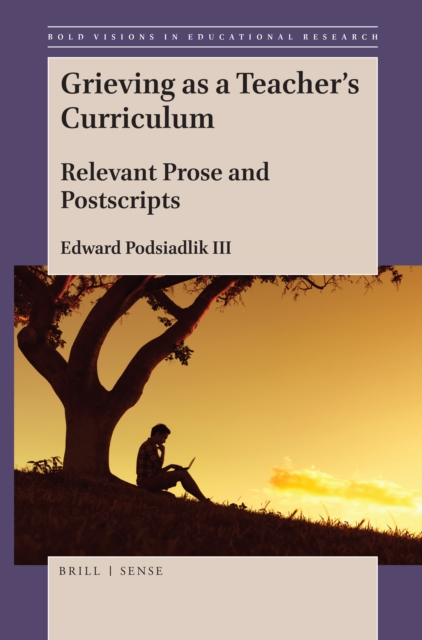
Grieving As a Teacher's Curriculum
Teachers are not automatons. An educator's personal values, concerns, and aspirations cannot be cleaved from one's professional life without impacting the quality and relevance of the teaching experience. This book examines spaces where the personal and professional intersect, thereby deepening our understanding of the nuances and complexities of a teacher's work. It draws readers into places of vulnerability—moments of grieving. As a teacher's curriculum—as a curriculum of life—grief has much to teach about sympathy, compassion, and resilience. Educational philosophy, literary analysis, and reflective practice are used to explore ways grief can help us better ascertain the scope and depth of the educators we are and have the potential to become. Pieces of literature used include works by Pat Conroy, Charles Dickens, Stephen King, Rabindranath Tagore, Virgil, Franz Wedekind, and Virginia Woolf. Also included are ideas from a diverse set of educational philosophers, social and cultural commentators, poets, and more. Chapters conclude with \"Topics for Reflection\" for further individual and/or collective reflection and discourse. Educators at all stages of their careers will benefit from this study that demonstrates the impact personal grieving can have on remembering, recovering, and reidentifying with one's mission and vision. As a resource for pre-service or veteran teachers, the text celebrates the power of introspection to transform our work, our lives, and the lives of our students. It is equally relevant for parents, coaches, mentors, and anyone who takes on the kinds of teacher roles that impact, nourish, and inspire the lives of others. See inside the book.
eBook

49 days
Day 1. Gotta get up. Gotta keep moving. This map - it says I have to cross over here. Wait, what's that...? And so begins a graphic novel story unlike any other: 49 Days. In Buddhist tradition, a person must travel for forty-nine days after they die, before they can fully cross over. Here in this book, readers travel with one Korean American girl, Kit, on her journey, while also spending time with her family and friends left behind. Agnes Lee has captivated readers across the world for years with her illustrations for the New York Times Metropolitan Diary. Her debut graphic novel is an unforgettable story of death, grief, love, and how we keep moving forward.
Book


Mourning nature : hope at the heart of ecological loss and grief
\"We are facing unprecedented environmental challenges, including global climate change, large-scale industrial development, rapidly increasing species extinction, ocean acidification, and deforestation--challenges which require new vocabularies and new ways to express grief and sorrow over the disappearance, degradation, and loss of nature. Seeking to redress the silence around ecologically-based anxiety in academic and public domains, and to extend the concepts of sadness, anger, and loss, Mourning Nature creates a lexicon for the recognition and expression of emotions related to environmental degradation. Exploring the ways in which grief is experienced in numerous contexts, this groundbreaking collection draws on classical, philosophical, artistic, and poetic elements to explain environmental melancholia. Understanding that it is not just how we mourn, but what we mourn that defines us, the authors introduce a new perspective on politics, ethics, and praxis in conservation, sustainability, and connections to and relationships with nature. An ecological elegy for a time of climatic and environmental upheaval, Mourning Nature challenges readers to turn devastating events into an opportunity for positive change.\"-- Provided by publisher.
BOOK

Mourning in the Anthropocene
Enormous ecological losses and profound planetary transformations mean that ours is a time to grieve beyond the human. Yet, Joshua Trey Barnett argues in this eloquent and urgent book, our capacity to grieve for more-than-human others is neither natural nor inevitable. Weaving together personal narratives, theoretical meditations, and insightful readings of cultural artifacts, he suggests that ecological grief is best understood as a rhetorical achievement. As a collection of worldmaking practices, rhetoric makes things matter, bestows value, directs attention, generates knowledge, and foments feelings. By dwelling on three rhetorical practices—naming, archiving, and making visible—Barnett shows how they prepare us to grieve past, present, and future ecological losses. Simultaneously diagnostic and prescriptive, this book reveals rhetorical practices that set our ecological grief into motion and illuminates pathways to more connected, caring earthly coexistence.
eBook

Wednesday's child : stories
\"A grieving mother makes a spreadsheet of everyone she's lost. Elsewhere, a professor develops a troubled intimacy with her hairdresser. And every year, a restless woman receives an email from a strange man twice her age and several states away. In the stories of Wednesday's Child, people strive for an ordinary existence until doing so becomes unsustainable, until the surface cracks and the grand mysterious forces--death, violence, estrangement--come to light. Even before such moments, everyday life is laden with meaning, studded with indelible details: a filched jar of honey, a mound of wounded ants, a photograph kept hidden for many years, until it must be seen.\"-- Inside front jacket flap.
Book

How we grieve : relearning the world
In this revised esition, Thomas Attig tells tales of survival to illustrate the poignant suffering that the loss of a loved one entails. Dr. Attig shows how through grieving we meet daunting challenges, make choices, and reshape our lives forever. In so doing, he redefines grief as an active, coping process rather than a stage to be endured, or a problem to be overcome. The book's many valuable lessons inform and instruct a wide audience of clinicians, caregivers, friends and family members of bereaved persons, and those who seek a general, non-clinical perspective on their own experience of grief.This version includes updated references and a new introduction.
eBook