
Catalogue Search | MBRL


Are you sure you want to remove the book from the shelf?

{{itemTitle}}
27,768
result(s) for
"Change (Philosophy)"
Sort by:


Mandarins of the future : modernization theory in Cold War America
Because it provided the dominant framework for \"development\" of poor, postcolonial countries, modernization theory ranks among the most important constructs of twentieth-century social science. In Mandarins of the Future: Modernization Theory in Cold War America Nils Gilman offers the first intellectual history of a movement that has had far-reaching and often unintended consequences.
After a survey of the theory's origins and its role in forming America's postwar sense of global mission, Gilman offers a close analysis of the people who did the most to promote it in the United States and the academic institutions they came to dominate. He first explains how Talcott Parsons at Harvard constructed a social theory that challenged the prevailing economics-centered understanding of the modernization process, then describes the work of Edward Shils and Gabriel Almond in helping Parsonsian ideas triumph over other alternative conceptions of the development process, and finally discusses the role of Walt Rostow and his colleagues at M.I.T. in promoting modernization theory during the Kennedy and Johnson administrations. By connecting modernization theory to the welfare state liberalism programs of the New Deal order, Gilman not only provides a new intellectual context for America's Third World during the Cold War, but also connects the optimism of the Great Society to the notion that American power and good intentions could stop the postcolonial world from embracing communism.
eBook

International relations of social change
This text critically reviews principal theories of the international dynamics of social change, including liberal modernization theory, Marxism, world-system theory, neo-Weberian approaches and recent developments in critical theory.
Book

Eco-republic : what the ancients can teach us about ethics, virtue, and sustainable living
Ancient lessons for sustainable citizenship
An ecologically sustainable society cannot be achieved without citizens who possess the virtues and values that will foster it, and who believe that individual actions can indeed make a difference. Eco-Republic draws on ancient Greek thought—and Plato's Republic in particular—to put forward a new vision of citizenship that can make such a society a reality. Melissa Lane develops a model of a society whose health and sustainability depend on all its citizens recognizing a shared standard of value and shaping their personal goals and habits accordingly. Bringing together the moral and political ideas of the ancients with the latest social and psychological theory, Lane illuminates the individual's vital role in social change, and articulates new ways of understanding what is harmful and what is valuable, what is a benefit and what is a cost, and what the relationship between public and private well-being ought to be.
Eco-Republic reveals why we must rethink our political imagination if we are to meet the challenges of climate change and other urgent environmental concerns. Offering a unique reflection on the ethics and politics of sustainability, the book goes beyond standard approaches to virtue ethics in philosophy and current debates about happiness in economics and psychology. Eco-Republic explains why health is a better standard than happiness for capturing the important links between individual action and social good, and diagnoses the reasons why the ancient concept of virtue has been sorely neglected yet is more relevant today than ever.
eBook

Privilege, agency and affect : understanding the production and effects of action
Drawing on a range of theoretical perspectives and engaging with new empirical evidence from around the world, this collection examines how privilege, agency and affect are linked, and where possibilities for social change might lie.
Book
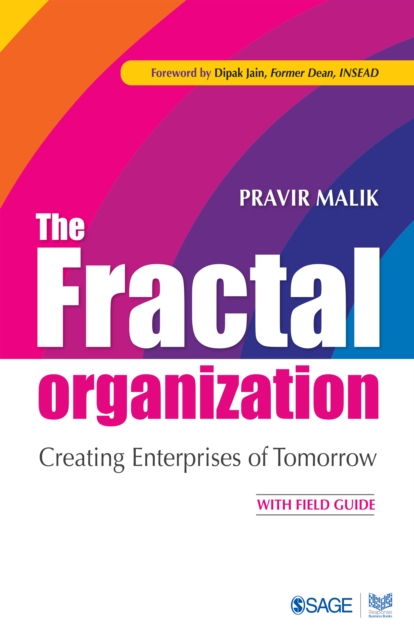
The fractal organization : creating enterprises of tomorrow
The biggest challenge facing leaders today is the creation of organizations that are capable of surviving and flourishing in these uncertain times. How does one create an organization that is sustainable in the long run, how can organizations be ready for uncertainties that the markets place upon them, how can an organization be simply brilliant by design? This book leverages the proposed meta-theory for progressive organizational design and dynamics real-world reflections to create fractal-based sustainable enterprises of tomorrow. In this meta-theory all instances of organization, from the smallest, such as an idea or a person, to the largest, such as global markets and planet earth herself, are fractals: the essence of their way of being is repeated on scales both smaller and larger than themselves. There is however, a particular class of fractals, that of progress, of which The Fractal Ladder is an ever-present manifestation, which spawns organizations that are truly progressive and sustainable in nature. In the scheme of things this class of fractals is of critical importance, and to master its replication and to fully understand the impact it will have in creating sustainable and dynamic organizations is a practical necessity. Divided into three parts, Part I - Theory, will present the theory behind the Fractal Organization. Part II - Exercises, will translate key elements of the fractal-based world-view into practical activities and exercises at the personal and workplace levels. Part III - Reflections, will apply the basic logic of the sun-marked physical-vital-mental fractal to many practical problems and situations we are faced with daily to suggest ways to address them.
eBook

Leadership in a globalized world : complexity, dynamics, and risks
\"Frannie Lâeautier presents a synthesis and interpretation of academic research in multiple disciplines and integrates it into a practical approach readily useable by leaders in government, corporations, and civil society, as well as those interested in development. Readers will benefit from invaluable research and its practical applications in the following areas: patterns of change in the global economy and implications for decision-making at local and national levels; risks deriving from globalization and how these affect policy responses; governance and its special role in leadership particularly in crisis situations. providing genuine examples from a variety of industries, firms, governments, and geographies, the book's innovative approaches are directly applicable to development finance, infrastructure, health, and agriculture.\" --book cover
Book
Climate change and philosophy : transformational possibilities
Climate Change and Philosophy presents ten original essays by an international team of expert contributors, exploring the important contribution philosophical inquiry can make to contemporary debates to do with climate change and the global environment.
eBook

