
Catalogue Search | MBRL


Are you sure you want to remove the book from the shelf?

{{itemTitle}}
7,757,569
result(s) for
"Change."
Sort by:

The change book : how things happen
\"From business cycles to budding trends, models make sense of a world that never stops spinning. [This book] delivers 52 ... models--each with a visual component--about how change happens\"--Amazon.com.
Book


Economics of climate change in the Arab world
This book takes both a global as well as a local perspective in assessing the impacts of climate change on the economy, agricultural sector, and households in three of the MENA countries; Syria, Tunisia and Yemen. The major channels of impact for global climate change are through changing world food (and energy) prices, especially since all the countries under analysis are or have become net importers of oil and petroleum products and many food commodities in recent years. The impacts of local climate change decrease crop yields in the longer run and through them, productivity in the agricultural sector and all the implications this may have on both, the livelihoods of those dependent on the sector as well as the rest of the economy. The analysis also covered what happens when both global and local climate changes work simultaneously for each country. Findings show that in all three countries the effects of climate change are negative for people and the economy-GDP falls and livelihoods suffer. Furthermore, the prevalence of extreme variations in climate-such as the droughts affecting Syria and the floods impacting Yemen-draws attention to the potentially significant drawbacks that are likely to not only affect any strides towards economic growth and development, but may also reverse such strides if appropriate policies are not in place to weather this storm. The analyses in this book apply CGE models.
eBook
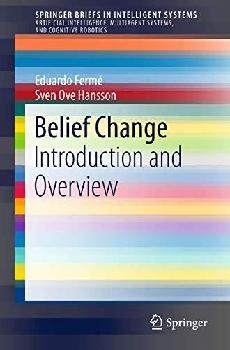
Belief change : introduction and overview
This book explains how the logic of theory change employs formal models in the investigation of changes in belief states and databases. The topics covered include equivalent characterizations of AGM operations, extended representations of the belief states, change operators not included in the original framework, iterated change, applications of the model, its connections with other formal frameworks, and criticism of the model.
Book

Flourishing in the Age of Climate Change
Flourishing in the Age of Climate
Change explores skills we need to
successfully navigate the distinctive environmental, social, and
economic challenges of the twenty-first century. Our
inability to address increasing resource constraints, social
conflict, and ecological decline lead many toward a deep pessimism
that saps motivation for change.
Drawing on research from environmental science, ethics,
psychology, sociology and educational theory, William M. Throop
shows why cultivating underdeveloped skills involved in
collaboration, humility, frugality and systems thinking can enable
flourishing within our context. He also illustrates how we can
strengthen such skills individually and how education can scale up
their cultivation, which will be essential for achieving
sustainability.
Flourishing in the Age of Climate Change is a hopeful,
practical resource for readers passionate about creating a world
where we can thrive, and where flourishing is widespread.
eBook


The Climate of Rebellion in the Early Modern Ottoman Empire
The Climate of Rebellion in the Early Modern Ottoman Empire explores the serious and far-reaching impacts of Little Ice Age climate fluctuations in Ottoman lands. This study demonstrates how imperial systems of provisioning and settlement that defined Ottoman power in the 1500s came unraveled in the face of ecological pressures and extreme cold and drought, leading to the outbreak of the destructive Celali Rebellion (1595–1610). This rebellion marked a turning point in Ottoman fortunes, as a combination of ongoing Little Ice Age climate events, nomad incursions and rural disorder postponed Ottoman recovery over the following century, with enduring impacts on the region's population, land use and economy.
eBook


The Climate Casino
Climate change is profoundly altering our world in ways that pose major risks to human societies and natural systems. We have entered the Climate Casino and are rolling the global-warming dice, warns economist William Nordhaus. But there is still time to turn around and walk back out of the casino, and in this essential book the author explains how.
Bringing together all the important issues surrounding the climate debate, Nordhaus describes the science, economics, and politics involved-and the steps necessary to reduce the perils of global warming. Using language accessible to any concerned citizen and taking care to present different points of view fairly, he discusses the problem from start to finish: from the beginning, where warming originates in our personal energy use, to the end, where societies employ regulations or taxes or subsidies to slow the emissions of gases responsible for climate change.
Nordhaus offers a new analysis of why earlier policies, such as the Kyoto Protocol, failed to slow carbon dioxide emissions, how new approaches can succeed, and which policy tools will most effectively reduce emissions. In short, he clarifies a defining problem of our times and lays out the next critical steps for slowing the trajectory of global warming.
eBook