
Catalogue Search | MBRL


Are you sure you want to remove the book from the shelf?

{{itemTitle}}
16,732
result(s) for
"Chemical engineering Mathematical models"
Sort by:
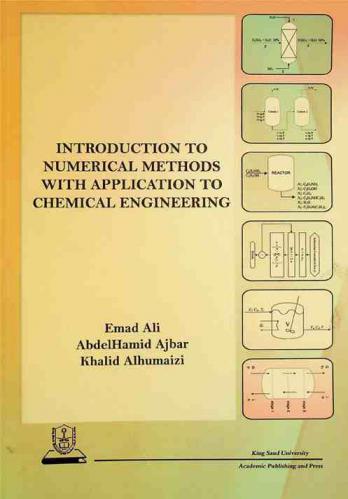
Introduction to numerical methods with application to chemical engineering
Many chemical engineering departments in diverse universities around the world, including the one in King Saud University include in the curriculum a course designed to teach numerical methods applied to chemical engineering. This book is essentially a compilation of the notes the three authors have used to teach this course over the years. We have covered in the textbook the numerical techniques that are most useful to the chemical engineer and that have wide applications. As an introduction to the book we included a chapter dealing with some practical considerations in numerical methods. The concepts of errors, conditioning of a problem and stability of algorithms were introduced to show the student to what extent he should trust any numerical values obtained by solving a problem in a digital computer. tt from Preface (p. v).
Book

Nonlinear and mixed-integer optimization : fundamentals and applications
Filling a void in chemical engineering and optimization literature, this book presents the theory and methods for nonlinear and mixed-integer optimization, and their applications in the important area of process synthesis.
eBook

Guidelines for determining the probability of ignition of a released flammable mass
\"Complemented by an estimating tool spreadsheet based on a fixed set of chemicals to assist in all siting studies, [Guidelines for determining the probability of ignition of a released flammable mass] converts a \"best guess\" to a calculated value based on available information and current technology. The text provides a technology-based approach to deriving the probability that a flammable mass will find an ignition source and ignite. It offers valuable information in the development of a facility's Emergency Response Plan\"-- Provided by publisher.
Book
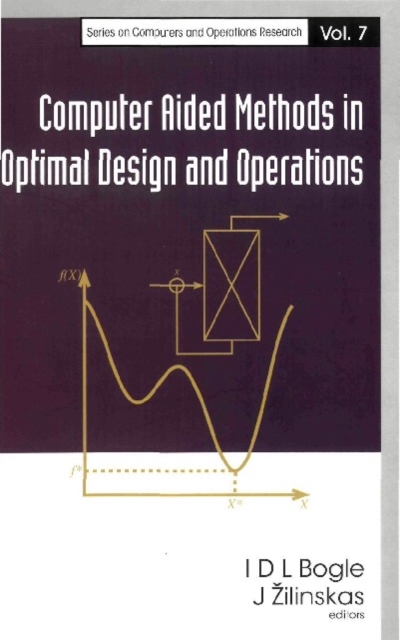
Computer aided methods in optimal design and operations
This book covers different topics on optimal design and operations with particular emphasis on chemical engineering applications. A wide range of optimization methods — deterministic, stochastic, global and hybrid — are considered.
eBook
Introducción Al Modelamiento y Simulación en Ingeniería Química
Esta obra introduce al lector en las bases de la teoría matemática y en los distintos métodos computacionales de modelamiento y simulación en Ingeniería, los cuales incluyen ejemplos para ayudar a entender la implementación de los diversos métodos de solución. El libro aborda el manejo de matlab®, software de preferencia por su practicidad y facilidad para la resolución de problemas; allí se presentan los principales conceptos, así como la apariencia de la consola, la creación de variables, la realización de operaciones básicas y el diseño de scripts y funciones. Luego, se hace una aproximación a la resolución de problemas matemáticos de carácter no lineal, lineal, diferencial, de diferencias parciales y ecuaciones algebrodiferenciales, así como también se aborda el método mesh para modelamiento matemático de torres de destilación. Es importante resaltar que para la comprensión del texto se debe contar con conocimientos en cálculo, ecuaciones diferenciales, equilibrio de fases, mecánica hidráulica, ingeniería de reacciones, fenómenos de transporte y separación de fases. La obra es fundamental para quienes se estén formando en Ingeniería Química, tanto para la adquisición de conocimientos en el área del modelamiento y simulación, como para aumentar el nivel de habilidades blandas.
eBook

Computational Models for Polydisperse Particulate and Multiphase Systems
Providing a clear description of the theory of polydisperse multiphase flows, with emphasis on the mesoscale modelling approach and its relationship with microscale and macroscale models, this all-inclusive introduction is ideal whether you are working in industry or academia. Theory is linked to practice through discussions of key real-world cases (particle/droplet/bubble coalescence, break-up, nucleation, advection and diffusion and physical- and phase-space), providing valuable experience in simulating systems that can be applied to your own applications. Practical cases of QMOM, DQMOM, CQMOM, EQMOM and ECQMOM are also discussed and compared, as are realizable finite-volume methods. This provides the tools you need to use quadrature-based moment methods, choose from the many available options, and design high-order numerical methods that guarantee realizable moment sets. In addition to the numerous practical examples, MATLAB scripts for several algorithms are also provided, so you can apply the methods described to practical problems straight away.
eBook

Geological storage of CO2
Despite the large research effort in both public and commercial companies, no textbook has yet been written on this subject.This book aims to provide an overview to the topic of Carbon Capture and Storage (CSS), while at the same time focusing on the dominant processes and the mathematical and numerical methods that need to be employed in order.
eBook

Flow in Fractured Porous Media: A Review of Conceptual Models and Discretization Approaches
The last decade has seen a strong increase of research into flows in fractured porous media, mainly related to subsurface processes but also in materials science and biological applications, as connected fractures can totally dominate flow patterns. Due to the fractures’ characteristics as approximately planar discontinuities with an extreme size-to-width ratio, they challenge standard macroscale mathematical and numerical modeling of flow based on averaging. Thus, over the last decades, various, and also fundamentally different, modeling approaches have been developed. This paper reviews common conceptual models and discretization approaches for flow in fractured porous media, with an emphasis on the dominating effects the fractures have on flow processes. In this context, the paper discusses the tight connection between physical and mathematical modeling and simulation approaches. Extensions and research challenges related to transport, multi-phase flow and fluid-solid interaction are also commented on.
Journal Article

Accelerating the implementation of biocatalysis in industry
Despite enormous progress in protein engineering, complemented by bioprocess engineering, the revolution awaiting the application of biocatalysis in the fine chemical industry has still not been fully realized. In order to achieve that, further research is required on several topics, including (1) rapid methods for protein engineering using machine learning, (2) mathematical modelling of multi-enzyme cascade processes, (3) process standardization, (4) continuous process technology, (5) methods to identify improvements required to achieve industrial implementation, (6) downstream processing, (7) enzyme stability modelling and prediction, as well as (8) new reactor technology. In this brief mini-review, the status of each of these topics will be briefly discussed.
Journal Article
Pore-Scale Imaging and Modelling of Reactive Flow in Evolving Porous Media: Tracking the Dynamics of the Fluid–Rock Interface
Fluid–mineral and fluid–rock interfaces are key parameters controlling the reactivity and fate of fluids in reservoir rocks and aquifers. The interface dynamics through space and time results from complex processes involving a tight coupling between chemical reactions and transport of species as well as a strong dependence on the physical, chemical, mineralogical and structural properties of the reacting solid phases. In this article, we review the recent advances in pore-scale imaging and reactive flow modelling applied to interface dynamics. Digital rocks derived from time-lapse X-ray micro-tomography imaging gives unprecedented opportunity to track the interface evolution during reactive flow experiments in porous or fractured media, and evaluate locally mineral reactivity. The recent improvements in pore-scale reactive transport modelling allow for a fine description of flow and transport that integrates moving fluid–mineral interfaces inherent to chemical reactions. Combined with three-dimensional digital images, pore-scale reactive transport modelling complements and augments laboratory experiments. The most advanced multi-scale models integrate sub-voxel porosity and processes which relate to imaging instrument resolution and improve upscaling possibilities. Two example applications based on the solver
porousMedia4Foam
illustrate the dynamics of the interface for different transport regimes (i.e., diffusive- to advective-dominant) and rock matrix properties (i.e., permeable vs. impermeable, and homogeneous vs. polymineralic). These parameters affect both the interface roughness and its geometry evolution, from sharp front to smeared (i.e., diffuse) interface. The paper concludes by discussing the challenges associated with precipitation processes in porous media, rock texture and composition (i.e., physical and mineralogical heterogeneity), and upscaling to larger scales.
Journal Article