
Catalogue Search | MBRL


Are you sure you want to remove the book from the shelf?

{{itemTitle}}
289
result(s) for
"Chemical laboratories Safety measures"
Sort by:

Destruction of hazardous chemicals in the laboratory
The fully updated reference on degrading and disposing of hazardous chemicals in the laboratory When it's time for laboratory technicians to get rid of hazardous materials, they can't simply dump them in the trash. Detailed procedures need to be followed to safely degrade and dispose of hazardous chemicals-from bulk quantities of material to accidental spills. This new edition of Destruction of Hazardous Chemicals in the Laboratory includes validated methods for safely degrading specific compounds, such as nitrosamines and aflatoxins, as well as general strategies that are applicable to all organic compounds. In addition, promising emerging technologies, such as advanced oxidation procedures, that are applicable to the destruction of hazardous compounds in the laboratory are discussed. Practical details are provided so these procedures can be readily implemented in the laboratory, often by technicians, without the use of exotic reagents or special equipment. Methods for the destruction of pharmaceuticals have been placed in a new and greatly expanded section, and many new monographs, including some on dealing with toxins derived from biological agents, are included. Destruction of Hazardous Chemicals in the Laboratory, Third Edition integrates all the available validated procedures for the safe destruction of hazardous chemicals in the laboratory into one complete volume. No comparable text in this field provides such a wealth of in-depth coverage on such an important topic. Together with books on the hazardous properties of chemicals and general precautionary procedures, this practical guide should form the nucleus of any library concerned with chemical safety.
eBook
Promoting Chemical Laboratory Safety and Security in Developing Countries
There is growing concern about the possible use of toxic industrial chemicals or other hazardous chemicals by those seeking to perpetrate acts of terrorism. The U.S. Chemical Security Engagement Program (CSP), funded by the U.S. Department of State and run by Sandia National Laboratories, seeks to develop and facilitate cooperative international activities that promote best practices in chemical security and safe management of toxic chemicals, including:
Partnering with host governments, chemical professionals, and industry to assess and fill gaps in chemical security abroad.
Providing technical expertise and training to improve best practices in security and safety among chemical professionals and industry.
Increasing transparency and accountability for dangerous chemical materials, expertise, and technologies.
Providing opportunities for collaboration with the international professional chemical community.
The Department of State called on the National Academies to assist in the CSP's efforts to promote chemical safety and security in developing countries.
eBook
Safe Science
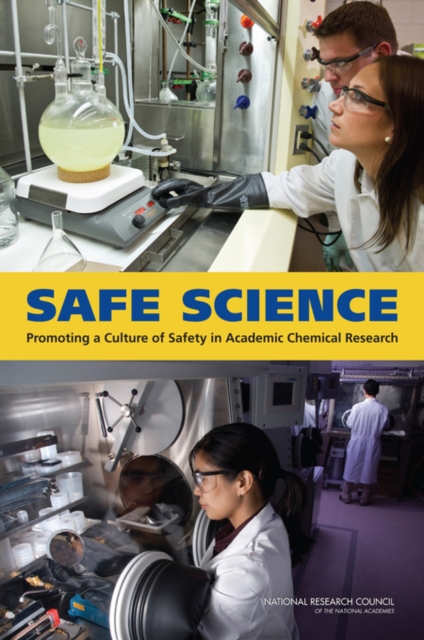
Recent serious and sometimes fatal accidents in chemical research laboratories at United States universities have driven government agencies, professional societies, industries, and universities themselves to examine the culture of safety in research laboratories. These incidents have triggered a broader discussion of how serious incidents can be prevented in the future and how best to train researchers and emergency personnel to respond appropriately when incidents do occur. As the priority placed on safety increases, many institutions have expressed a desire to go beyond simple compliance with regulations to work toward fostering a strong, positive safety culture: affirming a constant commitment to safety throughout their institutions, while integrating safety as an essential element in the daily work of laboratory researchers.
Safe Science takes on this challenge. This report examines the culture of safety in research institutions and makes recommendations for university leadership, laboratory researchers, and environmental health and safety professionals to support safety as a core value of their institutions. The report discusses ways to fulfill that commitment through prioritizing funding for safety equipment and training, as well as making safety an ongoing operational priority.
A strong, positive safety culture arises not because of a set of rules but because of a constant commitment to safety throughout an organization. Such a culture supports the free exchange of safety information, emphasizes learning and improvement, and assigns greater importance to solving problems than to placing blame. High importance is assigned to safety at all times, not just when it is convenient or does not threaten personal or institutional productivity goals. Safe Science will be a guide to make the changes needed at all levels to protect students, researchers, and staff.
eBook

Prudent practices in the laboratory: handling and management of chemical hazards
Prudent Practices in the Laboratory--the book that has served for decades as the standard for chemical laboratory safety practice--now features updates and new topics. This revised edition has an expanded chapter on chemical management and delves into new areas, such as nanotechnology, laboratory security, and emergency planning.Developed by experts from academia and industry, with specialties in such areas as chemical sciences, pollution prevention, and laboratory safety, Prudent Practices in the Laboratory provides guidance on planning procedures for the handling, storage, and disposal of chemicals. The book offers prudent practices designed to promote safety and includes practical information on assessing hazards, managing chemicals, disposing of wastes, and more.Prudent Practices in the Laboratory will continue to serve as the leading source of chemical safety guidelines for people working with laboratory chemicals: research chemists, technicians, safety officers, educators, and students.
eBook

An Assessment of the National Institute of Standards and Technology Chemical Science and Technology Laboratory
An Assessment of the National Institute of Standards and Technology Chemical Science and Technology Laboratory examines the operations of the Chemical Science and Technology Laboratory (CSTL) of the National Institute of Standards and Technology (NIST).
This book assesses the CSTL, based on the following criteria: (1) the technical merit of the current laboratory programs relative to current state-of-the-art programs worldwide; (2) the adequacy of the laboratory budget, facilities, equipment, and human resources, as they affect the quality of the laboratory's technical programs; and (3) the degree to which laboratory programs in measurement science and standards achieve their stated objectives and desired impact.\"
eBook
Responsible research with biological select agents and toxins
The effort to understand and combat infectious diseases has, during the centuries, produced many key advances in science and medicine-including the development of vaccines, drugs, and other treatments. A subset of this research is conducted with agents that, like anthrax, not only pose a severe threat to the health of humans, plants, and animals but can also be used for ill-intended purposes. Such agents have been listed by the government as biological select agents and toxins. The 2001 anthrax letter attacks prompted the creation of new regulations aimed at increasing security for research with dangerous pathogens. The outcome of the anthrax letter investigation has raised concern about whether these measures are adequate.
Responsible Research with Biological Select Agents and Toxins evaluates both the physical security of select agent laboratories and personnel reliability measures designed to ensure the trustworthiness of those with access to biological select agents and toxins. The book offers a set of guiding principles and recommended changes to minimize security risk and facilitate the productivity of research. The book recommends fostering a culture of trust and responsibility in the laboratory, engaging the community in oversight of the Select Agent Program, and enhancing the operation of the Select Agent Program.
eBook

Electrochemical biosensors based on nucleic acid aptamers
During recent decades, nucleic acid aptamers have emerged as powerful biological recognition elements for electrochemical affinity biosensors. These bioreceptors emulate or improve on antibody-based biosensors because of their excellent characteristics as bioreceptors, including limitless selection capacity for a large variety of analytes, easy and cost-effective production, high stability and reproducibility, simple chemical modification, stable and oriented immobilization on electrode surfaces, enhanced target affinity and selectivity, and possibility to design them in target-sensitive 3D folded structures. This review provides an overview of the state of the art of electrochemical aptasensor technology, focusing on novel aptamer-based electroanalytical assay configurations and providing examples to illustrate the different possibilities. Future prospects for this technology are also discussed.
Journal Article

A LoRa-Based Multi-Node System for Laboratory Safety Monitoring and Intelligent Early-Warning: Towards Multi-Source Sensing and Heterogeneous Networks
Laboratories are complex and dynamic environments where diverse hazards—including toxic gas leakage, volatile solvent combustion, and unexpected fire ignition—pose serious threats to personnel safety and property. Traditional monitoring systems relying on single-type sensors or manual inspections often fail to provide timely warnings or comprehensive hazard perception, resulting in delayed response and potential escalation of incidents. To address these limitations, this study proposes a multi-node laboratory safety monitoring and early warning system integrating multi-source sensing, heterogeneous communication, and cloud–edge collaboration. The system employs a LoRa-based star-topology network to connect distributed sensing and actuation nodes, ensuring long-range, low-power communication. A Raspberry Pi-based module performs real-time facial recognition for intelligent access control, while an OpenMV module conducts lightweight flame detection using color-space blob analysis for early fire identification. These edge-intelligent components are optimized for embedded operation under resource constraints. The cloud–edge–app collaborative architecture supports real-time data visualization, remote control, and adaptive threshold configuration, forming a closed-loop safety management cycle from perception to decision and execution. Experimental results show that the facial recognition module achieves 95.2% accuracy at the optimal threshold, and the flame detection algorithm attains the best balance of precision, recall, and F1-score at an area threshold of around 60. The LoRa network maintains stable communication up to 0.8 km, and the system’s emergency actuation latency ranges from 0.3 s to 5.5 s, meeting real-time safety requirements. Overall, the proposed system significantly enhances early fire warning, multi-source environmental monitoring, and rapid hazard response, demonstrating strong applicability and scalability in modern laboratory safety management.
Journal Article