
Catalogue Search | MBRL


Are you sure you want to remove the book from the shelf?

{{itemTitle}}
4,178
result(s) for
"Cherokees"
Sort by:

Sustaining the Cherokee Family
During the late nineteenth and early twentieth centuries, the federal government sought to forcibly assimilate Native Americans into American society through systematized land allotment. InSustaining the Cherokee Family, Rose Stremlau illuminates the impact of this policy on the Cherokee Nation, particularly within individual families and communities in modern-day northeastern Oklahoma.Emphasizing Cherokee agency, Stremlau reveals that Cherokee families' organization, cultural values, and social and economic practices allowed them to adapt to private land ownership by incorporating elements of the new system into existing domestic and community-based economies. Drawing on evidence from a range of sources, including Cherokee and United States censuses, federal and tribal records, local newspapers, maps, county probate records, family histories, and contemporary oral histories, Stremlau demonstrates that Cherokee management of land perpetuated the values and behaviors associated with their sense of kinship, therefore uniting extended families. And, although the loss of access to land and communal resources slowly impoverished the region, it reinforced the Cherokees' interdependence. Stremlau argues that the persistence of extended family bonds allowed indigenous communities to retain a collective focus and resist aspects of federal assimilation policy during a period of great social upheaval.
eBook

Public Indians, private Cherokees : tourism and tradition on tribal ground
A major economic industry among American Indian tribes is the public promotion and display of aspects of their cultural heritage in a wide range of tourist venues. Few do it better than the Eastern Band of the Cherokee, whose homeland is the Qualla Boundary of North Carolina. Through extensive research into the work of other scholars dating back to the late 1800s, and interviews with a wide range of contemporary Cherokees, Beard-Moose presents the two faces of the Cherokee people. One is the public face that populates the powwows, dramatic presentations, museums, and myriad roadside craft locations. The other is the private face whose homecoming, Indian fairs, traditions, belief system, community strength, and cultural heritage are threatened by the very activities that put food on their tables. Constructing an ethnohistory of tourism and comparing the experiences of the Cherokee with the Florida Seminoles and Southwestern tribes, this work brings into sharp focus the fine line between promoting and selling Indian culture.
eBook

Their Determination to Remain
The remarkable story of a North Carolina Cherokee
community who avoided forced removal on the Trail of
Tears During the 1838 forced Cherokee removal by
the US government, a number of close-knit Cherokee communities in
the Southern Appalachian Mountains refused to relinquish their
homelands, towns, and way of life. Using a variety of tactics,
hundreds of Cherokees avoided the encroaching US Army and
remained in the region. In his book
Their Determination to Remain: A Cherokee Community’s
Resistance to the Trail of Tears in North Carolina, Lance
Greene explores the lives of wealthy plantation owners Betty and
John Welch who lived on the southwestern edge of the Cherokee
Nation. John was Cherokee and Betty was White. Although few
Cherokees in the region participated in slavery, the Welches held
nine African Americans in bondage. During removal, the Welches
assisted roughly 100 Cherokees hiding in the steep mountains.
Afterward, they provided land for these Cherokees to rebuild a
new community, Welch’s Town. Betty became a wealthy and
powerful plantation mistress because her husband could no longer
own land. Members of Welch’s Town experienced a
transitional period in which they had no formal tribal government
or clear citizenship yet felt secure enough to reestablish a
townhouse, stickball fields, and dance grounds. Greene’s
innovative study uses an interdisciplinary approach,
incorporating historical narrative and archaeological data, to
examine how and why the Welches and members of Welch’s Town
avoided expulsion and reestablished their ways of life in the
midst of a growing White population who resented a continued
Cherokee presence. The Welch strategy included Betty’s
leadership in demonstrating outwardly their participation in
modern Western lifestyles, including enslavement, as John
maintained a hidden space—within the boundaries of their
land—for the continuation of traditional Cherokee cultural
practices.
Their Determination to Remain explores the complexities
of race and gender in this region of the antebellum South and the
real impacts of racism on the community.
eBook

Eastern Cherokee fishing
Cherokee identity as revealed in fishing methods and
materials. In
Eastern Cherokee Fishing , life histories, folktales, and
reminiscences about fish gathered from interviews with Cherokee
and non-Cherokee people provide a clear and personal picture of
the changes in the Qualla Boundary (Eastern Band of the) Cherokee
in the last 75 years. Coupled with documentary research, these
ethnographic histories illuminate changes in the language,
culture, and environment (particularly, aquatic resources) since
contact with Europeans and examine the role these changes have
played in the traditions and lives of the contemporary Cherokees.
Interviewees include a great range of informants, from native
speakers of Cherokee with extensive knowledge of traditional
fishing methods to Euro-American English speakers whose families
have lived in North Carolina for many generations and know about
contemporary fishing practices in the area. The topic of fishing
thus offers perspective on the Cherokee language, the vigor of
the Cherokee system of native knowledge, and the history of the
relationship between Cherokee people and the local environment.
Heidi Altman also examines the role of fishing as a tourist
enterprise and how fishing practices affect tribal waters.
eBook

Anetso, the Cherokee Ball Game
Anetso, a centuries-old Cherokee ball game still played today, is a vigorous, sometimes violent activity that rewards speed, strength, and agility. At the same time, it is the focus of several linked ritual activities. Is it a sport? Is it a religious ritual? Could it possibly be both? Why has it lasted so long, surviving through centuries of upheaval and change?Based on his work in the field and in the archives, Michael J. Zogry argues that members of the Eastern Band of Cherokee Nation continue to perform selected aspects of their cultural identity by engaging in anetso, itself the hub of an extended ceremonial complex, or cycle. A precursor to lacrosse, anetso appears in all manner of Cherokee cultural narratives and has figured prominently in the written accounts of non-Cherokee observers for almost three hundred years. The anetso ceremonial complex incorporates a variety of activities which, taken together, complicate standard scholarly distinctions such as game versus ritual, public display versus private performance, and tradition versus innovation.Zogry's examination provides a striking opportunity for rethinking the understanding of ritual and performance as well as their relationship to cultural identity. It also offers a sharp reappraisal of scholarly discourse on the Cherokee religious system, with particular focus on the Eastern Band of Cherokee Nation.
eBook

Ties That Bind
This beautifully written book, now in its second edition, tells the haunting saga of a quintessentially American family. In the late 1790s, Shoe Boots, a famed Cherokee warrior and successful farmer, acquired an African slave named Doll. Over the next thirty years, Shoe Boots and Doll lived together as master and slave and also as lifelong partners who, with their children and grandchildren, experienced key events in American history—including slavery, the Creek War, the founding of the Cherokee Nation and subsequent removal of Native Americans along the Trail of Tears, and the Civil War. This is the gripping story of their lives, in slavery and in freedom. Meticulously crafted from historical and literary sources, Ties That Bind vividly portrays the members of the Shoeboots family. Doll emerges as an especially poignant character, whose life is mostly known through the records of things done to her—her purchase, her marriage, the loss of her children—but also through her moving petition to the federal government for the pension owed to her as Shoe Boots's widow. A sensitive rendition of the hard realities of black slavery within Native American nations, the book provides the fullest picture we have of the myriad complexities, ironies, and tensions among African Americans, Native Americans, and whites in the first half of the nineteenth century. Updated with a new preface and an appendix of key primary sources, this remains an essential book for students of Native American history, African American history, and the history of race and ethnicity in the United States.
eBook

Center Places and Cherokee Towns
Examines how architecture and other aspects of the built
environment, such as hearths, burials, and earthen mounds, formed
center places within the Cherokee cultural landscape In
Center Places and Cherokee Towns , Christopher B. Rodning
opens a panoramic vista onto protohistoric Cherokee culture. He
posits that Cherokee households and towns were anchored within
their cultural and natural landscapes by built features that
acted as “center places.” Rodning investigates the
period from just before the first Spanish contact with
sixteenth-century Native American chiefdoms in La Florida through
the development of formal trade relations between Native American
societies and English and French colonial provinces in the
American South during the late 1600s and 1700s. Rodning focuses
particularly on the Coweeta Creek archaeological site in the
upper Little Tennessee Valley in southwestern North Carolina and
describes the ways in which elements of the built environment
were manifestations of Cherokee senses of place. Drawing on
archaeological data, delving into primary documentary sources
dating from the eighteenth century, and considering Cherokee
myths and legends remembered and recorded during the nineteenth
century, Rodning shows how the arrangement of public structures
and household dwellings in Cherokee towns both shaped and were
shaped by Cherokee culture. Center places at different scales
served as points of attachment between Cherokee individuals and
their communities as well as between their present and past.
Rodning explores the ways in which Cherokee architecture and the
built environment were sources of cultural stability in the
aftermath of European contact, and how the course of European
contact altered the landscape of Cherokee towns in the long run.
In this multi-faceted consideration of archaeology, ethnohistory,
and recorded oral tradition, Rodning adeptly demonstrates the
distinct ways that Cherokee identity was constructed through
architecture and other material forms.
Center Places and Cherokee Towns will have a broad
appeal to students and scholars of southeastern archaeology,
anthropology, Native American studies, prehistoric and
protohistoric Cherokee culture, landscape archaeology, and
ethnohistory.
eBook
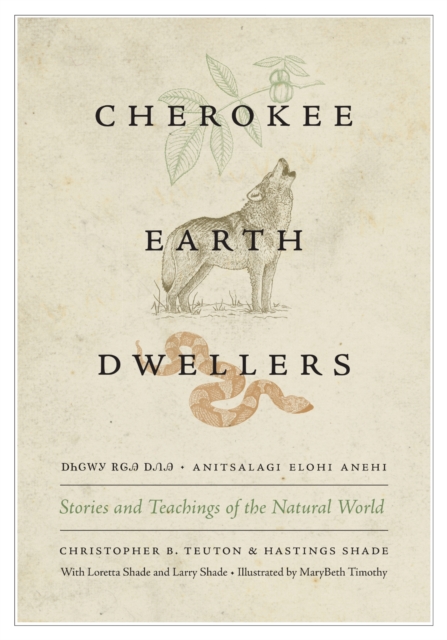
Ani Tsalagi Elohi Anehi: Cherokee Earth Dwellers : Stories and Teachings of the Natural World
\"Cherokee Earth Dwellers will be the first book to articulate a Cherokee view of the natural world grounded in Cherokee names for that world. Weaving together a chorus of voices of elders including Hastings Shade, who created booklets with over 600 Cherokee names for animals and plants, the manuscript explores how contemporary Cherokee knowledge keepers understand and engage the natural world. The core of the book is the names themselves, including birds, animals, edible plants, reptiles, amphibians, trees, insects, plants, and fish. Far more than a word list, however, the manuscript includes explanations, anecdotes, and stories attached to each entry that chart the contours of a Cherokee understanding of the natural world. Some of these names are known and in use today by Cherokee speakers, but the vast majority are no longer in everyday use within Cherokee community. What emerges in Cherokee Earth Dwellers is a breathtaking vision of
eBook

Cherokee Dispossession Through Claimant Self-Declaration: Assessing Cherokee Heritage Claims in the 2020 U.S. Census
Despite extensive and multigenerational efforts by the three federally recognized Cherokee tribes to educate the larger public about the sovereign right and authority of Cherokee governments to determine affiliation, well over a million unaffiliated and unsubstantiated American claimants still declare Cherokee heritage in official records, deforming public understanding and reinforcing dangerously anti-Native racial logics. This article considers the problems associated with the “Cherokee” population categories in the 2020 U.S. census, its relationship to genealogical stereotypes in mainstream family history research, its dangers to Cherokee nationhood, and its consequences for Indian Country as a whole.
Journal Article
