
Catalogue Search | MBRL


Are you sure you want to remove the book from the shelf?

{{itemTitle}}
32,061
result(s) for
"Cherry"
Sort by:

Cherry blossoms say spring
Looks at the life cycle of a cherry tree, the history behind the gift of the Japanese cherry trees to our nation's capital, and the association of cherry trees and spring.
Book

Feasibility of Little Cherry/X-Disease Detection in Prunus avium Using Field Asymmetric Ion Mobility Spectrometry
Little cherry disease (LCD) and X-disease have critically impacted the Pacific Northwest sweet cherry (Prunus avium) industry. Current detection methods rely on laborious visual scouting or molecular analyses. This study evaluates the suitability of field asymmetric ion mobility spectrometry (FAIMS) for rapid detection of LCD and X-disease infection in three sweet cherry cultivars (‘Benton’, ‘Cristalina’, and ‘Tieton’) at the post-harvest stage. Stem cuttings with leaves were collected from commercial orchards and greenhouse trees. FAIMS operated at 1.5 L/min and 50 kPa, was used for headspace analysis. Molecular analyses confirmed symptomatic and asymptomatic samples. FAIMS data were processed for ion current sum (Isum), maximum ion current (Imax), and area under the curve (IAUC). Symptomatic samples showed higher ion currents in specific FAIMS regions (p < 0.05), with clear differences between symptomatic and asymptomatic samples across compensation voltage and dispersion field ranges. Cultivar-specific variation was also observed in the data. FAIMS spectra for LCD/X-disease symptomatic samples differed from those for asymptomatic samples in other Prunus species, such as peach and nectarines. These findings support FAIMS as a potential diagnostic tool for LCD/X disease. Further studies with controlled variables and key growth stages are recommended to realize early-stage detection.
Journal Article

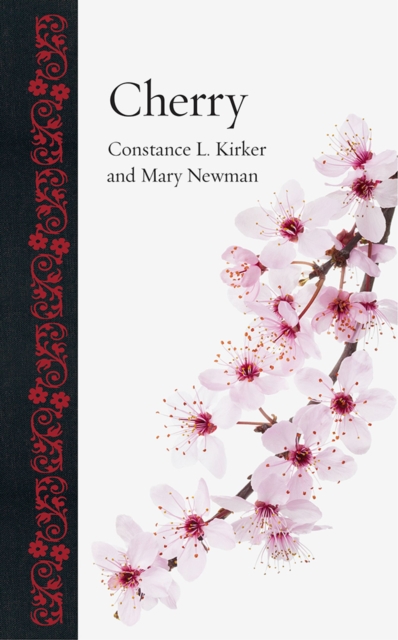
Cherry
Ripe, sensuous, irresistible: the cherry tree and its stunning blossoms conjure up many literal, metaphorical, and visceral sensations. We enjoy cherry picking, a cherry on top, and even, on occasion, losing one's cherry. Cherries have been consumed since prehistoric times, reaching great popularity among the ancient Romans. They have come to symbolize such divergent concepts as fertility, innocence, and seductiveness, inspiring Dutch still-life paintings, Freudian theory, contemporary pop artists, and one of the first food emojis. In Japan and other Asian cultures, the short-lived but beautiful cherry blossoms are important elements throughout art and literature. In this intriguing natural and cultural history, Constance L. Kirker and Mary Newman recount the origins, legends, celebrations, production, and health benefits of this beloved tree.
eBook

Sour cherries
An Afghan child learns to make sour cherry jam, stew, and tea with his mother, just like she learned from her mother.
CHILDBOOK



Genome-wide characterization of chalcone synthase genes in sweet cherry and functional characterization of CpCHS1 under drought stress
Cherries are one of the important fruit trees. The growth of cherry is greatly affected by abiotic stresses such as drought, which hinders its development. Chalcone synthase (CHS, EC 2.3.1.74) is a crucial rate-limiting enzyme in the flavonoid biosynthetic pathway that plays an important role in regulating plant growth, development, and abiotic stress tolerance. In the current study, three genes encoding chalcone synthase were identified in the genome of sweet cherry ( Prunus avium L.). The three genes contained fewer introns and showed high homology with CHS genes of other Rosaceae members. All members are predicted to localize in the cytoplasm. The conserved catalytic sites may be located at the Cys163, Phe214, His302, and Asn335 residues. These genes were differentially expressed during flower bud dormancy and fruit development. The total flavonoid content of Chinese cherry ( Cerasus pseudocerasus Lindl.) was highest in the leaves and slightly higher in the pulp than in the peel. No significant difference in total flavonoid content was detected between aborted kernels and normally developing kernels. Overexpression of Chinese cherry CpCHS1 in tobacco improved the germination frequency of tobacco seeds under drought stress, and the fresh weight of transgenic seedlings under drought stress was higher than that of the wild type, and the contents of SOD, POD, CAT, and Pro in OE lines were significantly increased and higher than WT under drought stress. These results indicate cherry CHS genes are conserved and functionally diverse and will assist in elucidating the functions of flavonoid synthesis pathways in cherry and other Rosaceae species under drought stress.
Journal Article

Sakura's cherry blossoms
\"Sakura's dad gets a new job in America, so she and her parents make the move from their home in Japan. When she arrives in the States, most of all she misses her grandmother and the cherry blossom trees, under which she and her grandmother used to play and picnic. She wonders how she'll ever feel at home in this new place, with its unfamiliar language and landscape. One day, she meets her neighbor, a boy named Luke, and begins to feel a little more settled. When her grandmother becomes ill, though, her family takes a trip back to Japan. Sakura is sad when she returns to the States and once again reflects on all she misses. Luke does his best to cheer her up -- and tells her about a surprise he knows she'll love, but she'll have to wait till spring. In the meantime, Sakura and Luke's friendship blooms and finally, when spring comes, Luke takes her to see the cherry blossom trees flowering right there in her new neighborhood.\"-- Provided by publisher.
Book

Comparative analysis of the complete plastid genomes in Prunus subgenus Cerasus
Prunus subgenus Cerasus (cherry) is an economically important group that distributed in temperate regions of the northern hemisphere. However, shared interspecific morphological traits and variability across taxa of Cerasus are among the impediments to taxonomic efforts to correctly delimit taxa. This is further complicated by a lack of genetic information on these taxa, with no focused genomic or phylogenetic studies being done on Cerasus. In this study, we conducted comparative analysis on the complete plastid genomes (plastomes) of 20 Cerasus species to gain a greater understanding of the attributes of the plastome of these taxa while helping resolve their phylogenetic placement in Prunus sensu lato and interspecific relationships within the subgenus. Our results displayed that (1) the plastomes of the 20 Cerasus species studied exhibited a typical quadripartite structure with conversed genome arrangement, structure, and moderate divergence. (2) The average size of complete plastomes for the Cerasus taxa studied was 157,861 bp, ranging from 157,458 to 158,024 bp. A total of 134 genes were annotated, including 86 protein-coding genes, 40 tRNAs, and 8 rRNAs across all species. In simple sequence repeat analysis, we found Cerasus had a comparable number of dispersed and tandem repeats to those identified in other angiosperm taxa, with only P. pseudocerasus found to contain trinucleotide repeats. Nucleotide diversity analysis revealed that the trnG-GCC gene and rpl32-trnL region had the highest Pi value showing potential as phylogenetic markers. (3) Two phylogenetic trees of the plastomes verified the monophyletic relationship of Cerasus and provided a more resolved species-level phylogeny. Our study provides detailed plastome information for exploring the phylogeny of subg. Cerasus taxa. We identified various types of repeats and nucleotide diversity hotspots, which can be a reference for species identification and reconstruction of phylogenetic relationships.
Journal Article