
Catalogue Search | MBRL


Are you sure you want to remove the book from the shelf?

{{itemTitle}}
4,814
result(s) for
"Chief executive officers Case studies."
Sort by:

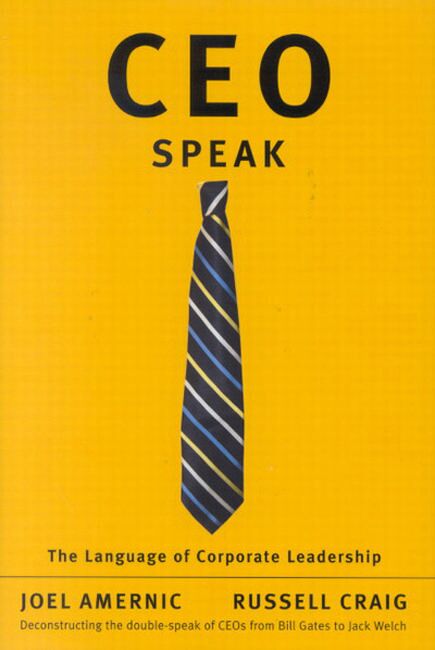
CEO-Speak
CEO-Speak explores the metaphors and persuasive strategies used by leaders at Enron, Microsoft, AOL-TimeWarner, General Electric, IBM, Nortel, Canadian National Railways, Andersen, Disney, and Alcan-Pechiney-Alusuisse. Amernic and Craig show that CEOs are frequently presented as heroes engaged in \"the war of business\" who can effect astonishing miracles of financial performance and reinvention. Contesting the notion that accounting is objective, CEO-Speak serves as an introduction to the controversies and ambiguities in corporate accountability and provides rich examples of the excesses of corporate communication.
eBook


CEO-Speak
In a post-Enron world, corporate accountability and ethical behaviour have become increasingly important. Joel Amernic and Russell Craig consider the implications of the corporate language of leadership.
eBook

Comebacks
Gold Medal Winner, Success and Motivation, 2011 Axiom Business Book Awards Insight from leaders who experienced major setbacks and redefined success In tough economic times, when careers are derailed and leaders are forced to rewrite their professional plans, this book enlightens and uplifts. Comebacks features an all-star cast of ten leaders who endured setbacks-for some a public fall in the midst of media scrutiny-then reassessed and moved ahead with new purpose. Based on revealing interviews, the book presents a behind-the'headlines glimpse into the lives of leaders; how they drew upon resources, both internal and external, to move on; and the lessons that helped them redefine success. Leaders profiled include: -Jacques Nasser, former CEO of Ford Motor Co., recently appointed Chairman of BHP Billiton, the world's largest natural resources company -Patricia Dunn, former Chair of Hewlett-Packard, vilified for her alleged role in corporate espionage only to be exonerated from all charges, today active in philanthropy -Jamie Dimon (JP Morgan), Herbert \"Pug\" Winokur (Enron Corp.), David Neeleman (JetBlue), and more Redmond, a top executive recruiter, and Crisafulli, author of The House of Dimon, show how all leaders face adversity, but true leaders turn adversity into success.
eBook


Exploitation-Exploration Tensions and Organizational Ambidexterity: Managing Paradoxes of Innovation
Achieving exploitation and exploration enables success, even survival, but raises challenging tensions. Ambidextrous organizations excel at exploiting existing products to enable incremental innovation and at exploring new opportunities to foster more radical innovation, yet related research is limited. Largely conceptual, anecdotal, or single case studies offer architectural or contextual approaches. Architectural ambidexterity proposes dual structures and strategies to differentiate efforts, focusing actors on one or the other form of innovation. In contrast, contextual approaches use behavioral and social means to integrate exploitation and exploration. To develop a more comprehensive model, we sought to learn from five, ambidextrous firms that lead the product design industry. Results offer an alternative framework for examining exploitation-exploration tensions and their management. More specifically, we present nested paradoxes of innovation: strategic intent (profit-breakthroughs), customer orientation (tight-loose coupling), and personal drivers (discipline-passion). Building from innovation and paradox literature, we theorize how integration and differentiation tactics help manage these interwoven paradoxes and fuel virtuous cycles of ambidexterity. Further, managing paradoxes becomes a shared responsibility, not only of top management, but across organizational levels.
Journal Article

A Bipolar Neutrosophic Multi Criteria Decision Making Framework for Professional Selection
Professional selection is a significant task for any organization that aims to select the most appropriate candidates to fill well-defined vacancies up. In the recruitment process, various individual characteristics are involved, such as leadership, analytical skills, independent thinking, innovation, stamina and personality, ambiguity and imprecision. It outlines staff contribution and therefore plays a significant part in human resources administration. Additionally, in the era of the Internet of Things and Big Data (IoTBD), professional selection would face several challenges not only to the safe selection and security but also to make wise and prompt decisions especially in the large-scale candidates and criteria from the Cloud. However, the process of professional selection is often led by experience, which contains vague, ambiguous and uncertain decisions. It is therefore necessary to design an efficient decision-making algorithm, which could be further escalated to IoTBD. In this paper, we propose a new hybrid neutrosophic multi criteria decision making (MCDM) framework that employs a collection of neutrosophic analytical network process (ANP), and order preference by similarity to ideal solution (TOPSIS) under bipolar neutrosophic numbers. The MCDM framework is applied for chief executive officer (CEO) selection in a case study at the Elsewedy Electric Group, Egypt. The proposed approach allows us to assemble individual evaluations of the decision makers and therefore perform accurate personnel selection. The outcomes of the proposed method are compared with those of the related works such as weight sum model (WSM), weight product model (WPM), analytical hierarchy process (AHP), multi-objective optimization based on simple ratio analysis (MOORA) and ANP methods to prove and validate the results.
Journal Article

Which CEO Characteristics and Abilities Matter?
We exploit a unique data set to study individual characteristics of CEO candidates for companies involved in buyout and venture capital transactions and relate these characteristics to subsequent corporate performance. CEO candidates vary along two primary dimensions: one that captures general ability and another that contrasts communication and interpersonal skills with execution skills. We find that subsequent performance is positively related to general ability and execution skills. The findings expand our view of CEO characteristics and types relative to previous studies.
Journal Article