
Catalogue Search | MBRL


Are you sure you want to remove the book from the shelf?

{{itemTitle}}
80
result(s) for
"Chihuahua (State)"
Sort by:

Agrarian revolt in the Sierra of Chihuahua, 1959-1965
\"Recounts Mexico's pivotal first socialist guerilla struggle in 1965, when armed farmers, agricultural workers, students, and teachers attacked an army base in Chihuahua with deadly consequences\"--Provided by publisher.
Book

Climate and Culture Change in North America AD 900–1600
Climate change is today's news, but it isn't a new phenomenon. Centuries-long cycles of heating and cooling are well documented for Europe and the North Atlantic. These variations in climate, including the Medieval Warm Period (MWP), AD 900 to 1300, and the early centuries of the Little Ice Age (LIA), AD 1300 to 1600, had a substantial impact on the cultural history of Europe. In this pathfinding volume, William C. Foster marshals extensive evidence that the heating and cooling of the MWP and LIA also occurred in North America and significantly affected the cultural history of Native peoples of the American Southwest, Southern Plains, and Southeast.
Correlating climate change data with studies of archaeological sites across the Southwest, Southern Plains, and Southeast, Foster presents the first comprehensive overview of how Native American societies responded to climate variations over seven centuries. He describes how, as in Europe, the MWP ushered in a cultural renaissance, during which population levels surged and Native peoples substantially intensified agriculture, constructed monumental architecture, and produced sophisticated works of art. Foster follows the rise of three dominant cultural centers-Chaco Canyon in New Mexico, Cahokia on the middle Mississippi River, and Casas Grandes in northwestern Chihuahua, Mexico-that reached population levels comparable to those of London and Paris. Then he shows how the LIA reversed the gains of the MWP as population levels and agricultural production sharply declined; Chaco Canyon, Cahokia, and Casas Grandes collapsed; and dozens of smaller villages also collapsed or became fortresses.
eBook

Ancestors and elites
Ancestors and Elites examines prehispanic ritual behaviors characteristic of the Casas Grandes region of Chihuahua, Mexico. Gordon Rakita analyzes the archaeological data from the site with respect to broader anthropological theories regarding both religious practices and the rise of complex societies. This confluence of empirical fact and general theory allows Rakita to explore in detail the complex, reciprocal relationship between ritual practices and developing social complexity at Paquimé, one of the best-documented archaeological sites in the region.
eBook
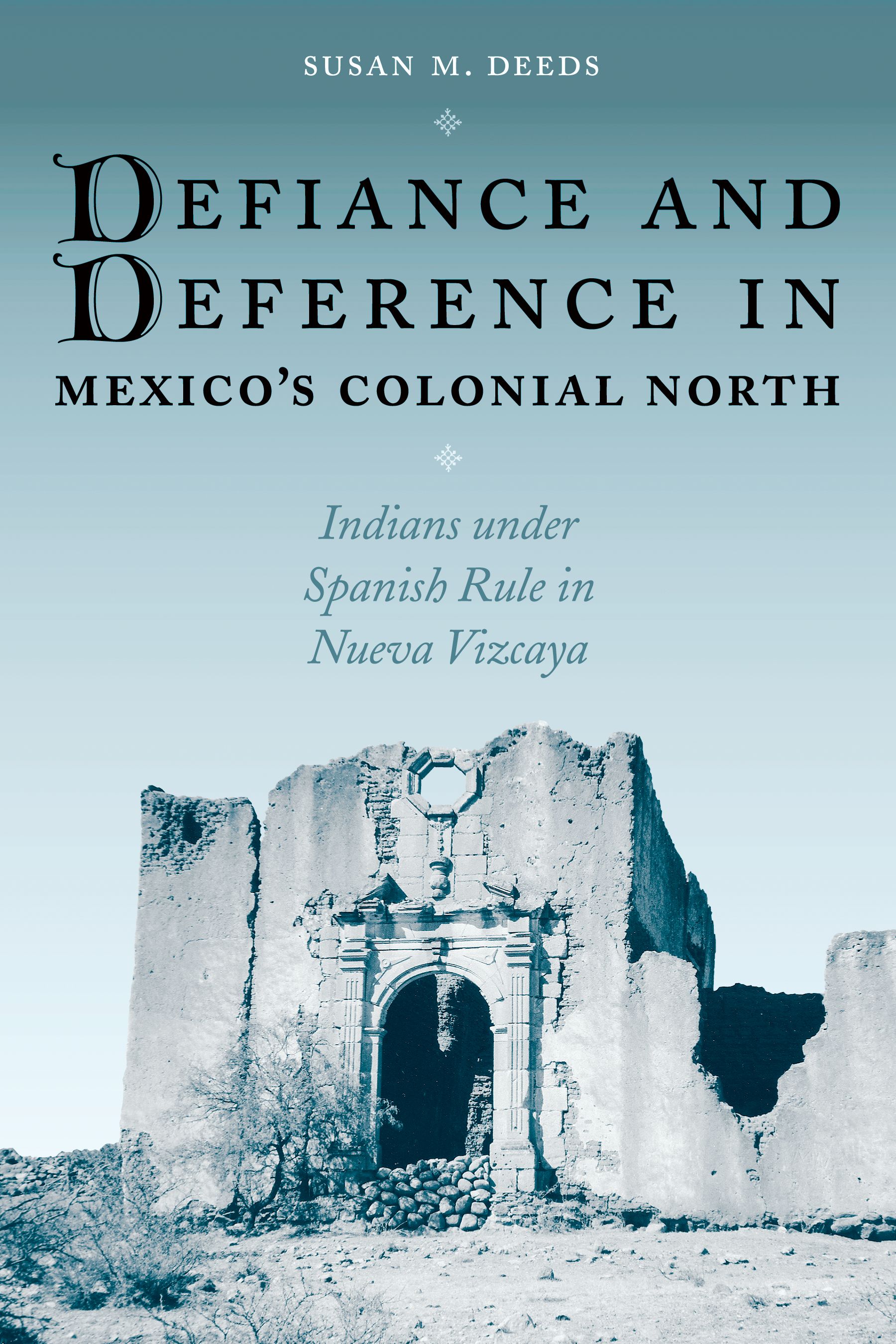
Defiance and Deference in Mexico's Colonial North
Thomas F. McGann Memorial Prize, Rocky Mountain Council on Latin American Studies, 2004 Southwest Book Award, Border Regional Library Association, 2003 In their efforts to impose colonial rule on Nueva Vizcaya from the sixteenth century to the middle of the seventeenth, Spaniards established missions among the principal Indian groups of present-day eastern Sinaloa, northern Durango, and southern Chihuahua, Mexico—the Xiximes, Acaxees, Conchos, Tepehuanes, and Tarahumaras. Yet, when the colonial era ended two centuries later, only the Tepehuanes and Tarahumaras remained as distinct peoples, the other groups having disappeared or blended into the emerging mestizo culture of the northern frontier. Why were these two indigenous peoples able to maintain their group identity under conditions of conquest, while the others could not? In this book, Susan Deeds constructs authoritative ethnohistories of the Xiximes, Acaxees, Conchos, Tepehuanes, and Tarahumaras to explain why only two of the five groups successfully resisted Spanish conquest and colonization. Drawing on extensive research in colonial-era archives, Deeds provides a multifaceted analysis of each group's past from the time the Spaniards first attempted to settle them in missions up to the middle of the eighteenth century, when secular pressures had wrought momentous changes. Her masterful explanations of how ethnic identities, subsistence patterns, cultural beliefs, and gender relations were forged and changed over time on Mexico's northern frontier offer important new ways of understanding the struggle between resistance and adaptation in which Mexico's indigenous peoples are still engaged, five centuries after the \"Spanish Conquest.\"
eBook

Defiance and deference in Mexico's colonial north : Indians under Spanish rule in Nueva Vizcaya
No detailed description available for \"Defiance and Deference in Mexico's Colonial North\".
eBook

OECD Territorial Reviews: Chihuahua, Mexico 2012
Located at the border with the US, Chihuahua has benefited from FDI and NAFTA. Chihuahua has been one of the richest regions in Mexico and one of the most dynamic in the OECD. However, the region’s FDI-trade link with the USA has also led to some vulnerability to external shocks. The two crises affecting the USA in the past decade affected Chihuahua more than any other state. Despite recent progress in the quality of education, other structural challenges such as lower productivity growth, high inactivity rates and dwindling employment rates have been factors in Chihuahua’s sluggish growth. Chihuahua not only displays large intra-regional and gender inequalities, but also the largest inter-ethnic inequality levels in the country. Chihuahua can gain from a territorial approach to policymaking that integrates sectoral policies, fostering value-added in rural activities, better linking SME-development and FDI-attraction policies, as well as between innovation capacities and applications. The region could also strengthen their recent inclusive governance arrangement with civil society and the private sector. Growth and development can only be possible if the current challenges in insecurity, water shortage and public finance are addressed.
eBook

Defiance and Deference in Mexico's Colonial North
In their efforts to impose colonial rule on Nueva Vizcaya from the sixteenth century to the middle of the seventeenth, Spaniards established missions among the principal Indian groups of present-day eastern Sinaloa, northern Durango, and southern Chihuahua, Mexico-the Xiximes, Acaxees, Conchos, Tepehuanes, and Tarahumaras. Yet, when the colonial era ended two centuries later, only the Tepehuanes and Tarahumaras remained as distinct peoples, the other groups having disappeared or blended into the emerging mestizo culture of the northern frontier. Why were these two indigenous peoples able to maintain their group identity under conditions of conquest, while the others could not?
In this book, Susan Deeds constructs authoritative ethnohistories of the Xiximes, Acaxees, Conchos, Tepehuanes, and Tarahumaras to explain why only two of the five groups successfully resisted Spanish conquest and colonization. Drawing on extensive research in colonial-era archives, Deeds provides a multifaceted analysis of each group's past from the time the Spaniards first attempted to settle them in missions up to the middle of the eighteenth century, when secular pressures had wrought momentous changes. Her masterful explanations of how ethnic identities, subsistence patterns, cultural beliefs, and gender relations were forged and changed over time on Mexico's northern frontier offer important new ways of understanding the struggle between resistance and adaptation in which Mexico's indigenous peoples are still engaged, five centuries after the \"Spanish Conquest.\"
eBook

Retaining a Mexican Labor Force
This paper sets forth the findings of a research study undertaken in Chihuahua, Mexico. The length of stay of 1 866 employees in six maquiladora plants is analyzed across a maximum of 24 months. By drawing on discrete time hazard modeling, the research analyzes the extent to which work and nonwork factors contributed to employee length of stay in the late 1980s. It examines, in particular, the influence of position, cohort grouping, plant type, and demographic characteristics on employee duration in the participating plants. The findings show that line operators at the peak of high employment turnover in the maquiladora industry remained employed for an average of 10 months. The study highlights important differences, for the results were not uniform across all maquiladora employees. There were variations in length of stay among employees of different types of plants, in different positions in the same company, different months of entry, and different migrant status. Important ethical issues can also be raised from the study, notably the question of structural turnover being intentionally designed as a consequence of the hiring policies of the multinational corporations in the area.
Journal Article

Análisis de regularidades en la publicación de temas de medio ambiente: caso del Estado de Chihuahua, México
El Estado de Chihuahua, México hace frontera con Estados Unidos de América con quien comparte fuentes de agua y cuencas atmosféricas. Como cualquier región cuenta con situaciones particulares en cuestiones de medio ambiente. En este estudio se identificaron las publicaciones realizadas sobre temáticas de medio ambiente del Estado de Chihuahua por medio del análisis en Scimago Journal Ranking (SJR), el Atlas de la Ciencia Mexicana (ACM), el software Publish or Perish y en la Biblioteca Virtual Ambiental del Estado de Chihuahua (BVA), la cual contiene información especializada de medio ambiente del Estado de Chihuahua y que se encuentra clasificada en las temáticas de Agua, Aire, Suelo, Biodiversidad, Energía, Residuos, Salud Ambiental y Otros. Se encontró que en el país de México como en el Estado de Chihuahua el mayor interés es sobre estudios del Agua. Observando además la importancia de utilizar herramientas como la BVA, que contienen información especializada en una región para un análisis de publicaciones de un área en concreto como el Estado de Chihuahua.
Journal Article

Dinamica temporal de las actividades economicas en el estado de Chihuahua, Mexico
El objetivo de esta investigación es dar a conocer los principales eventos históricos que dieron pauta a la actual configuración territorial de las actividades económicas en el estado de Chihuahua. Se exponen las posturas teórico-metodológicas que constituyeron la base para la reconstrucción espacio-temporal. Posteriormente, se efectúa la caracterización de las actividades económicas que se gestaron y desarrollaron en Chihuahua, mediante la identificación y reconocimiento de cuatro etapas históricas.
Journal Article