
Catalogue Search | MBRL


Are you sure you want to remove the book from the shelf?

{{itemTitle}}
9,229
result(s) for
"Child Welfare - psychology"
Sort by:

Ordinary magic : resilience in development
From a pioneering researcher, this book synthesizes the best current knowledge on resilience in children and adolescents. Ann S. Masten explores what allows certain individuals to thrive and adapt despite adverse circumstances, such as poverty, chronic family problems, or exposure to trauma.
Book

Enhancing Attachment Organization Among Maltreated Children: Results of a Randomized Clinical Trial
Young children who have experienced early adversity are at risk for developing disorganized attachments. The efficacy of Attachment and Biobehavioral Catch-up (ABC), an intervention targeting nurturing care among parents identified as being at risk for neglecting their young children, was evaluated through a randomized clinical trial. Attachment quality was assessed in the Strange Situation for 120 children between 11.7 and 31.9 months of age (M = 19.1, SD = 5.5). Children in the ABC intervention showed significantly lower rates of disorganized attachment (32%) and higher rates of secure attachment (52%) relative to the control intervention (57% and 33%, respectively). These results support the efficacy of the ABC intervention in enhancing attachment quality among parents at high risk for maltreatment.
Journal Article

International handbook of psychological well-being in children and adolescents : bridging the gaps between theory, research, and practice
\"This handbook addresses universal developmental and cultural factors contributingto child and adolescent mental health and well-being across the globe. It examinessociocultural contexts of development and identifies children's and adolescents'perspectives as critical to understanding and promoting their psychological well-being.It details the Promoting Psychological Well-Being Globally project's methodology fordata collection and analysis, provides cross-cultural analyses of its findings, and offers apractical model for clinicians and other professionals seeking to apply this knowledge toreal-life setting.\"--Back cover
Book

Does Money Matter? The Effects of Cash Transfers on Child Development in Rural Ecuador
A large body of research indicates that child development is sensitive to early‐life environments, so that poor children are at higher risk for poor cognitive and behavioral outcomes. These developmental outcomes are important determinants of success in adulthood. Yet, remarkably little is known about whether poverty‐alleviation programs improve children’s developmental outcomes. We examine how a government‐run cash transfer program for poor mothers in rural Ecuador influenced the development of young children. Random assignment at the parish level is used to identify program effects. Our data include a set of measures of cognitive ability that are not typically included in experimental or quasi‐experimental studies of the impact of cash transfers on child well‐being, as well as a set of physical health measures that may be related to developmental outcomes. The cash transfer program had positive, although modest, effects on the physical, cognitive, and socioemotional development of the poorest children in our sample.
Journal Article
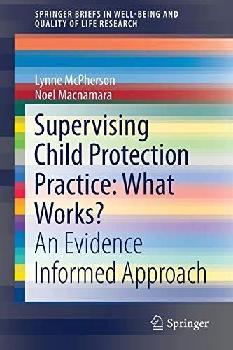
Supervising child protection practice : what works? : an evidence informed approach
This book presents a model of supervision that is based on both contemporary theory and research, which is strongly contextualized to child and family social work. It draws directly from analysis of in-depth interviews with experienced and post graduate qualified supervisors and supervisees about 'what works' in supervision. These findings bring 'news of difference' in relation to social work supervision offering hope, inspiration and a contemporary model of supervisory practice.
Book

Recurrence of Maltreatment After Newborn Home Visiting: A Randomized Controlled Trial
Objectives. To investigate whether a newborn home visiting program for primiparous adolescent mothers (aged 16–20 years at childbirth) reduced recurrence of child maltreatment in child protective services (CPS) reports. Methods. We conducted a randomized controlled trial of Healthy Families Massachusetts, a statewide home visiting program for young parents. A total of 704 first-time young mothers were randomly assigned to a home visiting group, or to a control group who we referred to other services and who received child development and parenting information. The outcome variable was CPS reports (2008–2016) available for 688 families—specifically, rereports following an initial report (up to mean child age of 7 years). Results. Of the 52% of families who experienced initial CPS reports, 53% experienced additional CPS reports. Children of mothers in the home visiting group were less likely to receive a second report and had a longer period of time between initial and second reports. Conclusions. The home visiting program reduced the recurrence of CPS maltreatment report by 32% and increased the length of time between initial and additional CPS reports. Home visiting parenting support and prevention programs may reduce the likelihood of recurrent maltreatment following completion of program services.
Journal Article

Justice for children and families : a developmental perspective
\"This book explores the values, ideas and structures that promote justice for children and families, and it does so from a developmental perspective. This is because, children come into the world completely helpless, and only very gradually develop the capacity to look after themselves. For at least a quarter of their natural lifespan, they depend on families and communities to meet their needs, protect their interests and nurture their potential\"-- Provided by publisher.
Book

Comparing longitudinal assessments of quality of life by patient and parent in newly diagnosed children with cancer: the value of both raters' perspectives
Purpose Health-related quality of life (HRQoL) information from children facing rare and/or life-threatening disease serves important clinical functions. Longitudinal HRQoL ratings from 222 child-parent dyads collected at four time points during the first 16 weeks of cancer treatment are presented. Patient and parent HRQoL reports at the domain level, based on the Pédiatrie Quality of Life Inventory ™ 4.0 Generic Core Scales, were compared over time, and variation in child/parent agreement by age, treatment intensity, and time on treatment was explored. Patients and methods Analyses included consideration of missingness, differences between child and parent group mean domain scores averaged over assessments, agreement between individual child and parent, compared to group averages, and within-subject changes between assessments. Results Children consistently reported higher functioning than their parents with differences varying by child age and HRQoL domain and diminishing over time. No differences were found by intensity of treatment. The between-subject correlation ranged from 0.61 (social functioning) to 0.86 (physical functioning) across time. Agreement within groups, defined by age, treatment intensity, and time were generally similar. Conclusions Results indicate moderate-to-good child/parent agreement with variability by domain of HRQoL. Findings underscore the complexity of self-and proxybased report and support the use of information from both raters.
Journal Article

Child welfare and development : a Japanese case study
\"Bamba and Haight provide an in-depth understanding of the everyday experiences and perspectives of maltreated children and their substitute caregivers and teachers in Japan. Their innovative research program combines strategies from developmental psychology, ethnography and action research. Although child advocates from around the world share certain goals and challenges, there is substantial cultural variation in how child maltreatment is understood, its origins, impact on children and families, as well as societal responses deemed appropriate. The authors step outside of the Western cultural context to illustrate creative ecologically- and developmentally-based strategies for supporting the psychosocial well-being of maltreated children in state care, provide an alternative but complementary model to the prevalent large-scale survey strategies for conducting international research in child welfare, and provide a resource for educators to enhance the international content of human development, education, social work and child welfare courses\"--Provided by publisher.
Book

Evaluating the implementation of a school-based emotional well-being programme: a cluster randomized controlled trial of Zippy's Friends for children in disadvantaged primary schools
Schools are recognized as one of the most important settings for promoting social and emotional well-being among children and adolescents. This clustered randomized controlled trial evaluated Zippy's Friends, an international school-based emotional well-being programme, with 766 children from designated disadvantaged schools. The purpose of this study was to evaluate the immediate and long term impact of the programme and to determine the impact of implementation fidelity on programme outcomes. Teachers reported emotional literacy outcomes using the Emotional Literacy Checklist, and emotional and behavioural outcomes using the Strengths and Difficulties Questionnaire. Controlling for the hierarchical structure of the data, path analysis using structural equation modelling revealed that the programme had a significant positive impact on the children's emotional literacy scores including significant improvements in the subscale scores of self-awareness (P < 0.001), self-regulation (P < 0.01), motivation (P < 0.001) and social skills (P < 0.001) at post-intervention. These results were maintained at 12-month follow-up (P < 0.01). The programme, however, did not have a significant impact on children's emotional and behavioural problems. Analysis of programme fidelity indicated that high fidelity was directly related to improved emotional literacy scores at post-intervention.
Journal Article