
Catalogue Search | MBRL


Are you sure you want to remove the book from the shelf?

{{itemTitle}}
135,100
result(s) for
"Child care services."
Sort by:

Childcare markets : can they deliver an equitable service?
This text brings together recent policy relevant research from seven nations operating childcare markets, allowing comparisons between privatisation and marketisation processes of early childcare education and care services.
Book

Third-child fertility intention and its socioeconomic factors among women aged 20–34 years in China
Background
The low birth rates and rapid population aging has drawn considerable attention from scholars and policymakers in China and around the world. In 2021, China launched the policy and supportive measures that allow up to 3 children per couple. This study aims to explore the influencing factors of the third-child fertility intention among women aged 20–34 years in China.
Methods
We draw data from the National Fertility Survey conducted in 2017. The nationally representative survey adopts a stratified, 3-stage, and probabilities proportional to size sampling method. A total of 61,588 valid samples aged 20–34 years old were obtained. Fertility desire and behavior, childbearing and service use, and potential influencing factors of fertility intention such as the history of pregnancy were assessed.
Results
In general, 5.01% of Chinese women of prime childbearing age had fertility intention for a third child, and the proportion varies by region across mainland China. Individual characteristics such as being ethnic minorities, being rural residents, and having more siblings are significantly positively correlated with the third-child fertility intention, while the intention was significantly lower among women with a higher income or education level, migrant women, and those engaged in the non-agricultural labor force. Women who already had a son had lower fertility intention for a third child. Moreover, it was the perceived acceptable costs of childcare services rather than the actual costs that mattered more for the fertility intention.
Conclusions
Our study concludes a series of socioeconomic factors, and previous childbearing and childrearing experiences are crucial for women’s fertility intention for a third child. These findings highlight the importance of launching supportive measures in addition to the introduction of the 3-child policy in promoting a fertility-friendly society.
Journal Article

Nannies, migration and early childhood education and care : an international comparison of in-home childcare policy and practice
This book presents new empirical research about in-home child care in Australia, the United Kingdom and Canada, three countries where governments are pursuing new ways to support the recruitment of in-home childcare workers through funding, regulation and migration.
Book
Cashing in on education
Investments in education across countries in Latin America and the Caribbean have transformed the lives of millions of girls and the prospects of their families and societies.Unleashing the full economic potential of women is nevertheless still a curtailed issue in the region: just about half of women are unable to participate in paid work.
eBook

Shadow mothers : nannies, au pairs, and the micropolitics of mothering
Shadow Mothers shines new light on an aspect of contemporary motherhood often hidden from view: the need for paid childcare by women returning to the workforce, and the complex bonds mothers forge with the \"shadow mothers\" they hire. Cameron Lynne Macdonald illuminates both sides of an unequal and complicated relationship. Based on in-depth interviews with professional women and childcare providers-- immigrant and American-born nannies as well as European au pairs--Shadow Mothers locates the roots of individual skirmishes between mothers and their childcare providers in broader cultural and social tensions. Macdonald argues that these conflicts arise from unrealistic ideals about mothering and inflexible career paths and work schedules, as well as from the devaluation of paid care work.
Book

Continuous Support from the Same Public Health Nurse and Parental Perception and Use of Health Care Services: A Retrospective Observational Study
ObjectiveContinuity is considered essential for high-quality maternal and child health care services, but studies to show this effect on parental well-being are still rare. We studied whether receiving support from the same public health nurse has a beneficial effect on parental perceptions of health care professionals and the use of childcare support services.MethodsMaternal and child health care services were provided by different nurses in a Japanese municipality until March 2019. From April 2019, all families with infants received continuous support from the same assigned nurse. A questionnaire covering parental perception and the use of services was sent by postal mail to 1,341 families with infants. The data were analyzed using χ2-test, t-test and logistic regression producing odds ratios (OR) with 95% confidence intervals (CI).ResultsParental perceptions of the availability of professionals to discuss children’s issues, the degree of understanding about available other childcare support services, the degree of utilizing other services, and satisfaction with health care services were higher in parents who received continuous support from the same assigned nurse compared to those who did not receive continuous support. Continuous support was associated with parental perceptions of the availability of professionals to discuss children’s issues (OR = 1.97, 95% CI 1.34–2.91) and the degree of understanding about available other child-care support services (OR = 1.65, 95% CI 1.11–2.44) after adjusting the results for socioeconomic factors.ConclusionsContinuous support from the same assigned nurse has benefits for parents. This offers a cost-effective way to improve parental well-being.SignificanceWhat is Already Known on this Subject? Continuity is regarded as important in maternal and child health care. Parental perceptions of professionals are typically better if parents receive support from the same midwife.What this Study adds? Parents who received support from the same assigned public health nurse had better perceptions of professionals and understanding of childcare support services than parents who received support from different nurses even when the number of visits did not differ. Having support from the same assigned nurse increases parental well-being without the need for additional resources.
Journal Article

The foster care system
Follow the story of Bobby and cara, two children whose family was torn apart, and learn more about the foster care system.
Book

The Relationship between Childcare Services Participation and Parental Subjective Well-Being under China’s Three-Child Policy—Based on the Mediation Effect of Parenting Stress
This study examined the relationship between children’s participation in childcare services from birth to 3 years of age and their parents’ subjective well-being, as well as the mediating role of parenting stress. In total, 990 parents of children aged 0–3 years from Beijing were surveyed. First, independent samples t-tests after propensity score matching revealed that parents who participated in childcare services may have significantly higher overall subjective well-being and life satisfaction than those who did not participate. Second, a descriptive analysis and an analysis of variance results indicated that remote location, low quality, and high price may be the major reasons for parents’ dissatisfaction with childcare services, and a regression analysis of childcare dissatisfaction showed that high-priced childcare services had a significant negative relationship with parent’s subjective well-being. Third, the results of a mediation analysis of parenting stress revealed that childcare services have significant direct effects on parents’ subjective well-being, and a small mediating effect of parenting stress on parent’s childcare service participation and parental subjective well-being. The findings demonstrate the importance of childcare services, especially for the provision of affordable childcare to improve parents’ subjective well-being and relieving pressure on parents.
Journal Article

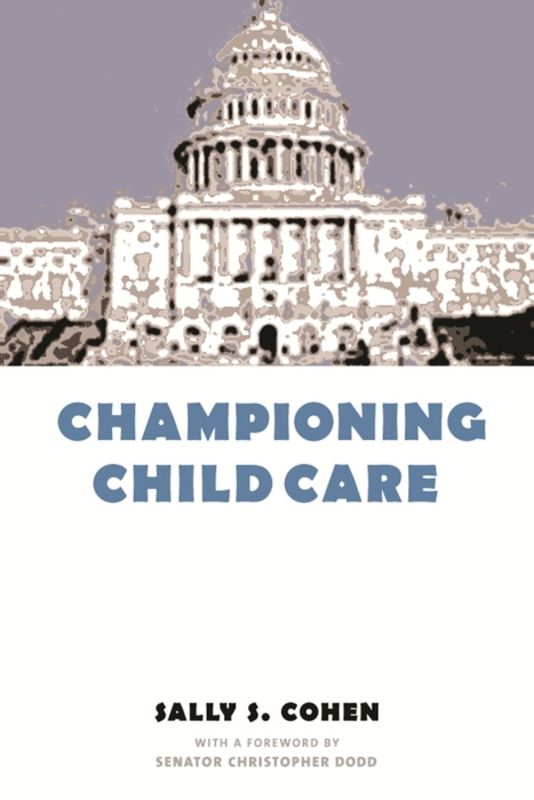
Championing Child Care
Why has child care legislation developed along its present course? How did the political players influence lawmakers? What do the politics of child care legislation over the past thirty years indicate for the future? Based on more than one hundred interviews with legislators and executive branch officials, archival research, and secondary sources, this book looks at the politics behind child care legislation, rather than analyzing child care as a work and family issue.
Identifying key junctures at which major child care bills were introduced and debated (1971, 1990, and 1996), Sally Cohen examines the politics surrounding each of these events and identifies the political structures and negotiations that evolved in the intervening years. In addition, Cohen looks at the impact the election of President Clinton has had on child care policymaking, and how child care legislation became part of other issues, including welfare reform, crime prevention, school readiness, and tax policy revisions.
eBook