
Catalogue Search | MBRL


Are you sure you want to remove the book from the shelf?

{{itemTitle}}
116,805
result(s) for
"Children Language"
Sort by:


The essential child : origins of essentialism in everyday thought
Essentialism is the idea that certain categories, such as “dog,” “man,” or “intelligence,” have an underlying reality or true nature that gives objects their identity. This book argues that essentialism is an early cognitive bias. Young children's concepts reflect a deep commitment to essentialism, and this commitment leads children to look beyond the obvious in many converging ways: when learning words, generalizing knowledge to new category members, reasoning about the insides of things, contemplating the role of nature versus nurture, and constructing causal explanations. This book argues against the standard view of children as concrete or focused on the obvious, instead claiming that children have an early, powerful tendency to search for hidden, non-obvious features of things. It also disputes claims that children build up their knowledge of the world based on simple, associative learning strategies, arguing that children's concepts are embedded in rich folk theories. Parents don't explicitly teach children to essentialize; instead, during the preschool years, children spontaneously construct concepts and beliefs that reflect an essentialist bias. The book synthesizes over fifteen years of empirical research on essentialism into a unified framework and explores the broader lessons that the research imparts concerning, among other things, human concepts, children's thinking, and the ways in which language influences thought.
eBook


Language impairment in multilingual settings : LITMUS in action across Europe
COST Action IS0804 \"Language Impairment in a Multilingual Society: Linguistic Patterns and the Road to Assessment\" aimed to profile bilingual specific language impairment (biSLI) by establishing a network for research on the linguistic and cognitive abilities of bilingual children with SLI across different migrant communities. A battery of tools for Language Impairment Testing in Multilingual Settings (LITMUS) was designed within the Action to achieve these aims, including the Parental Bilingual Questionnaire, the Sentence Repetition Task, the Crosslinguistic Lexical Tasks, the Multilingual Assessment Instrument for Narratives, and two nonword repetition tasks that are not language-specific. The chapters in this volume present research on one or more of the LITMUS tasks in bilingual children with typical language development and on use of the LITMUS testing battery for identifying possible language impairment. The work presented here will be of interest for researchers and clinicians alike, and have profound impact in our understanding of bilingual language development and impairment.
eBook


Language Brokers
In a nation lacking a comprehensive social safety net, people often scramble to find private solutions to structural problems. While existing scholarship primarily focuses on how adults, particularly mothers, navigate systematic gaps in social support, Language Brokers shifts our attention to bilingual children securing crucial resources for their families. Drawing upon interviews with working-class Mexican and Korean American language brokers, as well as healthcare providers, and months of participant observation in a Southern California police station, Hyeyoung Kwon reveals how children of immigrants translate more than simple verbal exchanges. Living at the intersection of multiple forms of inequality, these youth creatively use their in-between status to resolve structural problems to ensure their families' basic citizenship rights are upheld in interactions with teachers, social workers, landlords, doctors, and police officers. In an era of widespread racialized nativism, Language Brokers provides a critical examination of American culture, laying bare the contradictions between the ideals of equality and the exclusion of immigrants. Kwon underscores that dichotomous and racialized understandings of \"deserving\" and \"undeserving\" immigrants—which are embedded in everyday interactions and institutional practices—inform the routine ways in which immigrant youth attempt to cultivate belonging for their families.
eBook


Statistical Learning in Children With Specific Language Impairment
Jenny R. Saffran
Kathryn Robe-Torres
University of Wisconsin–Madison
Contact author: Julia L. Evans, School of Speech, Language, and Hearing Sciences, San Diego State University, 5500 Campanile Drive, San Diego, CA 92182-1518. E-mail: jevans{at}mail.sdsu.edu .
Purpose: In this study, the authors examined (a) whether children with specific language impairment (SLI) can implicitly compute the probabilities of adjacent sound sequences, (b) if this ability is related to degree of exposure, (c) if it is domain specific or domain general and, (d) if it is related to vocabulary.
Method: Children with SLI and normal language controls (ages 6;5–14;4 [years;months]) listened to 21 min of a language in which transitional probabilities within words were higher than those between words. In a second study, children with SLI and Age–Nonverbal IQ matched controls (8;0–10;11) listened to the same language for 42 min and to a second 42 min \"tone\" language containing the identical statistical structure as the \"speech\" language.
Results: After 21 min, the SLI group's performance was at chance, whereas performance for the control group was significantly greater than chance and significantly correlated with receptive and expressive vocabulary knowledge. In the 42-minute speech condition, the SLI group's performance was significantly greater than chance and correlated with receptive vocabulary but was no different from chance in the analogous 42-minute tone condition. Performance for the control group was again significantly greater than chance in 42-minute speech and tone conditions.
Conclusions: These findings suggest that poor implicit learning may underlie aspects of the language impairments in SLI.
KEY WORDS: specific language impairment, implicit learning, statistical learning, child language development, child language disorders
CiteULike Connotea Del.icio.us Digg Facebook Reddit Technorati Twitter What's this?
Journal Article

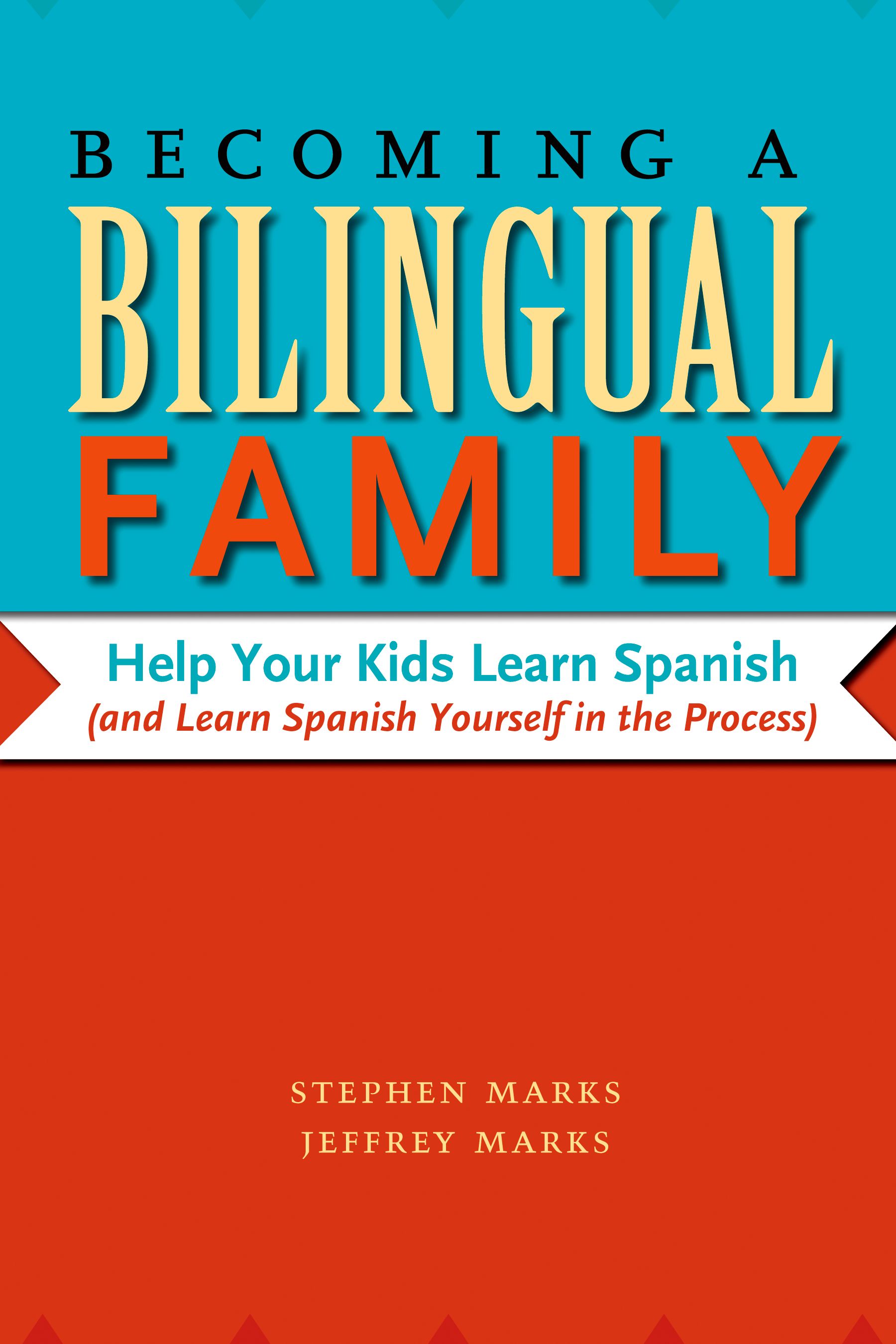
Becoming a Bilingual Family
Would you like your children to grow up bilingual, even if you aren’t yet? Then speak to your kids in Spanish as you learn the language along with them. Becoming a Bilingual Family gives English-speaking parents the tools to start speaking Spanish with their kids in their earliest years, when children are most receptive to learning languages. It teaches the vocabulary and idioms for speaking to children in Spanish and offers practical, proven ways to create a language-learning environment at home. The first part of the book introduces parents to many resources—books, audio books, music, television, computer programs, childcare workers, school, and friends—that can help you establish a home environment conducive to the acquisition of Spanish. The second part is a Spanish phrasebook that takes you through all the typical activities that parents and children share, from getting up in the morning to going to bed at night. Few, if any, other Spanish study aids provide this much vocabulary and guidance for talking to small children about common daily activities. The authors also include a quick course in Spanish pronunciation and enough grammar to get a parent started. Spanish-language resources, kids’ names in Spanish, and an easy-to-use index and glossary complete the book. Take the Markses’ advice and start talking to your kids in Spanish, even if it’s not perfect. You’ll learn the language together and share the excitement of discovering the peoples and cultures that make up the Spanish-speaking world.
eBook