
Catalogue Search | MBRL


Are you sure you want to remove the book from the shelf?

{{itemTitle}}
42,730
result(s) for
"Chile"
Sort by:


Race and the Chilean Miracle
The economic reforms imposed by Augusto Pinochet's regime (1973-1990) are often credited with transforming Chile into a global economy and setting the stage for a peaceful transition to democracy, individual liberty, and the recognition of cultural diversity. The famed economist Milton Friedman would later describe the transition as the \"Miracle of Chile.\" Yet, as Patricia Richards reveals, beneath this veneer of progress lies a reality of social conflict and inequity that has been perpetuated by many of the same neoliberal programs.InRace and the Chilean Miracle,Richards examines conflicts between Mapuche indigenous people and state and private actors over natural resources, territorial claims, and collective rights in the Araucanía region. Through ground-level fieldwork, extensive interviews with local Mapuche and Chileans, and analysis of contemporary race and governance theory, Richards exposes the ways that local, regional, and transnational realities are shaped by systemic racism in the context of neoliberal multiculturalism..Richards demonstrates how state programs and policies run counter to Mapuche claims for autonomy and cultural recognition. The Mapuche, whose ancestral lands have been appropriated for timber and farming, have been branded as terrorists for their activism and sometimes-violent responses to state and private sector interventions. Through their interviews, many Mapuche cite the perpetuation of colonialism under the guise of development projects, multicultural policies, and assimilationist narratives. Many Chilean locals and political elites see the continued defiance of the Mapuche in their tenacious connection to the land, resistance to integration, and insistence on their rights as a people. These diametrically opposed worldviews form the basis of the racial dichotomy that continues to pervade Chilean society.In her study, Richards traces systemic racism that follows both a top-down path (global, state, and regional) as well as a bottom-up one (local agencies and actors), detailing their historic roots. Richards also describes potential positive outcomes in the form of intercultural coalitions or indigenous autonomy. Her compelling analysis offers new perspectives on indigenous rights, race, and neoliberal multiculturalism in Latin America and globally.
eBook

Chile
\"Developed by literacy experts for students in grades three through seven, this book introduces young readers to the geography and culture of Chile\"--Provided by publisher.
BOOK

Enhancing Democracy
Since the end of the Pinochet regime, Chilean public policy has sought to rebuild democratic governance in the country. This book examines the links between the state and civil society in Chile and the ways social policies have sought to ensure the inclusion of the poor in society and democracy. Although Chile has gained political stability and grown economically, the ability of social policies to expand democratic governance and participation has proved limited, and in fact such policies have become subordinate to an elitist model of democracy and resulted in a restrictive form of citizen participation.
eBook


Crustacean Zooplankton Communities in Chilean Inland Waters
This book provides a checklist with updated information of the species of crustacean zooplankton in Chilean inland waters, while the results of an ecological study offers data for understanding the distribution and abundance of those faunal elements in the area.
eBook

Elemental
Elemental, based in Santiago, Chile, epitomizes a new generation of pioneering, socially engaged architects. The firm specializes in innovative, powerful, and humane public-interest projects, working on both large and small scales across Chile, the United States, Mexico, Switzerland, and China.0Featuring stunning images by renowned architectural photographers together with sketches and drawings from Aravena's personal notebooks, this book beautifully, often irreverently, displays Elemental's unique working methods and philosophy. Each project - from iconic structures like the Anacleto Angelini UC Innovation Centre to seaside residences and pioneering reconstruction plans - is accompanied by Aravena's engaging texts, bringing to life his understanding of civil society and the built environment.
Book

The society of equality : popular republicanism and democracy in Santiago de Chile, 1818-1851
On April 1, 1850, a planning meeting took place in Santiago, Chile, to organize a new political association that sought to democratize the thirty-year-old republic. The attendees were all male, and included master and journeymen tailors and shoemakers, two young men recently returned from a European sojourn, the conductor of the city’s orchestra, a law professor, and a few “liberals” from the opposition party in Congress. The attendees believed the Society of Reform, the city’s outmoded club for reformists, was inadequate, and they wanted to replace it with a group that reflected the more “revolutionary spirit” of the times. Wood argues that the society created at that meeting, the “Society of Equality,” set a new standard for democratic thought and action in Chilean history and was arguably the most democratic political association of its era in all of Latin America. It represented the first stirrings of modern democratic thought and practice—however fleeting—in Chile’s hierarchical class structure. Ironically, it would be the persistent class relationships that prevented the Society from withstanding the onslaught of Church and state repression.
eBook

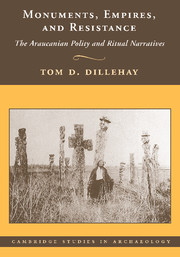
Monuments, Empires, and Resistance
From AD 1550 to 1850, the Araucanian polity in southern Chile was a center of political resistance to the intruding Spanish empire. In this 2007 book, Tom D. Dillehay examines the resistance strategies of the Araucanians and how they used mound building and other sacred monuments to reorganize their political and culture life in order to unite against the Spanish. Drawing on anthropological research conducted over three decades, Dillehay focuses on the development of leadership, shamanism, ritual, and power relations. His study combines developments in social theory with the archaeological, ethnographic, and historical records. Both theoretically and empirically informed, this book is a fascinating account of the only indigenous ethnic group to successfully resist outsiders for more than three centuries and to flourish under these conditions.
eBook