
Catalogue Search | MBRL


Are you sure you want to remove the book from the shelf?

{{itemTitle}}
4,259
result(s) for
"China -- Military policy"
Sort by:

Chinese strategy and military power in 2014 : Chinese, Japanese, Korean, Taiwanese and US perspectives
This report tracks and analyzes trends in Chinese military strategy, force structure, and regional activity. Chinese perspectives on their military's role and development are featured, as well as the views of other relevant regional actors.
Book

PLA influence on China's national security policymaking
No detailed description available for \"PLA Influence on China's National Security Policymaking\".
eBook


China's Global Engagement
Assessing China's rapidly changing role on the international stage
China is again undergoing a period of significant transition. Internally, China's leaders are addressing challenges to the economy and other domestic issues after three decades of dramatic growth and reforms. President Xi Jinping and other leaders also are refashioning foreign policy to better fit what they see as China's place in the world. This has included a more proactive approach to trade and related international economic affairs, a more vigorous approach to security matters, and a more focused engagement on international cultural and educational affairs.
In this volume, China specialists from around the world explore key issues raised by a changing China's interaction with a changing world. They chronicle China's emergence as a more capable actor whose engagement is reshaping international affairs in many dimensions. These include: global currency and trading systems; patterns of cooperation and competition in technological innovation; economic and political trends in the developing world; the American-led security order in the Asia-Pacific region; the practice of international military and humanitarian intervention; the use of naval power; the role of international law in persistent territorial and maritime disputes in the East and South China Seas; the international human rights regime; the circulation of Chinese talent trained abroad; a more globalized film industry; and programs to reshape global cultural awareness about China through educational initiatives.
Across these diverse areas, China's capacity-and desire-to influence events and outcomes have risen markedly. The results so far are mixed, and the future trajectory remains uncertain. But across the wide range of issues addressed in this book, China has become a major and likely an enduring participant.
eBook

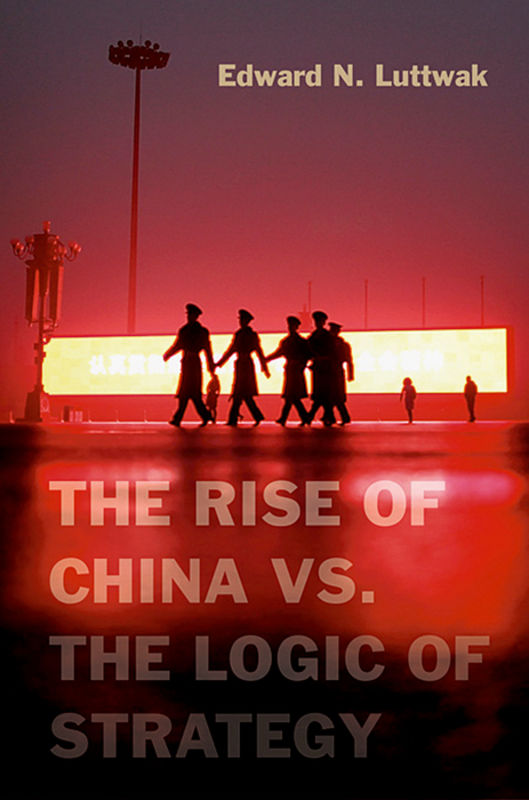
The Rise of China vs. the Logic of Strategy
As the rest of the world worries about what a future might look like under Chinese supremacy, Luttwak worries about China’s own future prospects. Applying the logic of strategy for which he is well known, he argues that the world’s second largest economy may be headed for a fall unless China’s leaders check their military ambitions.
eBook

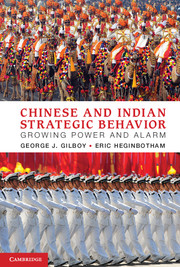
Chinese and Indian Strategic Behavior
This book offers an empirical comparison of Chinese and Indian international strategic behavior. It is the first study of its kind, filling an important gap in the literature on rising Indian and Chinese power and American interests in Asia. The book creates a framework for the systematic and objective assessment of Chinese and Indian strategic behavior in four areas: (1) strategic culture; (2) foreign policy and use of force; (3) military modernization (including defense spending, military doctrine and force modernization); and (4) economic strategies (including international trade and energy competition). The utility of democratic peace theory in predicting Chinese and Indian behavior is also examined. The findings challenge many assumptions underpinning Western expectations of China and India.
eBook


Chinese Nuclear Proliferation
While the world's attention is focused on the nuclearization of
North Korea and Iran and the nuclear brinkmanship between India and
Pakistan, China is believed to have doubled the size of its nuclear
arsenal, making it \"the forgotten nuclear power,\" as described in
Foreign Affairs . Susan Turner Haynes analyzes China's
buildup and its diversification of increasingly mobile, precise,
and sophisticated nuclear weapons. Haynes provides context and
clarity on this complex global issue through an analysis of
extensive primary source research and lends insight into questions
about why China is the only nuclear weapon state recognized under
the Nuclear Nonproliferation Treaty that continues to pursue
qualitative and quantitative advancements to its nuclear force. As
the gap between China's nuclear force and the forces of the nuclear
superpowers narrows against the expressed interest of many nuclear
and nonnuclear states, Chinese Nuclear Proliferation
offers policy prescriptions to curtail China's nuclear growth and
to assuage fears that the \"American world order\" presents a direct
threat to China's national security. Presenting technical concepts
with minimal jargon in a straightforward style, this book will be
of use to casual China watchers and military experts alike.
eBook