
Catalogue Search | MBRL


Are you sure you want to remove the book from the shelf?

{{itemTitle}}
13
result(s) for
"China -- Social life and customs -- 221 B.C.-960 A.D"
Sort by:

Daily life in ancient China
In this volume, Mu-chou Poo offers a new overview of daily life in Ancient China. Synthesizing a range of textual and archaeological materials, he brings a thematic approach to the topic that enables a multi-faceted understanding of the ideological, economical, legal, social, and emotional aspects of life in Ancient China. The volume focuses on the Han period and examines key topics such as government organization and elite ideology, urban and country life, practical technology, leisure and festivity, and death and burial customs. Written in clear and engaging prose, this volume serves as a useful introduction to the culture and society of Ancient China. It also enables students to better understand the construction of history and to reflect critically on the nature of historical writing.
Book

Problems of Han Administration
China's early emperors must pay their respects to their predecessors in the correct form; the conduct of government and commercial practice depended on a generally accepted system of weights and measures; critics needed a secure means of expressing their views.
eBook
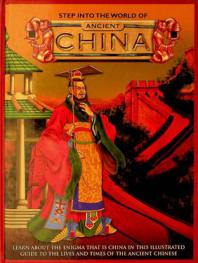
Step into the world of ancient China
Simple text with questions and answers describe daily life in ancient China.
Book

The Destruction of the Medieval Chinese Aristocracy
Historians have long been perplexed by the complete disappearance of the medieval Chinese aristocracy by the tenth century—the “great clans\" that had dominated China for centuries. In this book, Nicolas Tackett resolves the enigma of their disappearance, using new, digital methodologies to analyze a dazzling array of sources. Tackett systematically mines thousands of funerary biographies excavated in recent decades—most of them never before examined by scholars—while taking full advantage of the explanatory power of Geographic Information System (GIS) methods and social network analysis. Tackett supplements these analyses with extensive anecdotes culled from epitaphs, prose literature, and poetry, bringing to life women and men who lived a millennium in the past. The Destruction of the Medieval Chinese Aristocracy demonstrates that the great Tang aristocratic families adapted to the social, economic, and institutional transformations of the seventh and eighth centuries far more successfully than previously believed. Their political influence collapsed only after a large number were killed during three decades of extreme violence following Huang Chao’s sack of the capital cities in 880 CE. 2015 James Breasted Prize, American Historical Association
eBook

Facing the monarch : modes of advice in the early Chinese court
\"Focused on the era between the Spring and Autumn period and the latter Han dynasty, this volume investigates the dynamics between early Chinese ministers and monarchs at a time when ministers employed manifold innovative rhetorical tactics by analyzing discrete excerpts from classical Chinese works\"--Provided by publisher.
Book

Entombed Epigraphy and Commemorative Culture \u2028in Early Medieval China
In Entombed Epigraphy and Commemorative Culture Timothy M. Davis presents a history of early muzhiming-the most versatile and persistent commemorative form employed in the elite burials of pre-modern China. While previous scholars have largely overlooked the contemporary religious, social, and cultural functions of these epigraphic objects, this study directly addresses these areas of concern, answering such basic questions as: Why were muzhiming buried in tombs? What distinguishes commemorative biography from dynastic history biography? And why did muzhiming develop into an essential commemorative genre esteemed by the upper classes? Furthermore, this study reveals how aspiring families used muzhiming to satisfy their obligations to deceased ancestors, establish a multi-generational sense of corporate identity, and strengthen their claims to elite status.
eBook

Design by the book : Chinese ritual objects and the Sanli tu
\"Today, China's classical antiquity is often studied through recovered artifacts, but before this practice became widespread, scholars instead reconstructed the distant past through classical texts and transmitted illustrations. Among the most important illustrated commentaries was the Sanli tu, or Illustrations to the Ritual Classics, whose origins are said to date back to the great commentator Zheng Xuan. Design by the Book, which accompanies an exhibition at Bard Graduate Center Gallery, discusses the history and cultural significance of the Sanli tu in medieval China. The Sanli tu survives in a version produced around 960 by Nie Chongyi, a professor at the court of the Later Zhou (951-960) and Northern Song (960-1127) dynasties. It is now mostly remembered--if at all--for its controversial entries and as a quaint predecessor of the more empirical antiquarian scholarship produced since the mid-eleventh century. But such criticism hides the fact that the book remained a standard resource for more than 150 years, playing a crucial role in the Song dynasty's perception of ancient ritual and construction of a Confucian state cult. Richly illustrated, Design by the Book brings renewed focus to one of China's most fascinating medieval works\"-- Provided by publisher.
Book


The destruction of the medieval Chinese aristocracy
\"Tackett resolves the enigma of the complete disappearance by the tenth century of the medieval Chinese aristocracy, analyzing a dazzling array of sources to demonstrate that the great Tang aristocratic families were far more successful than previously believed in adapting to the many transformations of the seventh and eighth centuries\"-- Provided by publisher.
Book
