
Catalogue Search | MBRL


Are you sure you want to remove the book from the shelf?

{{itemTitle}}
526
result(s) for
"China Foreign relations 21st century."
Sort by:

Cold peace : China-India rivalry in the twenty-first century
The 21st century is likely to witness Asia's two largest civilizations, China and India, join the United States in an elite club of global superpowers. But while Beijing and Delhi have spent the past half-century free from armed conflict and enjoy cordial diplomatic relations, elements of rivalry have shadowed the relationship since the two countries went to war in 1962 over their disputed Himalayan border. 'Cold Peace' updates and deepens our understanding of the China-India relationship by unraveling the complex layers of rivalry between the two nations.
Book

The Evolving Relationship between China, the EU and the USA
This book closely scrutinizes the individual and collective roles played by China, the EU and the USA in contemporary world politics.
Examining the three actors’ respective strategic and policy positions on and behaviour towards the flux of the contemporary global order, the analysis focuses on three major issues and challenges: foreign and security policy; economics and trade; and climate change and energy. Discussing their relative power, as well as their interests, beliefs and positions on a set of decisive issues, this book explores bilateral relations between the three powers and the ways in which they may interact trilaterally in a broader global context to shape international politics.
Written by a stellar line-up of experts from the fields of politics and international relations, The Evolving Relationship between China, the EU and the USA will be of huge interest to students and scholars from within these fields, as well as policy-makers and practitioners more generally.
eBook


China's Soft Power and International Relations
China's soft power has attracted considerable attention in the recent decade. In this volume scholars from the U.K., Europe, the U.S., Singapore, Australia, Hong Kong and mainland China, including a number of well established and well known analysts on China, examine main areas where China has made noticeable advances in its appeal and influence. They include China's foreign policy discourse, international communication, cultural diplomacy, and foreign assistance. In addition, Chinese concept of soft power, foreign policy strategy, and the relationship between its international standing and that of the U.S. are also closely analysed. The volume covers some of the most recent development and assesses China's soft power critically. This book offers an assessment of China's efforts to cultivate its international image, as well as a critique of Nye's theory of soft power. It draws on case studies of the Chinese diplomatic practice and utilizes world opinion polls. This volume offers a theoretical and empirical perspective on the discussion on soft power with a particular focus on China's soft power.
eBook
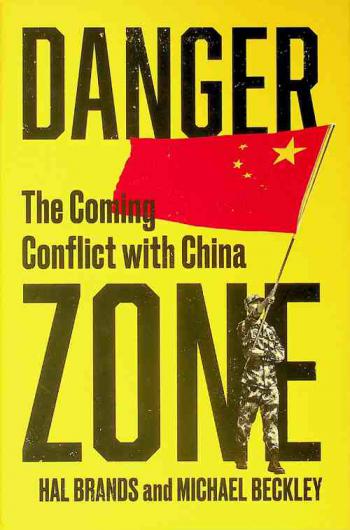
Danger zone : the coming conflict with China
\"A provocative and urgent analysis of the U.S.-China rivalry. It has become conventional wisdom that America and China are running a \"superpower marathon\" that may last a century. Yet Hal Brands and Michael Beckley pose a counterintuitive question: What if the sharpest phase of that competition is more like a decade-long sprint? The Sino-American contest is driven by clashing geopolitical interests and a stark ideological dispute over whether authoritarianism or democracy will dominate the 21st century. But both history and China's current trajectory suggest that this rivalry will reach its moment of maximum danger in the 2020s. China is at a perilous moment: strong enough to violently challenge the existing order, yet losing confidence that time is on its side. Numerous examples from antiquity to the present show that rising powers become most aggressive when their fortunes fade, their difficulties multiply, and they realize they must achieve their ambitions now or miss the chance to do so forever. China has already started down this path. Witness its aggression toward Taiwan, its record-breaking military buildup, and its efforts to dominate the critical technologies that will shape the world's future. Over the long run, the Chinese challenge will most likely prove more manageable than many pessimists currently believe-but during the 2020s, the pace of Sino-American conflict will accelerate, and the prospect of war will be frighteningly real. America, Brands and Beckley argue, will still need a sustainable approach to winning a protracted global competition. But first, it needs a near-term strategy for navigating the danger zone ahead\"-- Provided by publisher.

PLA influence on China's national security policymaking
No detailed description available for \"PLA Influence on China's National Security Policymaking\".
eBook


China's Global Engagement
Assessing China's rapidly changing role on the international stage
China is again undergoing a period of significant transition. Internally, China's leaders are addressing challenges to the economy and other domestic issues after three decades of dramatic growth and reforms. President Xi Jinping and other leaders also are refashioning foreign policy to better fit what they see as China's place in the world. This has included a more proactive approach to trade and related international economic affairs, a more vigorous approach to security matters, and a more focused engagement on international cultural and educational affairs.
In this volume, China specialists from around the world explore key issues raised by a changing China's interaction with a changing world. They chronicle China's emergence as a more capable actor whose engagement is reshaping international affairs in many dimensions. These include: global currency and trading systems; patterns of cooperation and competition in technological innovation; economic and political trends in the developing world; the American-led security order in the Asia-Pacific region; the practice of international military and humanitarian intervention; the use of naval power; the role of international law in persistent territorial and maritime disputes in the East and South China Seas; the international human rights regime; the circulation of Chinese talent trained abroad; a more globalized film industry; and programs to reshape global cultural awareness about China through educational initiatives.
Across these diverse areas, China's capacity-and desire-to influence events and outcomes have risen markedly. The results so far are mixed, and the future trajectory remains uncertain. But across the wide range of issues addressed in this book, China has become a major and likely an enduring participant.
eBook

China's global identity : considering the responsibilities of great power
What kind of great power will China become? It is uncertain how or if China's growing power, interests, and ambitions can be successfully accommodated within the current American dominated international order. Tiang Boon Hoo has undertaken the most in-depth examination to date of how Chinese elites view China's future role in the world. Without being blind to the potential dangers of China's rise, Hoo's findings force a reexamination of assumptions that China aims to be a revisionist power. In fact, even before Bill Clinton famously called for China to become a responsible great power in 1995, Chinese leaders were already considering this very issue. Hoo has conducted extensive field research in China and has analyzed several decades' worth of Chinese policy papers, speeches, and the work of Chinese scholars to better understand how the Chinese perceive their role as a rising great power. While China's best intentions do not ensure a peaceful rise, this book will help outside observers understand China's self-perceptions and intentions and to reconsider assumptions about the inevitability of US-China conflict.
Book

Chinese Diplomacy and the UN Security Council
China has emerged in the 21st century as a sophisticated, and sometimes contentious, actor in the United Nations Security Council. This is evident in a range of issues, from negotiations on Iran's nuclear program to efforts to bring peace to Darfur. Yet China's role as a veto-holding member of the Council has been left unexamined. How does it formulate its positions? What interests does it seek to protect? How can the international community encourage China to be a contributor, and not a spoiler?
This book is the first to address China's role and influence in the Security Council. It develops a picture of a state struggling to find a way between the need to protect its stakes in a number of 'rogue regimes', on one hand, and its image as a responsible rising power on the world stage, on the other. Negotiating this careful balancing act has mixed implications, and means that whilst China can be a useful ally in collective security, it also faces serious constraints. Providing a window not only into China's behaviour, but into the complex world of decision-making at the UNSC in general, the book covers a number of important cases, including North Korea, Iran, Darfur, Burma, Zimbabwe, Libya and Syria.
Drawing on extensive interviews with participants from China, the US and elsewhere, this book considers not only how the world affects China, but how China impacts the world through its behaviour in a key international institution. As such, it will be of great interest to students and scholars working in the fields of Chinese politics and Chinese international relations, as well as politics, international relations, international institutions and diplomacy more broadly.
eBook