
Catalogue Search | MBRL


Are you sure you want to remove the book from the shelf?

{{itemTitle}}
2,359
result(s) for
"China History, Military."
Sort by:

Military culture in imperial China
These original essays reexamine the relationship between culture and the military in Chinese society.
Book

Where Chiang Kai-shek Lost China
The civil war in China that ended in the 1949 victory of Mao Zedong's Communist forces was a major blow to US interests in the Far East and led to heated recriminations about how China was \"lost.\" Despite their significance, there have been few studies in English of the war's major campaigns. The Liao-Shen Campaign was the final act in the struggle for control of China's northeast. After the Soviet defeat of Japan in Manchuria, Communist Chinese and then Nationalist troops moved into this strategically important area. China's largest industrial base and a major source of coal, Manchuria had extensive railways and key ports (both still under Soviet control). When American mediation over control of Manchuria failed, full-scale civil war broke out. By spring of 1946, Chiang Kai-shek's Nationalist armies had occupied most of the southern, economically developed part of Manchuria, pushing Communist forces north of the Songhua (Sungari) River. But over the next two years, the tide would turn. The Communists isolated the Nationalist armies and mounted a major campaign aimed at destroying the Kuomintang forces. This is the story of that campaign and its outcome, which were to have such far-reaching consequences.
eBook


The Battle for Manchuria and the Fate of China
In the spring of 1946, Communists and Nationalist Chinese were battled for control of Manchuria and supremacy in the civil war. The Nationalist attack on Siping ended with a Communist withdrawal, but further pursuit was halted by a cease-fire brokered by the American general, George Marshall. Within three years, Mao Zedong's troops had captured Manchuria and would soon drive Chiang Kai-shek's forces off the mainland. Did Marshall, as Chiang later claimed, save the Communists and determine China's fate? Putting the battle into the context of the military and political struggles fought, Harold M. Tanner casts light on all sides of this historic confrontation and shows how the outcome has been, and continues to be, interpreted to suit the needs of competing visions of China's past and future.
eBook

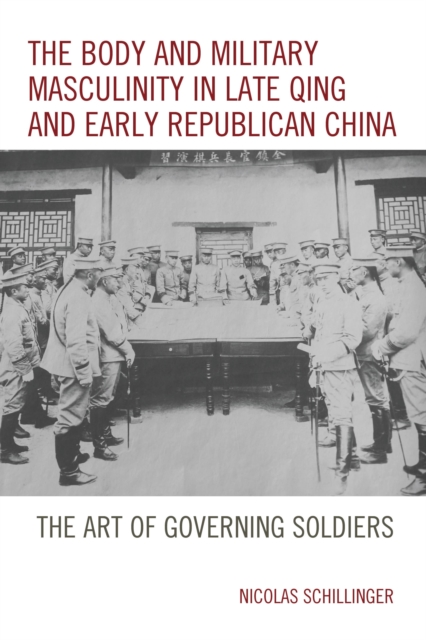
The body and military masculinity in late qing and early republican China
In 1894-1895, after suffering defeat against Japan in a war primarily fought over the control of Korea, the Qing government initiated fundamental military reforms and established \"New Armies\" modeled after the German and Japanese military.
eBook

War, Politics and Society in Early Modern China, 900-1795
This comprehensive survey of Chinese military history is the only book in English to span the significant years from 900 – 1795. Peter Lorge questions current theories on China’s relationship to war, and argues that war was the most important tool used by the Chinese in building and maintaining their empire.
Emphasizing the relationship between the military and politics, chapters are organised around specific military events and, Lorge argues, the strength of territorial claims and political impact of each dynasty were determined by their military capacity.
Ideal as a course adoption text for Asian military studies, this is also valuable for students of Chinese studies, military studies and Chinese history.
Peter Lorge is Senior Lecturer in Chinese History and Film at Vanderbilt University.
1. Unity Through War (900-1005) 2. Empires at Peace, Empires at War, 1005-1142 3. 1142-1272, Three Empires and A Century of War 4. A Chinese Empire? (1272-1355) 5. The Chinese Conquest Dynasty, 1355-1435 6. 1435-1610, The Politics of Imperial Collapse 7. 1610-1683, A People Created for War 8. 1684-1795, The Old Man of Ten Complete Military Victories
eBook


Eastern Fortress
Celebrated as a trading port, Hong Kong was also Britain’s “eastern fortress”. Likened by many to Gibraltar and Malta, the colony was a vital but vulnerable link in imperial strategy, exposed to a succession of enemies in a turbulent age and a troubled region. This book examines Hong Kong’s developing role in the Victorian imperial defence system, the emerging challenges from Russia, France, the United States, Germany, Japan and other powers, and preparations in the years leading up to the Second World War. A detailed chapter offers new interpretations of the Battle of Hong Kong of 1941, when the colony succumbed to the Japanese invasion. The remaining chapters discuss Hong Kong’s changing strategic role during the Cold War and the winding down of the military presence. The book not only focuses on policies and events, but also explores the social life of the garrison in Hong Kong, the struggles between military and civil authorities, and relations between the armed forces and civilians in Hong Kong. Drawing on original research in archives around the world, including English, Japanese, and Chinese sources, this is the first full-length study of the defence of Hong Kong from the beginning of the colonial period to the end of British military interests East of Suez in 1970. Illustrated with images and detailed maps, Eastern Fortress will be of interest to both students of history and general readers.
eBook