
Catalogue Search | MBRL


Are you sure you want to remove the book from the shelf?

{{itemTitle}}
586
result(s) for
"China Strategic aspects."
Sort by:

Chinese maritime power in the 21st century : strategic planning, policy and predictions
\"This book analyses China's maritime strategy for the 21st century, integrating strategic planning, policy thinking and strategic prediction. This book explains the construction and application of China's military, political, economic and diplomatic means for building maritime power, and predicts the future of China's maritime power by 2049, as well as development trends in global maritime politics. It explores both the strengths and the limitations of President Xi's 'Maritime Dream' and provides a candid assessment of the likely future balance at sea between China and the United States. This volume explains and discusses China's claims and intentions in the East and South China Seas and makes some recommendations for China's future policy that will lessen the chance of conflict with the United States and its closer neighbours. This book will be of much interest to students of maritime strategy, naval studies, Chinese politics and International Relations in general\"-- Provided by publisher.
Book

Xinjiang and China's Rise in Central Asia - A History
The recent conflict between indigenous Uyghurs and Han Chinese demonstrates that Xinjiang is a major trouble spot for China, with Uyghur demands for increased autonomy, and where Beijing’s policy is to more firmly integrate the province within China. This book provides an account of how China’s evolving integrationist policies in Xinjiang have influenced its foreign policy in Central Asia since the establishment of the People’s Republic in 1949, and how the policy of integration is related to China’s concern for security and its pursuit of increased power and influence in Central Asia.
The book traces the development of Xinjiang - from the collapse of the Qing empire in the early twentieth century to the present – and argues that there is a largely complementary relationship between China’s Xinjiang, Central Asia and grand strategy-derived interests. This pattern of interests informs and shapes China’s diplomacy in Central Asia and its approach to the governance of Xinjiang. Michael E. Clarke shows how China’s concerns and policies, although pursued with vigour in recent decades, are of long-standing, and how domestic problems and policies in Xinjiang have for a long time been closely bound up with wider international relations issues.
1. China and the Integration of Xinjiang: The History of a Permanent Provocation 2. Xinjiang from the Qing Conquest to the Republic of China, 1760-1949 3. Completing the Forbears Behest: The Resurgence of the State’s Integrationist Project under the PRC, 1949-1976 4. ‘Crossing the River by Feeling for the Stones’: Xinjiang in the ‘Reform’ Era, 1976-1990 5. Reaffirming Chinese Control in the Wake of Central Asia’s Transformation, 1991-1995 6. Biding Time and Building Capabilities: Xinjiang and Chinese Foreign Policy in Central Asia, 1996-2001 7. Walking on Three Legs: Balancing China’s Xinjiang, Central Asia and Grand Strategy Derived Interests, 2002-2009 8. The Integration of Xinjiang: Securing China’s ‘Silk Road’ to Great Power Status?
\"Overall, Clarke has done a wonderful job of piecing together a political history of Xinjiang’s strategic importance for Chinese policy in Central Asia. The achievement of Xinjiang and China’s Rise is in Clarke’s analysis, which is intelligent and comprehensive and offers a new perspective for framing Xinjiang in the larger global dynamics of contemporary politics.\" - Kristian Petersen, Ph.D., Gustavus Adolphus College; Journal of International and Global Studies
\"Clarke's book is indispensible for anyone interested China's ethnic relations, state formation, and foreign policy, especially during the communist regime. Summing Up: Essential. Upper-division undergraduates and above.\" -L. Teh, CHOICE (February 2012)
Michael E. Clarke is a Research Fellow at the Griffith Asia Institute, Griffith University, Australia. He is the co-editor of China, Xinjiang and Central Asia: History, Transition and Crossborder Interaction into the 21st Century (also published by Routledge).
eBook


A Glass Half Full?
How to stabilize the security relationship between Washington and Beijing.
The U.S.-China relationship has not always been smooth, but since Richard Nixon's opening in the early 1970s, the two countries have evolved a relationship that has been generally beneficial to both parties. Economic engagement and a diplomatic partnership together with robust trade and investment relations, among other activities, have meant a peaceful context for reform and China's rise, helping to lift millions of Chinese out of poverty and giving the PRC incentive to work within the U.S.-led global order.
The logic of the relationship, however, is now open to serious debate on both sides of the Pacific. After a period of American preoccupation with the Middle East, President Obama attempted a rebalancing of U.S. interests toward the Asia-Pacific region. With the Trump administration in office, the U.S.-China relationship appears to be at a crossroads: does it continue to focus on constructive engagement and managing differences, or prepare for a new era of rivalry and conflict?
Here, following up on their 2014 book,Strategic Reassurance and Resolve, the authors provide a more balanced assessment of the current state of relations and suggest measures that could help stabilize the security relationship, without minimizing the very real problems that both Beijing and Washington must address. The authors are hopeful, but are also under no illusions about the significance of the challenges now posed to the bilateral relationship, as well as regional order, by the rise of China and the responses of America together with its allies.
eBook

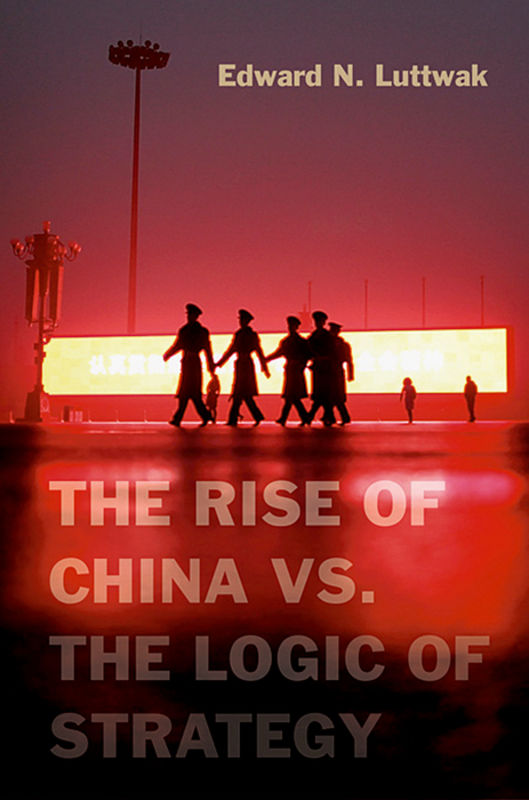
The Rise of China vs. the Logic of Strategy
As the rest of the world worries about what a future might look like under Chinese supremacy, Luttwak worries about China’s own future prospects. Applying the logic of strategy for which he is well known, he argues that the world’s second largest economy may be headed for a fall unless China’s leaders check their military ambitions.
eBook


Power, law, and maritime order in the South China Sea
Over the last few decades there has been growing recognition of the importance of a peaceful and stable South China Sea for Indo-Pacific security and development, a recognition that has been underlain, paradoxically, by the increasingly precarious situation in this body of water that straddles critical shipping lanes from the Indian to the Pacific.
eBook

China's strategic interests in the South China Sea : power and resources
\"Explores China's strategic interests in the South China Sea, with a specific emphasis on power projection and resource security. Contains sections on China's power and resources and case studies on Japan, Vietnam, the USA and the Philippines, and discusses how China's actions are reshaping the power dynamics in East and South-East Asia\"-- Provided by publisher.
Book

China’s Incomplete Military Transformation
Through extensive primary source analysis and independent analysis, this report seeks to answer a number of important questions regarding the state of China’s armed forces. The authors found that the PLA is keenly aware of its many weaknesses and is vigorously striving to correct them. Although it is only natural to focus on the PLA’s growing capabilities, understanding the PLA’s weaknesses—and its self-assessments—is no less important.
eBook