
Catalogue Search | MBRL


Are you sure you want to remove the book from the shelf?

{{itemTitle}}
19,735
result(s) for
"China rural"
Sort by:


The gender of memory
What can we learn about the Chinese revolution by placing a doubly marginalized group--rural women--at the center of the inquiry? In this book, Gail Hershatter explores changes in the lives of seventy-two elderly women in rural Shaanxi province during the revolutionary decades of the 1950s and 1960s. Interweaving these women's life histories with insightful analysis, Hershatter shows how Party-state policy became local and personal, and how it affected women's agricultural work, domestic routines, activism, marriage, childbirth, and parenting--even their notions of virtue and respectability. The women narrate their pasts from the vantage point of the present and highlight their enduring virtues, important achievements, and most deeply harbored grievances. In showing what memories can tell us about gender as an axis of power, difference, and collectivity in 1950s rural China and the present, Hershatter powerfully examines the nature of socialism and how gender figured in its creation.
eBook

Claiming homes : confronting domicide in rural China
\"Chinese citizens make themselves at home despite economic transformation, political rupture, and domestic dislocation in the contemporary countryside. By mobilizing labor and kinship to make claims over homes, people, and things, rural residents withstand devaluation and confront dispossession. As a particular configuration of red capitalism and socialist sovereignty takes root, this process challenges the relationship between the politics of place and the location of class in China and beyond\"-- Provided by publisher.
Book

Prosper or perish
The official banking institutions for rural China are Rural Credit Cooperatives (RCCs). Although these co-ops are mandated to support agricultural development among farm households, since 1980 half of RCC loans have gone to small and medium-sized industrial enterprises located in, and managed by, townships and villages. These township and village enterprises have experienced highly uneven levels of success, and by the end of the 1990s, half of all RCC loans were in or close to default, forcing China's central bank to bail out RCCs. InProsper or Perish, Lynette H. Ong examines the bias in RCC lending patterns, focusing on why the mobilization of rural savings has contributed to successful industrial development in some locales but not in others.
Interweaving insightful and theoretically informed discussions of rural credit, development, governance, and bank bailouts, Ong identifies various sources for China's uneven development. In the highly decentralized fiscal environment of the People's Republic, successful industrialization has significant implications for rural governance. Local governments depend on revenue from industrial output to provide public goods and services; unsuccessful enterprises starve local governments of revenue and result in radical cutbacks in services. High peasant burdens, land takings without adequate compensation by local governments, and other poor governance practices tend to be associated with unsuccessful industrialization. In light of the recent liberalization of the rural credit sector in China,Prosper or Perishmakes a significant contribution to debates within political science, economic development, and international banking.
eBook


Gender, Modernity and Male Migrant Workers in China
Rural-urban migration within China has transformed and reshaped rural people's lives during the past few decades, and has been one of the most visible phenomena of the economic reforms enacted since the late 1970s. Whilst Feminist scholars have addressed rural women's experience of struggle and empowerment in urban China, in contrast, research on rural men's experience of migration is a neglected area of study. In response, this book seeks to address the absence of male migrant workers as a gendered category within the current literature on rural-urban migration.
Examining Chinese male migrant workers' identity formation, this book explores their experience of rural-urban migration and their status as an emerging sector of a dislocated urban working class. It seeks to understand issues of gender and class through the rural migrant men's narratives within the context of China's modernization, and provides an in-depth analysis of how these men make sense of their new lives in the rapidly modernizing, post-Mao China with its emphasis on progress and development. Further, this book uses the men's own narratives to challenge the elite assumption that rural men's low status is a result of their failure to adopt a modern urban identity and lifestyle. Drawing on interviews with 28 male rural migrants, Xiaodong Lin unpacks the gender politics of Chinese men and masculinities, and in turn contributes to a greater understanding of global masculinities in an international context.
This book will be of great interest to students and scholars working in the fields of Chinese culture and society, gender studies, migration studies, sociology and social anthropology.
Shortlisted for this year's BSA Philip Abrams Memorial Prize.
eBook

The end of the village : planning the urbanization of rural China
\"How China's expansive new era of urbanization threatens to undermine the foundations of rural life. Centered on the mountainous region of Chongqing, which serves as an experimental site for the country's new urban development policies, The End of the Village analyzes the radical expansion of urbanization and its consequences for China's villagers. Offering an unprecedented look at the country's contentious shift in urban planning and policy, Nick R. Smith exposes the precarious future of rural life in China and suggests a critical reappraisal of how we think about urbanization.\"-- Provided by publisher.
BOOK

A Landscape of Travel
While the number of domestic leisure travelers has increased dramatically in reform-era China, the persistent gap between urban and rural living standards attests to ongoing social, economic, and political inequalities. The state has widely touted tourism for its potential to bring wealth and modernity to rural ethnic minority communities, but the policies underlying the development of tourism obscure some complicated realities. In tourism, after all, one person's leisure is another person's labor. A Landscape of Travel investigates the contested meanings and unintended consequences of tourism for those people whose lives and livelihoods are most at stake in China's rural ethnic tourism industry: the residents of village destinations. Drawing on ethnographic research conducted in Ping'an (a Zhuang village in Guangxi) and Upper Jidao (a Miao village in Guizhou), Jenny Chio analyzes the myriad challenges and possibilities confronted by villagers who are called upon to do the work of tourism. She addresses the shifting significance of migration and rural mobility, the visual politics of tourist photography, and the effects of touristic desires for \"exotic difference\" on village social relations. In this way, Chio illuminates the contemporary regimes of labor and leisure and the changing imagination of what it means to be rural, ethnic, and modern in China today.
eBook

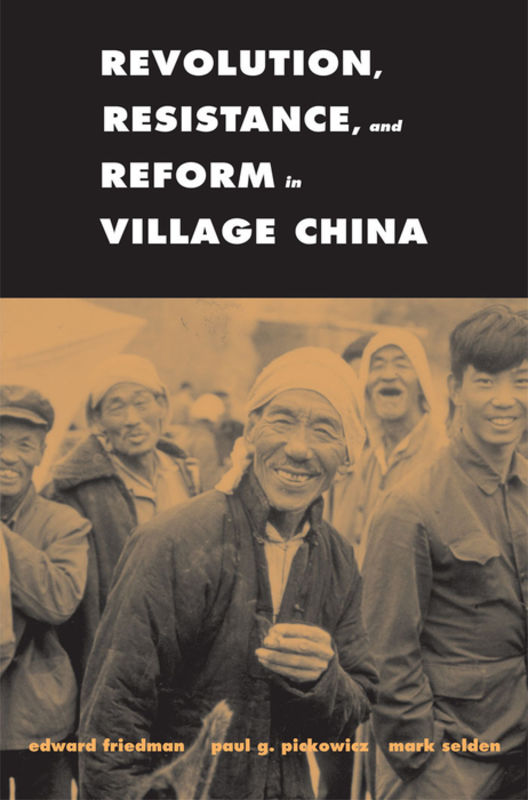
Revolution, Resistance, and Reform in Village China
Drawing on more than a quarter century of field and documentary research in rural North China, this book explores the contested relationship between village and state from the 1960s to the start of the twenty-first century. The authors provide a vivid portrait of how resilient villagers struggle to survive and prosper in the face of state power in two epochs of revolution and reform. Highlighting the importance of intra-rural resistance and rural-urban conflicts to Chinese politics and society in the Great Leap and Cultural Revolution, the authors go on to depict the dynamic changes that have transformed village China in the post-Mao era.This book continues the dramatic story in the authors' prizewinningChinese Village, Socialist State. Plumbing previously untapped sources, including interviews, archival materials, village records and unpublished memoirs, diaries and letters, the authors capture the struggles, pains and achievements of villagers across three generations of social upheaval.
eBook