
Catalogue Search | MBRL


Are you sure you want to remove the book from the shelf?

{{itemTitle}}
66
result(s) for
"Chinese characters Study and teaching."
Sort by:

The first 100 Japanese kanji : The quick and easy way to learn the basic japanese kanji
This is an invaluable study guide for learning basic Japanese characters. The first 100 Japanese Kanji is intended for beginning students, or experienced speakers who need to practice their written Japanese. Kanji are an essential part of the Japanese language and together with kana (hiragana and katakana) comprise the written component of Japanese. This book presents the kanji characters that are most commonly used. They have been carefully selected for rapid and effective learning. Each kanji's readings, meanings, and common compounds are presented, and romanized pronunciations for English speakers (romanji) are included as well. Printed with gray guidelines, stroke order guides are designed to be traced over to teach students the standard sequence of strokes used to write each character. Three indexes at the back allow the characters to be looked up as with a dictionary or by their readings. Students who wish to practice writing kanji will find extra practice sheets available. This book includes: Step-by-step stroke order diagrams for each character Special boxes with grid lines to practice writing characters Words and phrases using each kanji Romanizations (romanji) to help identify and pronounce every word.
eBook

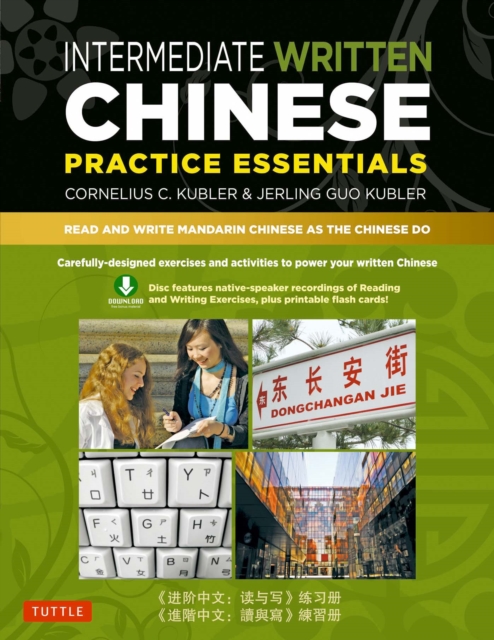
Intermediate Written Chinese Practice Essentials
Welcome to the world's most efficient method of learning Mandarin Chinese, whether you are striving to learn Chinese on your own or studying in a classroom setting.Part of the widely-used and highly acclaimed Kubler series, The Basic Chinese and Intermediate Chinese books provide separate but integrated \"tracks\" to help you learn to read, write and speak Chinese efficiently, at your own pace. Some students and teachers wish to emphasize speaking ability first, whereas others want to focus on learning to read and write Chinese at the same time. These Chinese language study books allow you the flexibility to acquire the spoken language and the written language with the method that best fits your needs. With the internationally-recognized Kubler system and accompanying downloadable content, you will: Learn to use 288 high-frequency Chinese characters, and over 700 popular words written with them Find yourself quickly reading and writing sentences with the correct Chinese grammar Be taught both simplified and traditional characters; you may choose to learn one or both Recognize a variety of fonts in both typeset and handwritten stylesBe prepared to use Chinese in many different contexts-from reading signs and newspapers, to computers and mobile phone texts Listen to hours of native-speaker recordings for free online, and have access to practice sheets and printable flashcardsIntermediate Written Chinese Practice Essentials stands out among Chinese books and textbooks for its dynamic study system and practical exercises, which will assist you in learning Chinese quickly and comfortably.
eBook

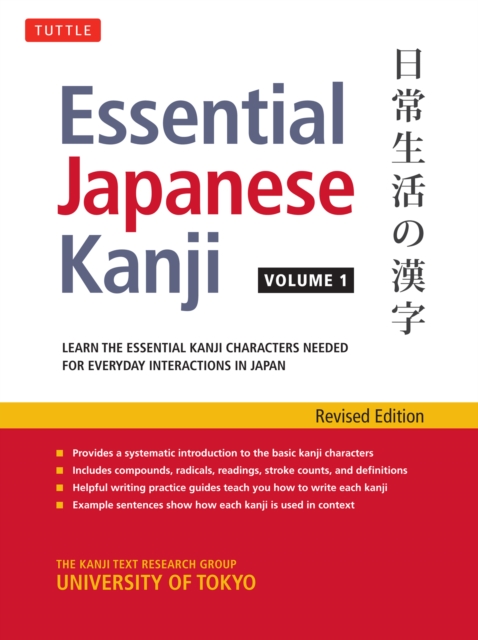
Essential Japanese Kanji Volume 1
Memorize tricky Japanese kanji with ease! Since its publication in 1993, this beginner Japanese workbook and textbook has been a hit with teachers and students for learning basic Japanese kanji characters. Speak, read and write Japanese with this newly revised edition that has been updated and expanded by members of the Kanji Text Research Group at the prestigious Tokyo University. Essential Japanese Kanji Volume 1 presents the 250 kanji characters that are most frequently found in many places in Japan, including: Street signs Restaurant menus Subway ticket machines ATMs Stroke order diagrams and writing practice squares present every kanji systematically alongside its various meanings, readings, vocabulary compounds and derivations. Extensive practice exercises and self-graded quizzes (with answer keys at the back) help you improve your skill at recognizing and using the kanji. In addition to the practical focus of learning the kanji in the context of actual situations, each chapter includes Advanced Placement (AP)-type exam questions mirroring the format of the College Board's Japanese Language and Culture examination. The captivating introduction explains the origins of the kanji and the Japanese kana phonetic alphabets. Appendices list the kanji in two ways--according to pronunciations and radicals--and a glossary of common vocabulary compounds.
eBook


The effect of applying augmented reality to Chinese character learning on novice CFL learners
Augmented Reality (AR) is believed a suitable teaching method for beginning-level Chinese as a Foreign Language (CFL) learners in learning Chinese characters, as the effects of AR on visualization may enhance recognition of pictographic characters and the integration of multimedia may facilitate comprehension of this logographic language. Yet the multimodal presentation may trigger different reactions in learners with distinct learning preference, including visual, aural, reading/writing, and kinesthetic (VARK) sensory modalities. This exploratory study aimed to investigate the effects and impacts of learning Chinese characters using AR application on beginning-level CFL learners, and took the impact of learning styles into consideration. Twenty-eight beginning-level Chinese as a foreign language (CFL) learner participated in the study, learning 24 Chinese characters with an AR application that demonstrated animated evolutionary processes. A Chinese character recognition test was implemented to evaluate the learning effects in terms of meaning identification and pinyin transliteration before and after the AR intervention. A VARK questionnaire was used to assess their preferred learning styles, and to cross-examine with the learning effects. The results showed significant improvements in the posttest, in particular the identification of character meanings. However, no significant difference was found in the test scores of the four modes of the VARK learning styles, though the learners with multimodal preferences that included the visual learning style had better scores.
Journal Article

Collins easy learning Mandarin Chinese characters
With thousands of characters to learn, beginning to read and write Chinese is a daunting task. Aimed at learners, this book explores 250 of the most common characters. The meaning of each is explained, along with information about its radical, the compound words it can form, its history, and more.
Book

A syllable-character collaborative model for enhanced Pinyin and Chinese recognition
In Chinese speech recognition, end-to-end speech recognition models usually use Chinese characters as direct output and perform poorly compared with other language models. The main reason for this phenomenon is that the relationship between Chinese text and pronunciation is more complex. Inspired by the learning process of Chinese beginners, who first master initials, finals, and pinyin before learning characters, we propose the Syllable-Character Collaborative Model (SCCM), which incorporates these phonetic elements into the training process. Additionally, we design a Pinyin-Ensemble module that employs an ensemble learning approach to reduce pinyin recognition errors, which in turn leads to a reduction in text recognition errors. Experiments on AISHELL-1 show that our approach not only reduces pinyin and character error rates compared to a prior end-to-end method using pinyin as auxiliary information, but also achieves a 45.7% relative reduction in Character Error Rate (CER) over the AISHELL-1 baseline.
Journal Article