
Catalogue Search | MBRL


Are you sure you want to remove the book from the shelf?

{{itemTitle}}
167
result(s) for
"Choreographers France."
Sort by:


Sunday : Pierre Droulers choreographer
Pierre Droulers, a pioneer of contemporary dance and choreographer of more than 30 works, celebrates 40 years of creation. Since the 1970s Droulers has contributed to the rise and flourishing of contemporary dance. As one of the first students to graduate from the Mudra School, he soon became a key player in the French and Belgian world of dance. Always in tune with the zeitgeist, he has right from his earliest days collaborated with emblematic artists such as jazz musician Steve Lacy, members of the underground scene including Winston Tong and Minimal Compact and the Beat poet Brion Gysin. Subsequently, Droulers has developed exchanges with visual artists, among others Michel Franًcois and Ann Veronica Janssens. This publication is an implicit portrait of the artist, but also of an era in which contemporary dance emerged. Based on quotes, archives, images, notes and artistic encounters, the monograph presents a delicate three-dimensional journey. With its collisions and entanglements of faces, landscapes, words, recurrences of obsessions and fantasies, it reveals zones of light and shade in Droulers's artistic world.
Book
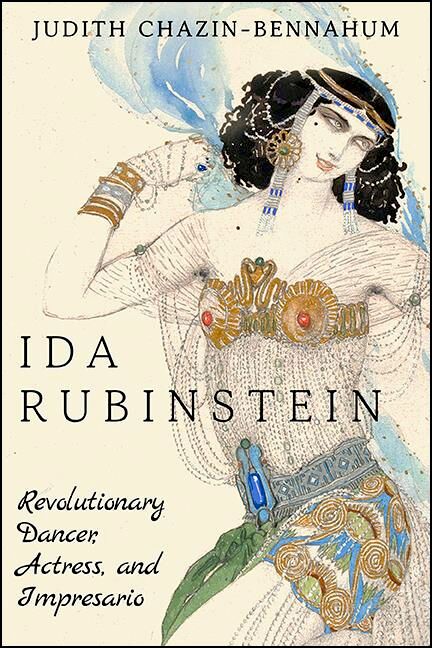
Ida Rubinstein
Ida Rubinstein (1883–1960) captivated Paris's dancers, composers, artists, and audiences from her time in the Ballets Russes in 1909 to her final performances in 1939. Trained in Russia as an actress and a dancer, her life spanned the artistic freedom of the Belle Époque through the ravages of World War I, the Depression, and finally World War II. This critical biography carefully examines aspects of Rubinstein's life and career that have previously received little attention. These include her early life in Russia, her writing about performance aesthetics, her curated approach to acting and dancing roles, and her encumbered position as a woman and a Jew. Rubinstein used her considerable fortune to produce dozens of plays, lyric creations, and ballets, making her one of the foremost producers of the first half of the twentieth century. Employing the greatest scenic artists, Léon Bakst and Alexander Benois; the distinguished composers Igor Stravinsky, Arthur Honegger, and Claude Debussy; celebrated writers including Paul Valéry and André Gide; and the brilliant choreographer Bronislava Nijinska, Rubinstein transformed twentieth-century theater and dance.
eBook


Maurice Bejart: a journey of initiation
\"The French-born dancer and choreographer Maurice Bejart is one of the great creative figures of modern dance. The hallmark of his ballets, from `Symphonie pour un homme seul' (1955) to `Nijinsky, Clown of God' (1990), has been a rejection of aestheticism in favour of dance as a universal language and total theatre. Here he talks about some of the themes that frequently crop up in his work.\" (UNESCO COURIER)
Journal Article


The Paris Opera Ballet Dancing Offstage
Abstract The spaces in which amateur and professional dancers practiced their art greatly changed during the Covid-19 pandemic due to the closures of theaters and dance studios, yet dance continued to bring people together online. This article studies the media presence of the Paris Opera Ballet (POB) between March 2020 and May 2021 to analyze how the aesthetic and moral concept of grace has evolved. During this difficult year, dance took on a therapeutic role as POB dancers offered free online classes and performed in video work, in addition to taking on a political role as discussions about racism in ballet sparked public debates.
Journal Article

Ballet and the harp
Choreographers, musicians, dramatists, composers, set designers, costumers and lighting designers all work together to make their collective visions manifest on stage. [...]as ballet evolved from an amusing entertainment for royalty to a profound statement of artistic expression, harpists have been and continue to be an important part of the whole, just as the art of ballet has exerted great influence on the evolution of the classical harp and its music over the last five hundred years. Initially, this staged art form of theatrical dance, music and drama was limited to invitation-only affairs in the palace or on its lawns. In 1661, dance enthusiast and participant King Louis XIV of France founded the Académie Royale de Danse (and then the Académie Royale de Musique in 1669) with teachers who codified what had become the conventional five foot positions, eight leg and arm positions, five arabesques, and the many steps and movements into what became, and still is, classical ballet technique. Even though her movements were limited by the long and confining costumes of the time, French ballerina Mlle La Fontaine's grace and charm opened the gate for more women in ballet's female roles and initiated profound changes in all aspects of ballet. Until the 1770s, ballet remained a component of opera. In this genre, music and dance partnered with the art of mime to tell stories and express emotions. Dance technique, music, and costume and set design all thrived and evolved during this creative and innovative time in ballet's history.
Journal Article

The Politics of Gender and the Revival of Ballet in Early Twentieth Century France
This essay, which is part of a larger project examining the revival of ballet in France, contextualizes critical responses to the ballet and its dancers within the greater debates and issues of the time concerning gender, athleticism, sexuality and the dancing body. It focuses on the ways in which shifts in gender ideology and attitudes toward the performing body affected the status of ballet and its recovery as a national art form. Ballet reentered the cultural consciousness of Western Europe and gained international allure between 1909 and 1938—a period when notions about the body, athleticism, nationalism, gender, sexuality, politics and the arts were being radically rethought and transformed. In this period, we find critics using ballet as a source through which to assert contemporary notions of gender, modernism and the nation. Through the illustration of shifting attitudes towards the female dancer, this essay reveals how both the transfiguration of gender ideology and new attitudes towards the corporeal body served as vital components in establishing the professionalization of ballet, the artistic legitimacy of its dancers, and, ultimately, the resurrection of a French art.
Journal Article