
Catalogue Search | MBRL


Are you sure you want to remove the book from the shelf?

{{itemTitle}}
35
result(s) for
"Christian literature, Latin (Medieval and modern) History and criticism."
Sort by:


Texts of the Passion
In this book Thomas H. Bestul constructs the literary history of the Latin Passion narratives, placing them within their social, cultural, and historical contexts. He examines the ways in which the Passion is narrated and renarrated in devotional treatises, paying particular attention to the modifications and enlargements of the narrative of the Passion as it is presented in the canonical gospels.
Of particular interest to Bestul are the representations of Jews, women, and the body of the crucified Christ. Bestul argues that the greatly enlarged role of the Jews in the Passion narratives of the twelfth and thirteenth centuries is connected to the rising anti-Judaism of the period. He explores how the representations of women, particularly the Virgin Mary, express cultural values about the place of women in late medieval society and reveal an increased interest in female subjectivity.
eBook

This is my body
The recipient of the annual Award for Outstanding Book in Theatre Practice and Pedagogy from the Association for Theatre in Higher Education, This Is My Body realigns representational practices in the early Middle Ages with current debates on the nature of representation. Michal Kobialkai's study views the medieval concept of representation as having been in flux and crossed by different modes of seeing, until it was stabilized by the constitutions of the Fourth Lateran Council in 1215. Kobialka argues that the concept of representation in the early Middle Ages had little to do with the tradition that considers representation in terms of Aristotle or Plato; rather, it was enshrined in the interpretation of Hoc est corpus meum [This is my body]—the words spoken by Christ to the apostles at the Last Supper—and in establishing the visibility of the body of Christ that had disappeared from view.
eBook

The idea of the theater in Latin Christian thought
This book considers medieval texts that deal with ancient theater as documents of Latin Christianity's intellectual history. As an exercise in medieval historiography, this study also examines biases in modern scholarship that seek links between these texts and performance practices. The effort to bring these texts together and place them in their intellectual contexts reveals a much more nuanced and contested discourse on Greco-Roman theater and medieval theatrical practice than has been acknowledged. The book is arranged chronologically and shows the medieval foundations for the Early Modern integration of dramatic theory and theatrical performance. The Idea of the Theater in Latin Christian Thought will be of interest to theater historians, intellectual historians, and those who work on points of contact between the European Middle Ages and Renaissance. The broad range of documents discussed (liturgical treatises, scholastic commentaries, philosophical tracts, and letters spanning many centuries) renders individual chapters useful to philosophers, aestheticians, and liturgists as well as to historians and historiographers. For theater historians, this study offers an alternative reading of familiar texts which may alter our understanding of the emergence of dramatic and theatrical traditions in the West. Because theater is rarely considered as a component of intellectual projects in the Middle Ages, this study opens a new topic in the writing of medieval intellectual history.
eBook

Hrotsvit of Gandersheim
Hrotsvit was the first dramatist of Christianity, the first female Saxon poet, the first Germanic author to employ the Faust theme, and one of the first Western writers to compose a Christian epic. The essays inHrotsvit of Gandersheimexamine the historical, cultural, legal, and political contexts of Hrotsvit's works, locating her opus within the tenth-century aristocratic and clerical intellectual milieu.
This collection contextualizes Hrotsvit's works with respect to heroic, sexual, domestic, behavioural, linguistic, theological, and hierarchical aspects of early medieval and patristic literary traditions. It also explores other literary texts that inform Hrotsvit's works and discusses the performance history and theatricality of Hrotsvit's plays.
Hrotsvit's keen awareness of contemporary issues and her determination, within the parameters of monastic-aristocratic ideological constraints, to provide her readers with a rich variety of exemplary female heroes and acts of personal courage, offer twenty-first-century readers a powerful model of responsibility and agency.
eBook

Macaronic sermons
Siegfried Wenzel's groundbreaking study seeks to describe and analyze the linguistically mixed, or macaronic, sermons in late fourteenth-century England. Not only are these works of considerable religious interest, they provide extensive information on their literary, linguistic, and cultural milieux. Macaronic Sermons begins by offering a typology of such works: those in which English words offer glosses, or offer structural functions, or offer neither of the two but yet are syntactically integrated. This last group is then examined in detail: reasons are given for this usage and for its origins, based on the realities of fourteenth-century England. Siefriend Wenzel draws valuable conclusions about the linguistic status quo of the era, together with the extent of education, the audiences' expectations, and the ways in which the authors' minds worked. Obviously of interest to scholars and students of early English literature, Macaronic Sermons also contains much valuable information for specialists in language development or oral theory, and for those interested in multicultural societies.
eBook

Epic Lives and Monasticism in the Middle Ages, 800–1050
This is the first book to focus on Latin epic verse saints' lives in their medieval historical contexts. Anna Taylor examines how these works promoted bonds of friendship and expressed rivalries among writers, monasteries, saints, earthly patrons, teachers and students in Western Europe in the central Middle Ages. Using philological, codicological and microhistorical approaches, Professor Taylor reveals new insights that will reshape our understanding of monasticism, patronage and education. These texts give historians an unprecedented glimpse inside the early medieval classroom, provide a nuanced view of the complicated synthesis of the Christian and Classical heritages, and show the cultural importance and varied functions of poetic composition in the ninth, tenth and eleventh centuries.
eBook

Latin epics of the New Testament : Juvencus, Sedulius, Arator
The topic of the book is three Christian epic poets of Late Antiquity who, though somewhat neglected in modern times, are notable in many ways, especially in their aim of harnessing the tradition of classical Latin epic to the task of presenting the New Testament to the learned readers, whether they be Christian believers or curious enquirers, perhaps put off by the style of Bible translations. This triad were pioneers in their time but their works would soon become staple ingredients of the medieval curriculum. The book carefully introduces each author, setting them in their own contexts and backgrounds (one was from the fourth, one from the fifth, and one from the sixth century), and examines their work in detail. Particular themes illustrated and discussed are their strategies in rendering, sometimes literally, sometimes not, the Biblical narratives, the ways in which they reflect and exploit the classical epic poets in their design, style and vocabulary, and the particular theological agendas which they may pursue, implicitly or explicitly. The book engages fully and critically with recent studies of Biblical epic and investigates critically and in detail numerous other questions. Full details of all modern studies that relate to these poets and their backgrounds are given in a large bibliography.
eBook
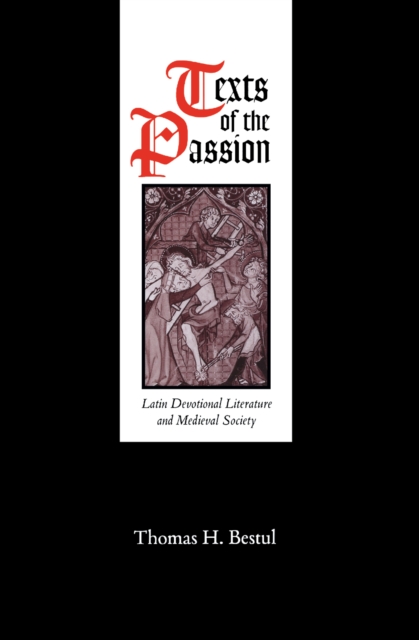
Texts of the passion : Latin devotional literature and medieval society
In this book Thomas H. Bestul constructs the literary history of the Latin Passion narratives, placing them within their social, cultural, and historical contexts. He examines the ways in which the Passion is narrated and renarrated in devotional treatises, paying particular attention to the modifications and enlargements of the narrative of the Passion as it is presented in the canonical gospels. Of particular interest to Bestul are the representations of Jews, women, and the body of the crucified Christ. Bestul argues that the greatly enlarged role of the Jews in the Passion narratives of the twelfth and thirteenth centuries is connected to the rising anti-Judaism of the period. He explores how the representations of women, particularly the Virgin Mary, express cultural values about the place of women in late medieval society and reveal an increased interest in female subjectivity.
eBook

Sexual Violence and Rape in the Middle Ages
Die neue englischsprachige Reihe zur Medivistik strebt eine methodisch reflektierte, anspruchsvolle Verbindung von Text- und Kulturwissenschaft an. Sie widmet sich den kulturellen Grundthemen der mittelalterlichen Welt aus der Perspektive der Literatur- und Geschichtswissenschaft. Grundthemen' sind die kulturprgenden Denkbilder, Weltanschauungen, Sozialstrukturen und Alltagsbedingungen des mittelalterlichen Lebens, also z. B. Kindheit und Alter, Sexualitt, Religion, Medizin, Rituale, Arbeit, Armut und Reichtum, Aberglauben, Erde und Kosmos, Stadt und Land, Krieg, Emotionen, Kommunikation, Reisen usw. Die Reihe greift wichtige aktuelle Fachdiskussionen auf und stellt ein Forum der interdisziplinren Mittelalter-Forschung dar. Fundamentals of Medieval and Early Modern Culture steht Sammelbnden ebenso offen wie Monographien. Intention ist immer, kompendienhafte Werke zu zentralen Fragen der mittelalterlichen Kulturgeschichte vorzulegen, die einen soliden berblick ber einen geschlossenen Themenkreis aus der Perspektive verschiedener Fachdisziplinen vermitteln. Im Ganzen bietet die Reihe so eine Enzyklopdie der mittelalterlichen Literatur- und Kulturgeschichte und ihrer Hauptthemen. Es werden ca. zwei Bnde pro Jahr erscheinen.
eBook