
Catalogue Search | MBRL


Are you sure you want to remove the book from the shelf?

{{itemTitle}}
74
result(s) for
"Christianity and literature -- Great Britain -- History -- 17th century"
Sort by:


The Maudlin Impression
Patricia Badir's The Maudlin Impression investigates
the figure of Mary Magdalene in post-medieval English religious
writings and visual representations. Badir argues that the medieval
Magdalene story was not discarded as part of Reformation
iconoclasm, but was enthusiastically embraced by English writers
and artists and retold in a wide array of genres. This rich study
bridges the historical division between medieval and early modern
culture by showing the ways in which Protestant writers, as well as
Catholics, used the medieval stories, art, and symbolism related to
the biblical Magdalene as resources for thinking about the role of
the affective and erotic in Christian devotion. Their literary and
artistic glosses protected a range of religious devotional
practices and lent embodied, tangible form to the God of the
Reformation. They employed the Magdalene figure to articulate
religious experience by means of a poetics that could avoid
controversial questions of religious art while exploring the
potency and appeal of the beautiful.
The Maudlin Impression is a literary history of
imitation and invention. It participates in the \"religious turn\" in
early modern studies by demonstrating the resilience of a single
topos across time and across changing Christian beliefs.
eBook

Alterations of State
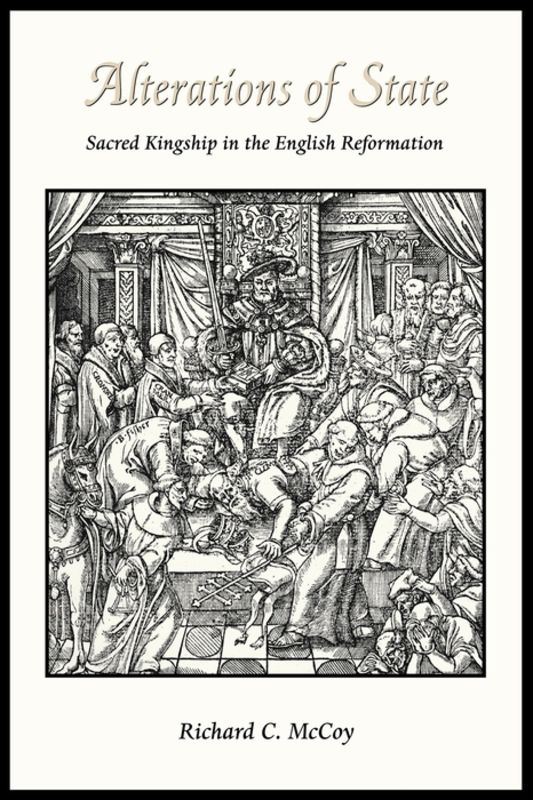
Traditional notions of sacred kingship became both more grandiose and more problematic during England's turbulent sixteenth and seventeenth centuries. The reformation launched by Henry VIII and his claims for royal supremacy and divine right rule led to the suppression of the Mass, as the host and crucifix were overshadowed by royal iconography and pageantry. These changes began a religious controversy in England that would lead to civil war, regicide, restoration, and ultimately revolution.
Richard McCoy shows that, amid these sometimes cataclysmic Alterations of State, writers like John Skelton, Shakespeare, John Milton, and Andrew Marvell grappled with the idea of kingship and its symbolic and substantive power. Their artistic representations of the crown reveal the passion and ambivalence with which the English viewed their royal leaders. While these writers differed on the fundamental questions of the day -- Skelton was a staunch defender of the English monarchy and traditional religion, Milton was a radical opponent of both, and Shakespeare and Marvell were more equivocal -- they shared an abiding fascination with the royal presence or, sometimes more tellingly, the royal absence.
Ranging from regicides real and imagined -- with the very real specter of the slain King Charles I haunting the country like a revenant of the king's ghost in Shakespeare's Hamlet -- from the royal sepulcher at Westminster Abbey to Peter Paul Reubens's Apotheosis of King James at Whitehall, and from the Elizabethan compromise to the Glorious Revolution, McCoy plumbs the depths of English attitudes toward the king, the state, and the very idea of holiness. He reveals how older notions of sacred kingship expanded during the political and religious crises that transformed the English nation, and helps us understand why the conflicting emotions engendered by this expansion have proven so persistent.
eBook
Representing Revolution in Milton and his Contemporaries
David Loewenstein's Representing Revolution in Milton and his Contemporaries is a wide-ranging exploration of the interactions of literature, polemics and religious politics in the English Revolution. Loewenstein highlights the powerful spiritual beliefs and religious ideologies in the polemical struggles of Milton, Marvell and their radical Puritan contemporaries during these revolutionary decades. By examining a wide range of canonical and non-canonical writers - John Lilburne, Winstanley the Digger and Milton, amongst others - he reveals how radical Puritans struggled with the contradictions and ambiguities of the English Revolution and its political regimes. His portrait of a faction-riven, violent seventeenth-century revolutionary culture is an original and significant contribution to our understanding of these turbulent decades and their aftermath. By placing Milton's great poems in the context of the period's radical religious politics, it should be of interest to historians as well as literary scholars.
eBook

The Cambridge Companion to Writing of the English Revolution
This collection of fifteen essays by leading scholars examines the extraordinary diversity and richness of the writing produced in response to, and as part of, the upheaval in the religious, political and cultural life of the nation which constituted the English Revolution. The turmoil of the civil wars fought out from 1639 to 1651, the shock of the execution of Charles I, and the uncertainty of the succeeding period of constitutional experiment were enacted and refigured in writing which both shaped and was shaped by the tumultuous times. The various strategies of this battle of the books are explored through essays on the course of events, intellectual trends and the publishing industry; in discussions of canonical figures such as Milton, Marvell, Bunyan and Clarendon; and in accounts of women's writing and of fictional and non-fictional prose. A full chronology, detailed guides to further reading and a glossary are included.
eBook
The Power of the Passive Self in English Literature, 1640–1770
Challenging recent work that contends that seventeenth-century English discourses privilege the notion of a self-enclosed, self-sufficient individual, The Power of the Passive Self in English Literature recovers a counter-tradition that imagines selves as more passively prompted than actively choosing. This tradition - which Scott Paul Gordon locates in seventeenth-century religious discourse, in early eighteenth-century moral philosophy, in mid eighteenth-century acting theory, and in the emergent novel - resists autonomy and defers agency from the individual to an external 'prompter'. Gordon argues that the trope of passivity aims to guarantee a disinterested self in a culture that was increasingly convinced that every deliberate action involves calculating one's own interest. Gordon traces the origins of such ideas from their roots in the non-conformist religious tradition to their flowering in one of the central texts of eighteenth-century literature, Samuel Richardson's Clarissa.
eBook


Faithful translators : authorship, gender, and religion in Early Modern England
With Faithful Translators Jaime Goodrich offers the first in-depth examination of women’s devotional translations and of religious translations in general within early modern England. Placing female translators such as Queen Elizabeth I and Mary Sidney Herbert, Countess of Pembroke, alongside their male counterparts, such as Sir Thomas More and Sir Philip Sidney, Goodrich argues that both male and female translators constructed authorial poses that allowed their works to serve four distinct cultural functions: creating privacy, spreading propaganda, providing counsel, and representing religious groups. Ultimately, Faithful Translators calls for a reconsideration of the apparent simplicity of \"faithful\" translations and aims to reconfigure perceptions of early modern authorship, translation, and women writers.
eBook