
Catalogue Search | MBRL


Are you sure you want to remove the book from the shelf?

{{itemTitle}}
18
result(s) for
"Christianity and politics -- Protestant churches -- History -- 20th century"
Sort by:


Latin America's Neo-Reformation
The purpose of this study is to focus on the intersection of religion and politics. Do different religions result in different politics? More specifically, are there significant contrasts between the political attitudes and behavior of Catholics and Protestants in Latin America?
eBook

Religion and American Foreign Policy, 1945–1960
The Cold War was in many ways a religious war. Presidents Truman and Eisenhower and other American leaders believed that human rights and freedom were endowed by God, that God had called the United States to defend liberty, and that Soviet communism was evil because of its atheism and enmity to religion. Along with security and economic concerns, these religious convictions helped determine both how the United States defined the enemy and how it fought the conflict. Meanwhile, American Protestant churches failed to seize the moment. Internal differences over theology and politics, and resistance to cooperation with Catholics and Jews, hindered Protestant leaders domestically and internationally. Frustrated by these internecine disputes, Truman and Eisenhower attempted to construct a new civil religion to mobilize domestic support for Cold War measures, determine the strategic boundaries of containment, unite all religious faiths against communism, and to undermine the authority of communist governments abroad.
eBook

For God and Globe
For God and Globerecovers the history of an important yet largely forgotten intellectual movement in interwar America. Michael G. Thompson explores the way radical-left and ecumenical Protestant internationalists articulated new understandings of the ethics of international relations between the 1920s and the 1940s. Missionary leaders such as Sherwood Eddy and journalists such as Kirby Page, as well as realist theologians including Reinhold Niebuhr, developed new kinds of religious enterprises devoted to producing knowledge on international relations for public consumption.For God and Globecenters on the excavation of two such efforts-the leading left-wing Protestant interwar periodical,The World Tomorrow, and the landmark Oxford 1937 ecumenical world conference. Thompson charts the simultaneous peak and decline of the movement in John Foster Dulles's ambitious efforts to link Christian internationalism to the cause of international organization after World War II.
Concerned with far more than foreign policy, Christian internationalists developed critiques of racism, imperialism, and nationalism in world affairs. They rejected exceptionalist frameworks and eschewed the dominant \"Christian nation\" imaginary as a lens through which to view U.S. foreign relations. In the intellectual history of religion and American foreign relations, Protestantism most commonly appears as an ideological ancillary to expansionism and nationalism.For God and Globechallenges this account by recovering a movement that held Christian universalism to be a check against nationalism rather than a boon to it.
eBook

Word across the Water
In Word Across the
Water , Tom Smith brings the histories of
Hawai'i and the Philippines together to argue that US imperial
ambitions towards these Pacific archipelagos were deeply
intertwined with the work of American Protestant
missionaries. As self-styled interpreters of history,
missionaries produced narratives to stoke interest in their cause,
locating US imperial interventions and their own evangelistic
projects within divinely ordained historical trajectories.
As missionaries worked in the shadow of their nation's empire,
however, their religiously inflected historical narratives came to
serve an alternative purpose. They emerged as a way for
missionaries to negotiate their own status between the imperial and
the local and to come to terms with the diverse spaces, peoples,
and traditions of historical narration that they encountered across
different island groups.
Word Across the Water encourages scholars of empire and
religion alike to acknowledge both the pernicious nature of
imperial claims over oceanic space underpinned by religious and
historical arguments, and the fragility of those claims on the
ground.
eBook
Steel City Gospel
Demonstrating the power religious language, ideas, and institutions had in shaping progressive reform in Pittsburgh, this cross-disciplinary study addresses significant debates in the fields of Progressive-Era political history and American religious history, while telling the story of an industrial city in a crucial era of change.
eBook

Minorities and Reconstructive Coalitions
As with Muslims today, Catholics were once suspected of being antidemocratic, oppressive of women, and supportive of extremist political violence. By the end of the twentieth century, Catholics were considered normal and sometimes valorized as exemplary citizens. Can other ethnic, racial, and religious minorities follow the same path? Minorities and Reconstructive Coalitions provides an answer by comparing the stories of ethnic Catholics' political incorporation in Australia, Canada, and the United States. Through comparative and historical analysis, the book shows that reconstructive coalitions, such as labor and pan-Christian moral movements, can bring Catholics and Protestants together under new identities, significantly improving Catholic standing. Not all coalitions are reconstructive or successful, and institutional structures such as regional autonomy can enhance or inhibit the formation of these coalitions. The book provides overviews of the history of Catholics in the three countries, reorients the historiography of Catholic incorporation in the United States, uncovers the phenomenon of minority overrepresentation in politics, and advances unique arguments about the impact of coalitions on minority politics.
eBook
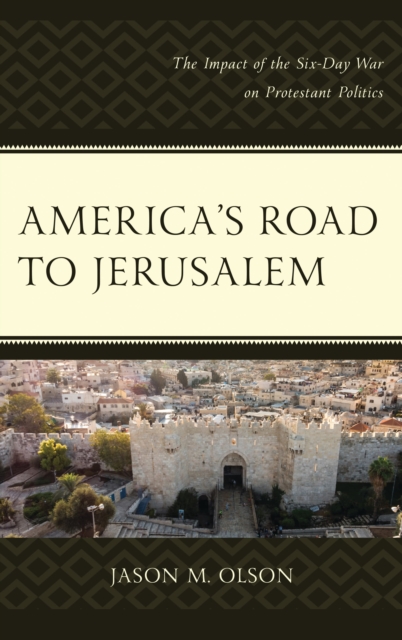
America's Road to Jerusalem
This study examines the role of the Six-Day War in American Protestant politics and culture.The author argues that American foreign policy towards the Arab-Israeli conflict, culminating in the Trump Administration's 2017 recognition of Jerusalem as Israel's capital, and the domestic Evangelical communities who supported it, has a direct.
eBook
A Protestant church in communist China
Freedom of religious belief is guaranteed under the constitution of the People’s Republic of China, but the degree to which this freedom is able to be exercised remains a highly controversial issue. Much scholarly attention has been given to persecuted underground groups such as Falun, but one area that remains largely unexplored is the relationship between officially registered churches and the communist government. This study investigates the history of one such official church, Moore Memorial Church in Shanghai. This church was founded by American Methodist missionaries. By the time of the 1949 revolution, it was the largest Protestant church in East Asia, running seven day a week programs. As a case study of one individual church, operating from an historical (rather than theological) perspective, this study examines the experience of people at this church against the backdrop of the turbulent politics of the Mao and Deng eras. It asks and seeks to answer questions such as: were the people at the church pleased to see the foreign missionaries leave? Were people forced to sign the so-called “Christian manifesto”? Once the church doors were closed in 1966, did worshipers go underground? Why was this particular church especially chosen to be the first re-opened in Shanghai in 1979? What explanations are there for its phenomenal growth since then? A considerable proportion of the data for this study is drawn from Chinese language sources, including interviews, personal correspondence, statistics, internal church documents and archives, many of which have never previously been published or accessed by foreign researchers. The main focus of this study is on the period from 1949 to 1989, a period in which the church experienced many ups and downs, restrictions and limitations. The Mao era, in particular, remains one of the least understood and seldom written about periods in the history of Christianity in China. This study therefore makes a significant contribution to our evolving understanding of the delicate balancing act between compromise, co-operation and compliance that categorizes church-state relations in modern China.
eBook

HUMAN RIGHTS AS RADICAL ANTHROPOLOGY: PROTESTANT THEOLOGY AND ECUMENISM IN THE TRANSWAR ERA
From the 1920s through the 1940s, European and Anglo-American Protestants perceived a crisis of humanity. While trying to determine religion's role in a secular age, church leaders redefined the human being as a theological person in community with others and in partnership with God. This new anthropology contributed to a personalist conception of human rights that rivalled Catholic and secular conceptions. Alongside such innovations in post-liberal theology, ecumenical Protestants organized a series of meetings to unite the world churches. Their conference at Oxford in July 1937 led to the creation of the World Council of Churches. Thus, Protestants of the transwar era supplied the two main ingredients of any human rights regime: a universalist commitment to defending individual human beings regardless of race, nationality, or class and a global institutional framework for enacting that commitment. Through the story of Protestant thinkers and activists, this article recasts the history of human rights as part of a larger history of critical reappraisals of humanity. Understanding why human rights came into prominence at various twentieth-century moments may require abandoning ‘rights talk’ for human talk, or, a comparative history of radical anthropologies and their relationship to broader socio-economic, political, and cultural crises.
Journal Article