
Catalogue Search | MBRL


Are you sure you want to remove the book from the shelf?

{{itemTitle}}
4
result(s) for
"Christianity and politics Italy Rome History To 1500."
Sort by:

The virtues of economy : governance, power, and piety in late medieval Rome
\"This book explores the transformation of Roman political culture from c.1350 to c.1450, and its implications for the history of the city, the Papacy, and the modern state. Specifically, it examines the gradual transition of Roman political elites from a commitment to governing Rome as a free city-commune to a willingness to act as the governing agents of a sovereign papacy. It emphasizes that understanding this transition requires recognition of Roman political engagement not merely with a civic society, constituted of citizens of the city-commune, but with the broader political society of Rome in its guise as the spiritual capital of Latin Christendom. Through an analysis of the transformative effects of everyday Roman politics, this book reframes the story of the establishment of papal sovereignty in Rome as the product of synergy between papal ambitions and local political culture\"-- Provided by publisher.
Book

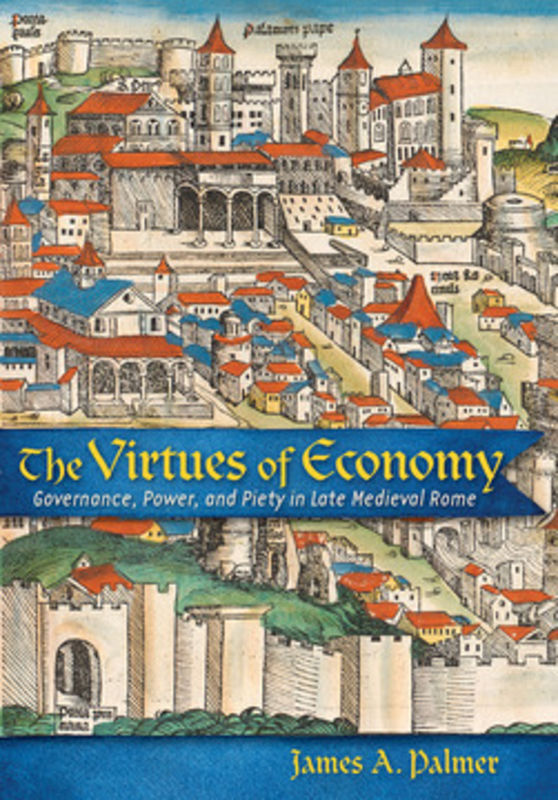
The Virtues of Economy
The humanist perception of fourteenth-century Rome as a slumbering ruin awaiting the Renaissance and the return of papal power has cast a long shadow on the historiography of the city. Challenging this view, James A. Palmer argues that Roman political culture underwent dramatic changes in the late Middle Ages, with profound and lasting implications for city's subsequent development. The Virtues of Economy examines the transformation of Rome's governing elites as a result of changes in the city's economic, political, and spiritual landscape. Palmer explores this shift through the history of Roman political society, its identity as an urban commune, and its once-and-future role as the spiritual capital of Latin Christendom. Tracing the contours of everyday Roman politics, The Virtues of Economy reframes the reestablishment of papal sovereignty in Rome as the product of synergy between papal ambitions and local political culture. More broadly, Palmer emphasizes Rome's distinct role in evolution of medieval Italy's city-communes.
eBook
Court and Politics in Papal Rome, 1492–1700
This 2002 book attempts to overcome the traditional historiographical approach to the role of the early modern papacy by focusing on the actual mechanisms of power in the papal court. The period covered extends from the Renaissance to the aftermath of the peace of Westphalia in 1648 - after which the papacy was reduced to a mainly spiritual role. Based on research in Italian and other European archives, the book concentrates on the factions at the Roman court and in the college of cardinals. The sacred college came under great international pressure during the election of a new pope, and consequently such figures as foreign ambassadors and foreign cardinals are examined, as well as political liaisons and social contacts at court. Finally, the book includes an analysis of the ambiguous nature of Roman ceremonial, which was both religious and secular: a reflection of the power struggle both in Rome and in Europe.
eBook