
Catalogue Search | MBRL


Are you sure you want to remove the book from the shelf?

{{itemTitle}}
42,675
result(s) for
"Church and education."
Sort by:


A Pedagogy of Faith
This is the first book-length study in English to investigate Freire’s landmark educational theory and practice through the lens of his lifelong Catholicism. A Pedagogy of Faith explores this often-overlooked dimension of one of the most globally prominent and influential educational thinkers of the past fifty years. Leopando illustrates how vibrant currents within twentieth-century Catholic theology shaped central areas of Freire’s thought and activism, especially his view of education as a process of human formation in light of the divinely-endowed “vocation” of persons to shape culture, society, and history. With the contemporary resurgence of authoritarian political and cultural forces throughout much of the world, Freire’s theologically-grounded affirmation of radical democracy, social justice, historical possibility, and the absolute dignity of the human person remains as vital and relevant as ever.
eBook


The Edinburgh History of Education in Scotland
Leading historians discuss the distinctive and internationally significant history of Scottish education
The excellence of Scottish education is, as it is commonly understood, 'held to be absolute'. One of the key national 'myths' has emphasised the quality, distinctiveness and accessibility of educational institutions north of the Border. The 'democratic intellect', the 'lad o'pairts' and other aspects of the Scottish educational tradition have been identified as key elements of national identity.
In this book, a range of authors consider the truth behind the 'myth', and between them tell the story of the development of Scottish education over a period lasting almost a millenium. From the medieval origins of the Scottish universities, to the development of parish schooling after the Reformation, to the reforms of the nineteenth century, to the radical extension of educational participation throughout the twentieth century, this book traces the emergence of the complex educational structure of today's Scotland out of all these legacies.
Key FeaturesThe first multi-authored history of education in Scotland that covers the whole of its medieval and modern historyAn unrivalled group of historians and social scientists with extensive expertise in Scottish historySets new agendas for the future of historical research in Scotland
eBook


Long Eclipse
Taking a social and cultural history approach, Gidney argues that for much of the twentieth century a liberal Protestant establishment imparted its own particular vision of moral and intellectual purpose to denominational and non-denominational campuses alike. Examining administrators' pronouncements, the moral regulation of campus life, and student religious clubs, she demonstrates that Protestant ideals and values were successfully challenged only in the post-World War II period when a number of factors, including a loosening of social mores, a more religiously diverse student body, and the ascent of the multiversity finally eroded Protestant hegemony. Only in the late 1960s, however, can one begin to speak of a university whose public voice was predominantly secular and where the voice of liberal Protestantism had been reduced to one among many.
eBook

American Indian/First Nations schooling : from the Colonial period to the present
\"Tracing the history of Native American schooling in North America, this book emphasizes factors in society at large--and sometimes within indigenous communities--which led to Native American children being separate from the white majority. Charles Glenn examines the evolving assumptions about race and culture as applied to schooling, the reactions of parents and tribal leadership in the United States and Canada, and the symbolic as well as practical role of indigenous languages and of efforts to maintain them\"-- Provided by publisher.
Book

Church, state, and the control of schooling in Ireland. 1900 - 1944
In the final two decades of British rule in Ireland the Roman Catholic Church saw its pre-eminent role in the control of schooling threatened by the secularist and democratic reforms of the imperial administration. Consequently, the Catholic bishops increasingly viewed the success of the nationalist movement as the best guarantee of the continuation of the educational status quo. The nationalist alliance proved a key element in obstructing proposed reforms in the pre-independence period - a period characterized by church-state hostility. In this volume Dr Titley examines the institutional continuity of the Irish school system, focusing on the role of the church as educational power broker. He shows how, in the congenial atmosphere of the new Irish state, the secular and ecclesiastical authorities shared the same educational philosophy and view of the role of religion in the schools. He argues that the church jealously guarded its educational hegemony because of the important role played by the schools in producing candidates for the religious life and an unquestioning middle class. Dr Titley also suggests that the failure of the secularist ideology to make headway in education proves that the Irish revolution was, in reality, a conservative reaction which insulated the country from modernizing influences. This volume is an important contribution to educational theory and to the cultural history of modern Ireland.
eBook

Leadership and religious schools : international perspectives and challenges
\"Leadership in religious schools is a complex and often misunderstood subject. Educational leaders must perform the dual task of encouraging religious identities while relating them to wider issues of citizenship. Religious identity needs to be made relevant to the whole school community--parents, staff, students--and leaders need to take care to expand how human identity is conceived and manifested. Given these challenges, learning and leadership take on a special importance in faith-based and religious schools. This unique volume brings together leading international scholars in the field to explore the many dimensions of leadership: religious, faith, spiritual, ministerial, educational, and curriculum leadership. The contributors demonstrate, through case studies and grounded theory, that these schools require leaders who are conversant with a very wide range of styles and issues. Other issues discussed include styles of leadership, relationships with stakeholders, motivation, satisfaction and stress, school culture, and ethos and charisma. This is an insightful collection of essays that will be of great use to all those studying and researching school leadership\"-- Provided by publisher.
Book
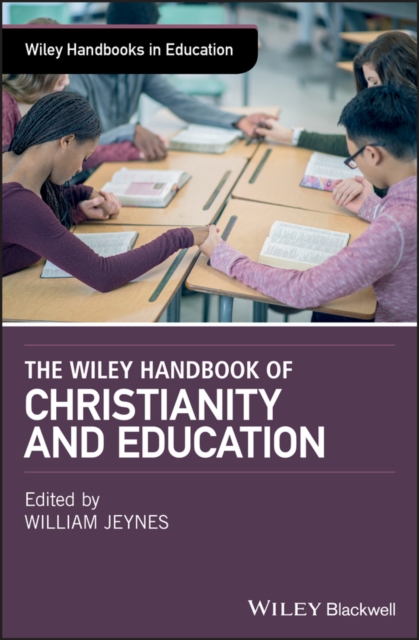
The Wiley Handbook of Christianity and Education
A comprehensive source that demonstrates how 21st century Christianity can interrelate with current educational trends and aspirations
The Wiley Handbook of Christianity and Education provides a resource for students and scholars interested in the most important issues, trends, and developments in the relationship between Christianity and education. It offers a historical understanding of these two intertwined subjects with a view to creating a context for the myriad issues that characterize—and challenge—the relationship between Christianity and education today.
Presented in three parts, the book starts with thought-provoking essays covering major issues in Christian education such as the movement away from God in American education; the Christian paradigm based on love and character vs. academic industrial models of American education; why religion is good for society, offenders, and prisons; the resurgence of vocational exploration and its integrative potential for higher education; and more. It then looks at Christianity and education around the globe—faith-based schooling in a pluralistic democracy; religious expectations in the Latino home; church-based and community-centered higher education; etc. The third part examines how humanity is determining the relationship between Christianity and education with chapters covering the use of Christian paradigm of living and learning; enrollment, student demographic, and capacity trends in Christian schools after the introduction of private schools; empirical studies on the perceptions of intellectual diversity at elite universities in the US; and more.
* Provides the breadth and depth of knowledge necessary to gain a sophisticated and nuanced understanding of the complex relationship between Christianity and education and its place in contemporary society
* A long overdue assessment of the subject, one that takes into account the enormous changes in Christian education
* Presents a global consideration of the subject
* Examines Christian education across elementary, secondary, and post-secondary levels
The Wiley Handbook of Christianity and Education will be of great interest to Christian educators in the academic world, the teaching profession, the ministry, and the college and graduate level student body.
eBook