
Catalogue Search | MBRL


Are you sure you want to remove the book from the shelf?

{{itemTitle}}
7,044
result(s) for
"Church finance"
Sort by:

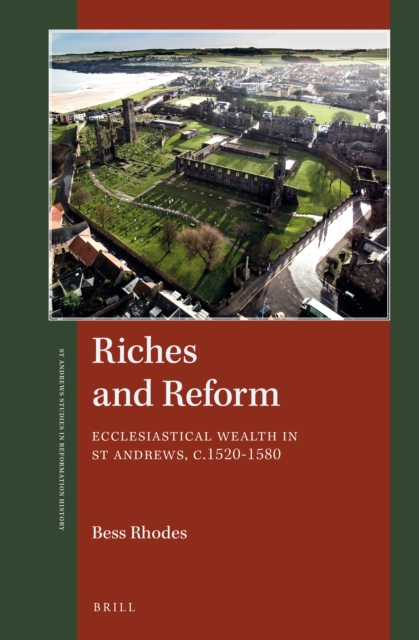
Riches and Reform: Ecclesiastical Wealth in St Andrews, C.1520-1580
The Scottish Reformation is often presumed to have had little economic impact. Traditionally, scholars maintained that Scotland's late medieval church gradually secularised its estates, and that the religious changes of 1560 barely disrupted an ongoing trend. In Riches and Reform Bess Rhodes challenges this assumption with a study of church finance in Scotland's religious capital of St Andrews, a place once regarded as the 'cheif and mother citie of the Realme'. Drawing on largely unpublished charters, rentals, and account books, Riches and Reform argues that in St Andrews the Reformation triggered a rapid, large-scale, and ultimately ruinous redistribution of ecclesiastical wealth. Communal assets built up over generations were suddenly dispersed through a combination of official policies, individual opportunism, and a crisis in local administration, leading the post-Reformation churches and city of St Andrews into 'poverte and decay'.
eBook
Guidelines Finance
The goal of the ministry of finance is to fund ministries that nurture persons in their faith. The finance system in the congregation will raise, manage, and disperse the funds of the congregation that help realize the mission and vision of the church. This Guideline is designed to help equip you in leading this ministry group in your congregation.This is one of the twenty-six Guidelines for Leading Your Congregation 2017-2020 that cover church leadership areas including Church Council and Small Membership Church; the administrative areas of Finance and Trustees; and ministry areas focused on nurture, outreach, and witness including Worship, Evangelism, Stewardship, Christian Education, age-level ministries, Communications, and more.
eBook
The e-Giving Guide for Every Church
The purpose of this book is to help churches raise more money for ministry and mission by better using electronic media. Although philanthropy in the US is growing, churches continue to receive a declining portion of that philanthropy. Part of the challenge is that America is becoming significantly less dependent on paper currency (cash and checks) yet the church continues to count on paper currency as their primary media for donations. There have been warning signals for several years. Many churches face shrinking budgets and membership and are beginning to ask the right questions. The author's goal is to capture this teachable moment with a resource that will encourage pastors and church leaders to utilize tools already available to change the trajectory of their resourcing; because nothing is more important than what God has called them to do.The banking and electronic giving industries have not made it easy for churches to understand their services or fees. This book will take the confusion and fear away and open churches to new possibilities.
eBook


Vermögen der Kirche - Vermögende Kirche?
Mit Paulus ruft uns die Kirche auch heute zu: ,,Ich suche ja nicht euer Geld, sondern euch!\" (2 Kor 12,14). Angesichts einer relativ vermögenden deutschen und österreichischen Kirche, die die Kirchensteuer bzw. den Kirchenbeitrag einhebt, wird dem einen oder anderen dieser Satz vielleicht als purer Sarkasmus erscheinen. Doch auch Paulus hat Geld für die Jerusalemer Gemeinde gesammelt und war wirtschaftlich gesehen nicht untüchtig. Was hat Paulus also anders gemacht als die Kirche von heute? Wäre es vielleicht besser, wenn die Kirche arm und unvermögend ist? Wäre sie dann nicht auch tatsächlich in mancher Hinsicht ,,unvermögend\"? Was und wieviel vermag eine vermögende Kirche in der gegenwärtigen Zeit zu bewirken?.
eBook
The crisis in the churches : spiritual malaise, fiscal woe
At a time when already overworked clergy are being called upon by budget cutting politicians to do more for the poor, the sick, and the elderly, American churches are suffering persistent financial shortfalls. In fact, contrary to popular media images of millionaire televangelists, America’s churches are cutting back programs and staff, clergy salaries are stagnating, and many parishes are having trouble raising enough money to keep the church lit and heated on Sunday. Why are America’s churches in financial distress? Robert Wuthnow, a leading commentator on religious life in America, asserts that the steady drop in donations, volunteering, and personal involvement is a direct result of a spiritual crisis--a crisis caused in large part by the clergy’s failure to address the vital relationships between faith and money, work, stewardship, giving, and economic justice. In The Crisis in the Churches, Wuthnow offers a searching study of this financial crisis and of the spiritual vacuum that has silently grown worse during the past decade. To do this, he lets the churches speak for themselves, quoting extensively from interviews with clergy and laity in sixty Protestant and Catholic congregations throughout the U.S., and drawing from the texts of over 200 sermons, from church financial records, and a national survey. What emerges is that parishioners often feel the church does not care about what they do from Monday to Friday, offers no guidance in their most pressing day to day concerns, yet always seems to be asking for more money. Clergy, for their part, say they hesitate to talk about finances because they know “the money question” makes people uncomfortable. But failure to raise the subject often makes it necessary to cut the very programs and services that middle class parishioners desire and would support. Wuthnow argues that in order to survive, churches must find ways to minister to the economic concerns of their own middle class parishioners. Indeed, of every $1,000 received by churches, $900 comes from people who work in middle class occupations. Clearly, anything that motivates middle class members to become more involved will strengthen a church’s financial well being and capacity to serve its people. Although the situation is critical, Wuthnow finds much cause for hope. He points to ideas and programs that some churches have enacted to challenge their members to think differently about work and money and giving. Parishioners sometimes respond positively when clergy speak boldly and concretely about matters of faith and finance, and some churches have formed small groups whose members meet regularly to discuss issues of spirituality, work, personal finances, and stewardship. A serious and sympathetic examination of the crisis behind the stained glass, this thought-provoking volume will be highly valuable both practically and as moral support to clergy, parishioners, and anyone else concerned about restoring vitality and significance to American churches.
eBook
Guidelines Trustees
Your role as trustee is governed by The Book of Discipline. Being a trustee of your local church is an important role and one in which you can take great pleasure. This Guideline is intended to be a guide as you begin fulfilling your responsibilities, and a reference throughout your tenure as trustee.This is one of the twenty-six Guidelines for Leading Your Congregation 2017-2020 that cover church leadership areas including Church Council and Small Membership Church; the administrative areas of Finance and Trustees; and ministry areas focused on nurture, outreach, and witness including Worship, Evangelism, Stewardship, Christian Education, age-level ministries, Communications, and more.
eBook

Riches and Reform
In Riches and Reform Bess Rhodes explores the ruinous financial consequences of the Reformation in Scotland's ecclesiastical capital of St Andrews, tracing how the religious changes of the sixteenth century triggered economic crisis and eventual urban decline.
eBook

Christianity and social service in modern Britain : the disinherited spirit
An elegantly written study that charts the relationship between Christianity and social service in Britain since the eighteenth century and presents a challenging new interpretation of the links between Christian decline and democratic traditions.
eBook