
Catalogue Search | MBRL


Are you sure you want to remove the book from the shelf?

{{itemTitle}}
21
result(s) for
"Chypre Histoire."
Sort by:


Divided Cities
In Jerusalem, Israeli and Jordanian militias patrolled a fortified, impassable Green Line from 1948 until 1967. In Nicosia, two walls and a buffer zone have segregated Turkish and Greek Cypriots since 1963. In Belfast, \"peaceline\" barricades have separated working-class Catholics and Protestants since 1969. In Beirut, civil war from 1974 until 1990 turned a cosmopolitan city into a lethal patchwork of ethnic enclaves. In Mostar, the Croatian and Bosniak communities have occupied two autonomous sectors since 1993. These cities were not destined for partition by their social or political histories. They were partitioned by politicians, citizens, and engineers according to limited information, short-range plans, and often dubious motives. How did it happen? How can it be avoided?
Divided Citiesexplores the logic of violent urban partition along ethnic lines-when it occurs, who supports it, what it costs, and why seemingly healthy cities succumb to it. Planning and conservation experts Jon Calame and Esther Charlesworth offer a warning beacon to a growing class of cities torn apart by ethnic rivals. Field-based investigations in Beirut, Belfast, Jerusalem, Mostar, and Nicosia are coupled with scholarly research to illuminate the history of urban dividing lines, the social impacts of physical partition, and the assorted professional responses to \"self-imposed apartheid.\" Through interviews with people on both sides of a divide-residents, politicians, taxi drivers, built-environment professionals, cultural critics, and journalists-they compare the evolution of each urban partition along with its social impacts. The patterns that emerge support an assertion that division is a gradual, predictable, and avoidable occurrence that ultimately impedes intercommunal cooperation. With the voices of divided-city residents, updated partition maps, and previously unpublished photographs,Divided Citiesilluminates the enormous costs of physical segregation.
eBook

The island of missing trees
\"Two teenagers, a Greek Cypriot and a Turkish Cypriot, meet at a taverna on the island they both call home. In the taverna, hidden beneath garlands of garlic, chili peppers and creeping honeysuckle, Kostas and Defne grow in their forbidden love for each other. A fig tree stretches through a cavity in the roof, and this tree bears witness to their hushed, happy meetings and eventually, to their silent, surreptitious departures. The tree is there when war breaks out, when the capital is reduced to ashes and rubble, and when the teenagers vanish. Decades later, Kostas returns. He is a botanist looking for native species, but really, he's searching for lost love. Years later a Ficus carica grows in the back garden of a house in London where Ada Kazantzakis lives. This tree is her only connection to an island she has never visited -- her only connection to her family's troubled history and her complex identity as she seeks to untangle years of secrets to find her place in the world. A moving, beautifully written, and delicately constructed story of love, division, transcendence, history, and eco-consciousness, The Island of Missing Trees is Elif Shafak's best work yet.\"-- Jacket flap
Book

Cyprus
Vassilis K. Fouskas and Alex O. Tackie provide a non-partisan approach to the Cyprus issue that goes beyond the perceptions of ruling elites on the island and their NATO masters, which are historically responsible for the division of Cyprus today. Fouskas and Tackie argue that the rise to power of two left-wing parties on both sides of the Green Line means it is time to launch a serious political dialogue to initiate a post-imperial constitutional process. This is a feasible undertaking, not least because Cyprus is a member of the EU, but not a member of NATO. Short and accessible, this book aims to revive a debate in the spirit of Dervis Ali Kavatzoglou and Constantine Misiaoulis, popular symbols of a united, democratic and independent Cyprus.
eBook


Divided Cyprus : modernity, history, and an island in conflict
[U]shers the reader into the complexities of the categorical
ambiguity of Cyprus [and]... concentrates... on the Dead Zone of the divided
society, in the cultural space where those who refuse to go to the poles
gather. -- Anastasia Karakasidou, Wellesley College The
volatile recent past of Cyprus has turned this island from the idyllic island
of Aphrodite of tourist literature into a place renowned for hostile
confrontations. Cyprus challenges familiar binary divisions, between Christianity
and Islam, Greeks and Turks, Europe and the East, tradition and modernity.
Anti-colonial struggles, the divisive effects of ethnic nationalism, war, invasion,
territorial division, and population displacements are all facets of the notorious
Cyprus Problem. Incorporating the most up-to-date social and cultural research on
Cyprus, these essays examine nationalism and interethnic relations, Cyprus and the
European Union, the impact of immigration, and the effects of tourism and
international environmental movements, among other topics.
eBook
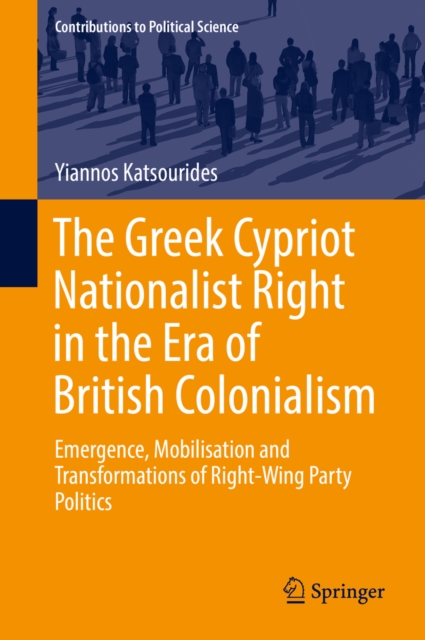
The Greek Cypriot Nationalist Right in the Era of British Colonialism
This book analyses the processes and factors that contributed to the emergence and eventual consolidation of the Greek Cypriot Right in the era of British colonialism. It seeks to understand political developments in Cyprus in the period extending from 1900 to 1955 with regard to their social, ideological and economic determinants. By examining changing forms of political life, a general reconstitution of the political sphere and a specific set of changes in the ideology and organisation of the Greek Cypriots, the author offers a framework for analysing Greek Cypriot right-wing party politics, identifying its sources of mobilisation and main actors such as the Church of Cyprus, and understanding its subsequent transformations.
eBook

Materia Magica
This exciting new study draws on objects excavated or discovered in the late nineteenth or early twentieth century at three Mediterranean sites. Through the three case studies,Materia Magicaidentifies specific forms of magic that may be otherwise unknown. It isolates the practitioners of magic and examines whether magic could be used as a form of countercultural resistance. Andrew T. Wilburn discovers magic in the objects of ancient daily life, suggesting that individuals frequently turned to magic, particularly in crises. Local forms of magic may have differed, and Wilburn proposes that the only way we can find small-town sorcerers is through careful examination of the archaeological evidence.
Studying the remains of spells enacted by practitioners, Wilburn's work unites the analysis of the words written on artifacts and the physical form of these objects. He situates these items within their contexts, to study how and why they were used.Materia Magicaapproaches magic as a material endeavor, in which spoken spells, ritual actions, and physical objects all played vital roles in the performance of a rite.
Materia Magicadevelops a new method for identifying and interpreting the material remains of magical practice by assessing artifacts within their archaeological contexts. Wilburn suggests that excavations undertaken in recent centuries can yield important lessons about the past, and he articulates the ways in which we can approach problematic data.
eBook

Past in Pieces: Belonging in the New Cyprus
On April 23, 2003, to the surprise of much of the world, the ceasefire line that divides Cyprus opened. The line had partitioned the island since 1974, and so international media heralded the opening of the checkpoints as a historic event that echoed the fall of the Berlin Wall. As in the moment of the Wall's collapse, cameras captured the rush of Cypriots across the border to visit homes unwillingly abandoned three decades earlier. It was a euphoric moment, and one that led to expectations of reunification. But within a year Greek Cypriots overwhelmingly rejected at referendum a United Nations plan to reunite the island, despite their Turkish compatriots' support for the plan. InThe Past in Pieces, anthropologist Rebecca Bryant explores why the momentous event of the opening has not led Cyprus any closer to reunification, and indeed in many ways has driven the two communities of the island further apart. This chronicle of the \"new Cyprus\" tells the story of the opening through the voices and lives of the people of one town that has experienced conflict. Over the course of two years, Bryant studied a formerly mixed town in northern Cyprus in order to understand both experiences of life together before conflict and the ways in which the dissolution of that shared life is remembered today. Tales of violation and loss return from the past to shape meanings of the opening in daily life, redefining the ways in which Cypriots describe their own senses of belonging and expectations of the political future. By examining the ways the past is rewritten in the present, Bryant shows how even a momentous opening may lead not to reconciliation but instead to the discovery of new borders that may, in fact, be the real ones.
eBook

Tradition and Innovation in the Ancient Near East
In July, 2011, the International Association for Assyriology met in Rome, Italy, for 5 days to deliver and listen to papers on the theme \"Tradition and Innovation in the Ancient Near East\". This volume, the proceedings of the conference, contains more than 40 of the papers read at the 57th annual Rencontre, including 3 plenary lectures/papers, many papers directly connected with the theme, as well as a workshop on parents and children. The papers covered every period of Mesopotamian history, from the third millennium through the end of the first millennium B.C.E. The attendees were warmly hosted by faculty and students from the Università di Roma \"La Sapienza\".
eBook