
Catalogue Search | MBRL


Are you sure you want to remove the book from the shelf?

{{itemTitle}}
34
result(s) for
"Cities and towns, medieval, in literature."
Sort by:

Urban panegyric and the transformation of the medieval city, 1100-1300
This study offers the first extensive analysis of the function and significance of urban panegyric in the Central Middle Ages, a flexible literary genre which enjoyed a marked and renewed popularity in the period 1100 to 1300. In doing so, it connects the production of urban panegyric to major underlying transformations in the medieval city and explores praise of cities primarily in England, Flanders, France, Germany, Iberia, and Italy (including the South and Sicily). The volume demonstrates how laudatory ideas on the city appeared in extremely diverse textual formats which had the potential to interact with a wide audience via multiple textual and material sources. When contextualized within the developments of the twelfth and thirteenth centuries these ideas could reflect more than formulaic, rhetorical outputs for an educated elite, they were instead integral to the process of urbanisation. In Urban Panegyric and the Transformation of the Medieval City, 1100-1300, Paul Oldfield assesses the generation of ideas on the Holy City, on counter-narratives associated with the Evil City, on the inter-relationship between the City and abundance (primarily through discourses on commercial productivity, hinterlands and population size), on0landscapes and sites of power, and on knowledge generation and the construction of urban histories.
Book
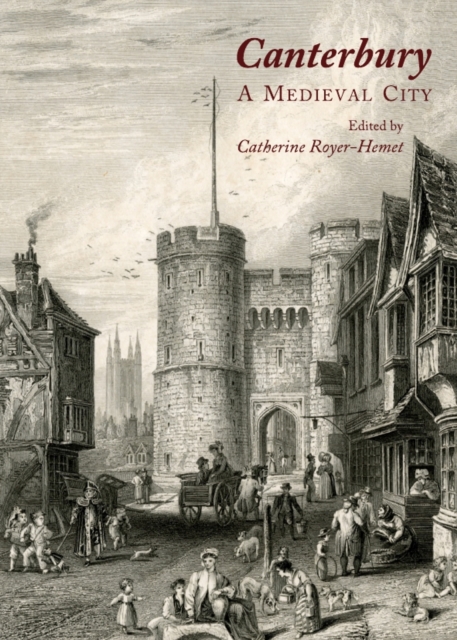
Canterbury
Between the Celtic tribe of the Iron Age the Cantiaci and the twenty-first-century inhabitants of Canterbury, three millenia stand during which the city has been enjoying unparalleled fame, particularly since it became the religious heart of the country in 597 AD. While ambling through the streets of modern Canterbuy, one is able to if careful enough to do so get the feel of the medieval city. There must be reasons for that enduring impact of the past and it might be because of the ov.
eBook

On the Causes of the Greatness and Magnificence of Cities
This edition of the treatise - which includes an introduction by Geoffrey W. Symcox on the intellectual context within which it was conceived - is a must-read for anyone interested in the life of cities both historical and contemporary.
eBook

Urban Space in the Middle Ages and the Early Modern Age
Although the city as a central entity did not simply disappear with the Fall of the Roman Empire, the development of urban space at least since the twelfth century played a major role in the history of medieval and early modern mentality within a social-economic and religious framework. Whereas some poets projected urban space as a new utopia, others simply reflected the new significance of the urban environment as a stage where their characters operate very successfully. As today, the premodern city was the locus where different social groups and classes got together, sometimes peacefully, sometimes in hostile terms. The historical development of the relationship between Christians and Jews, for instance, was deeply determined by the living conditions within a city. By the late Middle Ages, nobility and bourgeoisie began to intermingle within the urban space, which set the stage for dramatic and far-reaching changes in the social and economic make-up of society. Legal-historical aspects also find as much consideration as practical questions concerning water supply and sewer systems. Moreover, the early modern city within the Ottoman and Middle Eastern world likewise finds consideration. Finally, as some contributors observe, the urban space provided considerable opportunities for women to carve out a niche for themselves in economic terms.
eBook

Interpreting Urban Spaces in Italian Cultures
Made up of both material and symbolic elements, the urban space is always dynamic and transitional; it brings together or separates the past and the present, the public and the private, the center and the periphery. The present volume focuses on the interaction between the social processes and spatial forms that shape the identity of Italian cities. Using both canonical and less well-known texts along with cultural artifacts, the essays in the volume deprovincialize the Italian city, interpreting the material and symbolic practices that have made it into a unique entity whose enduring influence extends far outside Italy.
eBook

Cities of Destruction
Erika Gottlieb and E. J. Brown have both argued that Huxley’s Brave New World (1932) and Orwell’s Nineteen Eighty-Four (1949) owe varying degrees of debt to Zamyatin’s dystopian novel We (1921). In the following article it will be argued that the narrative structures and characters of both these British novels constitute more fundamentally a secular transformation of John Bunyan’s The Pilgrim’s Progress (1678), but incorporate elements of futility and pessimism not present to the original religious allegory, due to liberal humanist and democratic values replacing the religious vision.
Journal Article

Reproducing Athens
Reproducing Athens examines the role of romantic comedy, particularly the plays of Menander, in defending democratic culture and transnational polis culture against various threats during the initial and most fraught period of the Hellenistic Era. Menander's romantic comedies--which focus on ordinary citizens who marry for love--are most often thought of as entertainments devoid of political content. Against the view, Susan Lape argues that Menander's comedies are explicitly political. His nationalistic comedies regularly conclude by performing the laws of democratic citizen marriage, thereby promising the generation of new citizens. His transnational comedies, on the other hand, defend polis life against the impinging Hellenistic kingdoms, either by transforming their representatives into proper citizen-husbands or by rendering them ridiculous, romantic losers who pose no real threat to citizen or city.
eBook

Medieval Practices of Space
The contributors to this volume cross disciplinary and theoretical boundaries to read the words, metaphors, images, signs, poetic illusions, and identities with which medieval men and women used space and place to add meaning to the world. Contributors: Kathleen Biddick, Charles Burroughs, Michael Camille, Tom Conley, Donnalee Dox, Jody Enders, Valerie K. J. Flint, Andrzej Piotrowski, and Daniel Lord Smail.
eBook

Reading Ruins: Arthurian Caerleon and the Untimely Architecture of History
This article considers the literary deployment of the ruins of Caerleon within the Itinerarium Cambriae of Gerald of Wales. In describing the city, Gerald significantly notes both its Galfridian status as an Arthurian rival to Rome and the Roman origins of the city itself. Read in the context of Gerald's own re-reading of Geoffrey of Monmouth's Historia, the episode reveals Gerald's deployment of an Arthurian past and place as commentary upon the present colonial space of Wales.
Journal Article

Bound by the City
Explores the connections between sexual difference and political structure in ancient Greek tragedy.
eBook