
Catalogue Search | MBRL


Are you sure you want to remove the book from the shelf?

{{itemTitle}}
1,509
result(s) for
"Citizenship America History."
Sort by:


Forging People
Forging People explores the way in which Hispanic
American thinkers in Latin America and Latino/a philosophers in the
United States have posed and thought about questions of race,
ethnicity, and nationality, and how they have interpreted the most
significant racial and ethnic labels used in Hispanic America in
connection with issues of rights, nationalism, power, and identity.
Following the first introductory chapter, each of the essays
addresses one or more influential thinkers, ranging from Bartolomé
de Las Casas on race and the rights of Amerindians; to Simón
Bolívar's struggle with questions of how to forge a nation from
disparate populations; to modern and contemporary thinkers on
issues of race, unity, assimilation, and diversity. Each essay
carefully and clearly presents the views of key authors in their
historical and philosophical context and provides brief
biographical sketches and reading lists, as aids to students and
other readers.
Forging People is an indispensable resource for anyone
who works, teaches, or is interested in the thought, history, and
social situation of Latin America and the views of Latinos residing
in the United States.
eBook


The Practice of Citizenship
In the years between the American Revolution and the U.S. Civil War, as legal and cultural understandings of citizenship became more racially restrictive, black writers articulated an expansive, practice-based theory of citizenship. Grounded in political participation, mutual aid, critique and revolution, and the myriad daily interactions between people living in the same spaces, citizenship, they argued, is not defined by who one is but, rather, by what one does.In The Practice of Citizenship, Derrick R. Spires examines the parallel development of early black print culture and legal and cultural understandings of U.S. citizenship, beginning in 1787, with the framing of the federal Constitution and the founding of the Free African Society by Absalom Jones and Richard Allen, and ending in 1861, with the onset of the Civil War. Between these two points he recovers understudied figures such as William J. Wilson, whose 1859 \"Afric-American Picture Gallery\" appeared in seven installments in The Anglo-African Magazine, and the physician, abolitionist, and essayist James McCune Smith. He places texts such as the proceedings of black state conventions alongside considerations of canonical figures such as Frances Ellen Watkins Harper and Frederick Douglass.Reading black print culture as a space where citizenship was both theorized and practiced, Spires reveals the degree to which concepts of black citizenship emerged through a highly creative and diverse community of letters, not easily reducible to representative figures or genres. From petitions to Congress to Frances Harper's parlor fiction, black writers framed citizenship both explicitly and implicitly, the book demonstrates, not simply as a response to white supremacy but as a matter of course in the shaping of their own communities and in meeting their own political, social, and cultural needs.
eBook


How race is made in America
How Race Is Made in America examines Mexican Americans—from 1924, when American law drastically reduced immigration into the United States, to 1965, when many quotas were abolished—to understand how broad themes of race and citizenship are constructed. These years shaped the emergence of what Natalia Molina describes as an immigration regime, which defined the racial categories that continue to influence perceptions in the United States about Mexican Americans, race, and ethnicity. Molina demonstrates that despite the multiplicity of influences that help shape our concept of race, common themes prevail. Examining legal, political, social, and cultural sources related to immigration, she advances the theory that our understanding of race is socially constructed in relational ways—that is, in correspondence to other groups. Molina introduces and explains her central theory, racial scripts, which highlights the ways in which the lives of racialized groups are linked across time and space and thereby affect one another. How Race Is Made in America also shows that these racial scripts are easily adopted and adapted to apply to different racial groups.
eBook


Transnational Palestine : migration and the right of return before 1948
Tens of thousands of Palestinians migrated to the Americas in the final decades of the nineteenth century and early decades of the twentieth. By 1936, an estimated 40,000 Palestinians lived outside geographic Palestine. Transnational Palestine is the first book to explore the history of Palestinian immigration to Latin America, the struggles Palestinian migrants faced to secure Palestinian citizenship in the interwar period, and the ways in which these challenges contributed to the formation of a Palestinian diaspora and to the emergence of Palestinian national consciousness.
Nadim Bawalsa considers the migrants' strategies for economic success in the diaspora, for preserving their heritage, and for resisting British mandate legislation, including citizenship rejections meted out to thousands of Palestinian migrants. They did this in newspapers, social and cultural clubs and associations, political organizations and committees, and in hundreds of petitions and pleas delivered to local and international governing bodies demanding justice for Palestinian migrants barred from Palestinian citizenship. As this book shows, Palestinian political consciousness developed as a thoroughly transnational process in the first half of the twentieth century—and the first articulation of a Palestinian right of return emerged well before 1948.
eBook

Legacy of the lash : race and corporal punishment in the Brazilian Navy and the Atlantic World
\"Legacy of the Lash is a compelling social and cultural history of the Brazilian navy in the decades preceding and immediately following the 1888 abolition of slavery in Brazil. Focusing on non-elite, mostly black enlisted men and the oppressive labor regimes under which they struggled, the book is an examination of the four-day Revolta da Chibata (Revolt of the Lash) of November 1910, during which nearly half of Rio de Janeiro's enlisted men rebelled against the use of corporal punishment in the navy. These men seized four new, powerful warships, turned their guns on Rio de Janeiro, Brazil's capital city, and held its population hostage until the government abolished the use of the lash as a means of military discipline. Although the revolt succeeded, the men involved paid dearly for their actions. This event provides a clear lens through which to examine racial identity, violence, masculinity, citizenship, modernity, and the construction of the Brazilian nation\"-- Provided by publisher.
Book
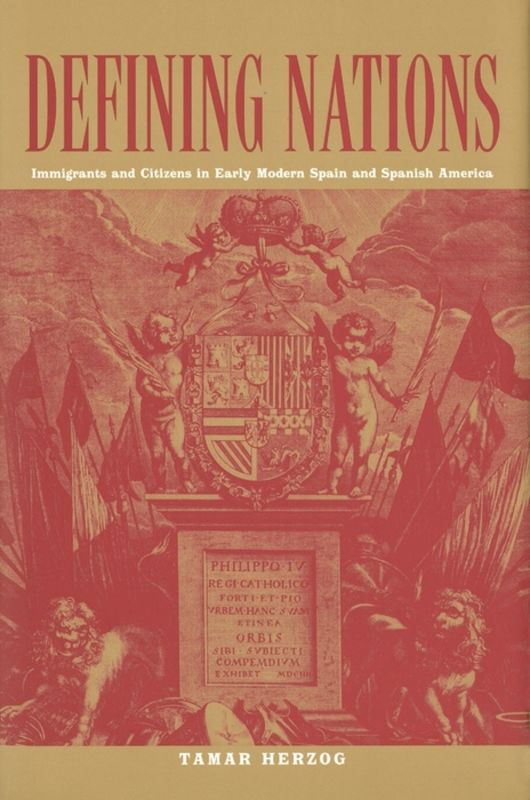
Defining Nations
In this book Tamar Herzog explores the emergence of a specifically Spanish concept of community in both Spain and Spanish America in the eighteenth century. Challenging the assumption that communities were the natural result of common factors such as language or religion, or that they were artificially imagined, Herzog reexamines early modern categories of belonging. She argues that the distinction between those who were Spaniards and those who were foreigners came about as local communities distinguished between immigrants who were judged to be willing to take on the rights and duties of membership in that community and those who were not.
eBook