
Catalogue Search | MBRL


Are you sure you want to remove the book from the shelf?

{{itemTitle}}
278
result(s) for
"Civil Rights Act of 1964"
Sort by:

Equality on Trial
In 1964, as part of its landmark Civil Rights Act, Congress outlawed workplace discrimination on the basis of such personal attributes as sex, race, and religion. This provision, known as Title VII, laid a new legal foundation for women's rights at work. Though President Kennedy and other lawmakers expressed high hopes for Title VII, early attempts to enforce it were inconsistent. In the absence of a consensus definition of sex equality in the law or society, Title VII's practical meaning was far from certain.The first history to foreground Title VII's sex provision, Equality on Trial examines how the law's initial promise inspired a generation of Americans to dispatch expansive notions of sex equality. Imagining new solidarities and building a broad class politics, these workers and activists engaged Title VII to generate a pivotal battle over the terms of democracy and the role of the state in all labor relationships. But the law's ambiguity also allowed for narrow conceptions of sex equality to take hold. Conservatives found ways to bend Title VII's possible meanings to their benefit, discovering that a narrow definition of sex equality allowed businesses to comply with the law without transforming basic workplace structures or ceding power to workers. These contests to fix the meaning of sex equality ultimately laid the legal and cultural foundation for the neoliberal work regimes that enabled some women to break the glass ceiling as employers lowered the floor for everyone else.Synthesizing the histories of work, social movements, and civil rights in the postwar United States, Equality on Trial recovers the range of protagonists whose struggles forged the contemporary meanings of feminism, fairness, and labor rights.
eBook


Paths Out of Dixie: The Democratization of Authoritarian Enclaves in America's Deep South, 1944-1972
The transformation of the American South--from authoritarian to democratic rule--is the most important political development since World War II. It has re-sorted voters into parties, remapped presidential elections, and helped polarize Congress. Most important, it is the final step in America's democratization.Paths Out of Dixieilluminates this sea change by analyzing the democratization experiences of Georgia, Mississippi, and South Carolina.
Robert Mickey argues that Southern states, from the 1890s until the early 1970s, constituted pockets of authoritarian rule trapped within and sustained by a federal democracy. These enclaves--devoted to cheap agricultural labor and white supremacy--were established by conservative Democrats to protect their careers and clients. From the abolition of the whites-only Democratic primary in 1944 until the national party reforms of the early 1970s, enclaves were battered and destroyed by a series of democratization pressures from inside and outside their borders. Drawing on archival research, Mickey traces how Deep South rulers--dissimilar in their internal conflict and political institutions--varied in their responses to these challenges. Ultimately, enclaves differed in their degree of violence, incorporation of African Americans, and reconciliation of Democrats with the national party. These diverse paths generated political and economic legacies that continue to reverberate today.
Focusing on enclave rulers, their governance challenges, and the monumental achievements of their adversaries,Paths Out of Dixieshows how the struggles of the recent past have reshaped the South and, in so doing, America's political development.
eBook
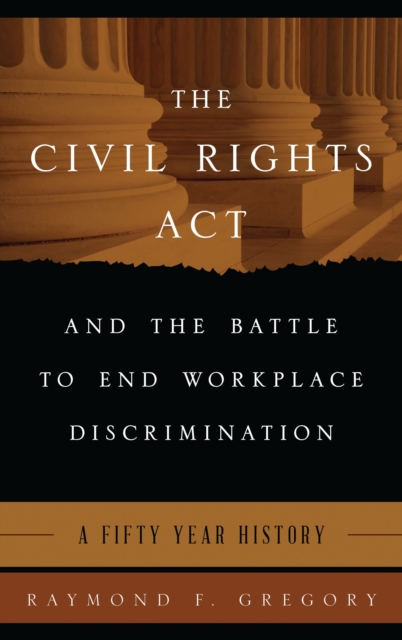
The Civil Rights Act and the battle to end workplace discrimination
On the fiftieth anniversary of the Civil Rights Act of 1964, Raymond F. Gregory evaluates our progress towards the full implementation of Title VII, which prohibits discrimination in the workplace, and how the law has come to protect against discrimination based on more than just race, but on gender, age, ethnicity, and sexual orientation.
eBook

Inferentialism, Title VII, and Legal Concepts
We are all textualists now, or so it has been claimed. But textualism, the practice of interpreting statutes solely by reference to their words, is often associated with conservative judicial outcomes. This is especially true when a focus on statutory text is combined with the belief that the meanings of words are fixed. This combination creates a sort of textualist originalism, in which judges interpret statutes in accordance with what the words of a statute meant to the relevant linguistic community at the time of a statute's enactment.
In reaction to this conservative interpretive method, rejecting textualism but keeping an originalist commitment to fixed meanings provides one possible progressive response. Rather than focusing primarily on the statute's language, one might instead look to the statute's animating logic, purpose, or potential to create certain moral or economic outcomes. But rejecting a focus on statutory text is not the only progressive response to the originalist textualist. A second approach accepts that the meanings of statutes derive from text but denies that statutory text has a meaning that is fixed and unchanging. Often, advocates of this latter approach run into difficulty specifying how and when the meanings of words used in statutes change. And some might worry that any such account will leave judges too much room to determine that the meanings of a statute's words have changed, thus enabling judges to express their policy preferences through the act of statutory interpretation.
This Comment addresses the second approach. It engages with a particular account in philosophy of language that views meanings as resulting from inferential connections among concepts. Inferentialism suggests that we can think of these inferential connections as constitutive of meaning and thus think of meaning as in a real sense responsive to the on-the-ground effects of using a particular word. As those effects change, as new inferential connections are recognized, so too change the meanings of words. This Comment argues that this repeated process of changed inferential significance provides us with an account of dynamic meaning that judges can take notice of but not impose themselves upon. It thus provides a methodology through which judges can read statutory text to mean something new or different without thereby merely expressing a political preference.
Journal Article

Identity Politics within Kentucky’s Civil Service and the Growth of the Bureaucratic State
For five decades now the various levels of government in the United States, through the use of affirmative action and diversity policies, have sought a more racially and gender-wise equitable society with respect to equal employment opportunity. Governments established hiring goals for women and racial minorities. Goals became quotas as state and local governments (and private employers) that were dependent on federal money made certain that goals produced desired results by preferring people based on their race or gender. This article is a case study of how the Commonwealth’s welfare cabinet over two decades ago used long-standing civil service regulations and policies to pursue preferential employment practices while conterminously pursuing greater societal equity by reducing governmental oversight of welfare programs. All this foreshadowed President Biden’s iteration of affirmative action—federal equity directives regarding employment preferences and greater conditions of equality. After the events described herein, Democratic Kentucky transformed itself into a Republican state.
Journal Article

The Politics of Women's Rights
Here Christina Wolbrecht boldly demonstrates how the Republican and Democratic parties have helped transform, and have been transformed by, American public debate and policy on women's rights. She begins by showing the evolution of the positions of both parties on women's rights over the past five decades. In the 1950s and early 1960s, Republicans were slightly more favorable than Democrats, but by the early 1980s, the parties had polarized sharply, with Democrats supporting, and Republicans opposing, such policies as the Equal Rights Amendment and abortion rights. Wolbrecht not only traces the development of this shift in the parties' relative positions--focusing on party platforms, the words and actions of presidents and presidential candidates, and the behavior of the parties' delegations in Congress--but also seeks to explain the realignment.
The author considers the politically charged developments that have contributed to a redefinition and expansion of the women's rights agenda since the 1960s--including legal changes, the emergence of the modern women's movement, and changes in patterns of employment, fertility, and marriage. Wolbrecht explores how party leaders reacted to these developments and adopted positions in ways that would help expand their party's coalition. Combined with changes in those coalitions--particularly the rise of social conservatism within the GOP and the affiliation of social movement groups with the Democratic party--the result was the polarization characterizing the parties' stances on women's rights today.
eBook
Desegregation is Not a Black and White Issue: Latino Advocacy for Equal Schooling before and after Brown
This article argues for the importance of reframing the history of school desegregation in the United States beyond Black and white and beyond the regional frames through which this history has been interpreted. In Western states, most Latino children attended schools segregated not by law but by custom starting in the early twentieth century; Latino students also encountered de facto segregation in the Eastern and Midwestern cities with large Puerto Rican populations by the 1950s. Parents, students, advocates, and activists protested the inequality of educational outcomes for Latino children over many decades, developing distinctive strategies to address the combination of racial and language-based discrimination faced by Latino students. Yet, because they were marginalized in political debates in the 1960s and 1970s and because most national-level historical scholarship on school desegregation focuses on Black and white participants, Latinos’ role in this aspect of our national civil rights history has remained obscured.
Journal Article

ADMINISTERED ENTITLEMENTS: COLLECTIVE BARGAINING TO AFFIRMATIVE ACTION
This essay tells the story of the development of two of the most significant and controversial entitlement programs in twentieth-century U.S. history—collective bargaining and affirmative action. It focuses on the nexus between them—how New Deal empowerment of labor unions contributed to racial discrimination, and thus fed the Great Society race-based programs of affirmative action. The evolving relationship between the courts and the bureaucracies is emphasized, particularly how the judiciary went from an obstacle to an enabler of the entitlement state.
Journal Article

Beyond Speech: Students’ Civil Rights in Schools
Educators, including school leaders, must be able to handle legal dilemmas involving student speech, but these do not occur in a vacuum. Often, speech issues are commingled with other legal challenges. This article explores student rights beyond free speech that are guaranteed at PK-12 U.S. public schools. We clarify when educators must attend to students’ unique needs, especially when courts have identified that certain students are members of protected classes. This article explains the overarching constitutional framework in which the U.S. Supreme Court has applied the 14th Amendment’s Equal Protection Clause to protect the rights of students to be free from invidious discrimination. We describe how modern U.S. courts apply levels of review, including strict scrutiny, intermediate scrutiny, and rational basis review to equal protection cases. We then synthesize federal statutory law and case law that protect students. Specifically, we discuss how Title VI of the Civil Rights Act of 1964 (Title VI 1964) prohibits discrimination based on race, color, ethnicity, national origin, language proficiency, and religion. Next, we delve into the recent changes relevant to the application of Title IX of the Education Amendments of 1972 (Title IX 1972) to students based on sex, sexual orientation, and gender identity. Our final focus covers students with disabilities, including medical conditions, who are protected by the Individuals with Disabilities Education Act (IDEA 1990) and Section 504 of the Rehabilitation Act (Section 504 1973).
Journal Article