
Catalogue Search | MBRL


Are you sure you want to remove the book from the shelf?

{{itemTitle}}
30,930
result(s) for
"Civil marriage"
Sort by:

Civil War wives : the lives and times of Angelina Grimké Weld, Varina Howell Davis, and Julia Dent Grant
In the life stories of three \"accidental heroes\"--women whose marriages provided them with position and perspective they would not otherwise have had--one of the nation's premier historians offers a unique understanding of the tumultuous social and political landscape of their time.
Book

SAME-SEX MARRIAGE BEYOND CHARTER DIALOGUE
In this article, I argue that the dialogue debate has obscured a much richer story that can be told about Halpern v Canada, same-sex marriage, and the complex relationship between courts and legislatures. The federal government was deeply divided on same-sex marriage. Parliament, the Liberal government, the federal Cabinet, and the liberal caucus were all deeply divided. From the outside, it may have appeared as a ‘courts versus government’ battle, with the federal government defending the opposite-sex definition of marriage right up until the Ontario Court of Appeal struck it down as unconstitutional in Halpern. But a closer look shows that the federal government’s about-face after Halpern had been in the making for years, with supporters trying to use court decisions as well as changing public opinion to wedge open the marriage issue. The same-sex marriage case study can be retold as a story not of dialogue between courts and Parliament but, rather, as a contestation within government. I argue that this story – of conflict and contestation within government and the use of court decisions by proponents of same-sex marriage – can provide a richer account of the evolution of the federal government and the adoption of the Civil Marriage Act.
Journal Article


The Durability of Marriage in Poland in the Years 1945–1950 in the Light of the Practice of the District Court in Kraków and in Słupsk
The new law on marriage (and civil status records) introduced in post-war Poland on 1 January 1946 created a new legal status for many planning to enter into marriage and those who wanted to divorce. The law unified on a national scale, treated marriage as a secular institution, and concluded before a state civil registrar. The spouses could enter only a subsequent religious marriage according to their confession. Five outdated marriage codifications, dating back to partition times, were eliminated from legal circulation. A new secular divorce law was introduced, which was separated from the religious norms of spouses, and thus Catholics were allowed to divorce. The socialist state limited the freedom to divorce by introducing a broad catalog of positive grounds for divorce. The possibility of divorce upon the spouses’ unanimous request was introduced for a period of 3 years (1946–1948). This was a chance for spouses who had not had children and had not lived together for many years to apply for divorce. The practical effect of introducing the new divorce law after 1946 was that the District Courts in Kraków and Słupsk saw a sharp increase in divorce cases, and the parties initiating divorce were increasingly women (wives).
Journal Article

Ellen's broom
Ellen has always known that the broom hanging on her family's cabin wall is a special symbol of her parents' wedding during slave days, so she proudly carries it to the courthouse when the marriage becomes legal.
BOOK
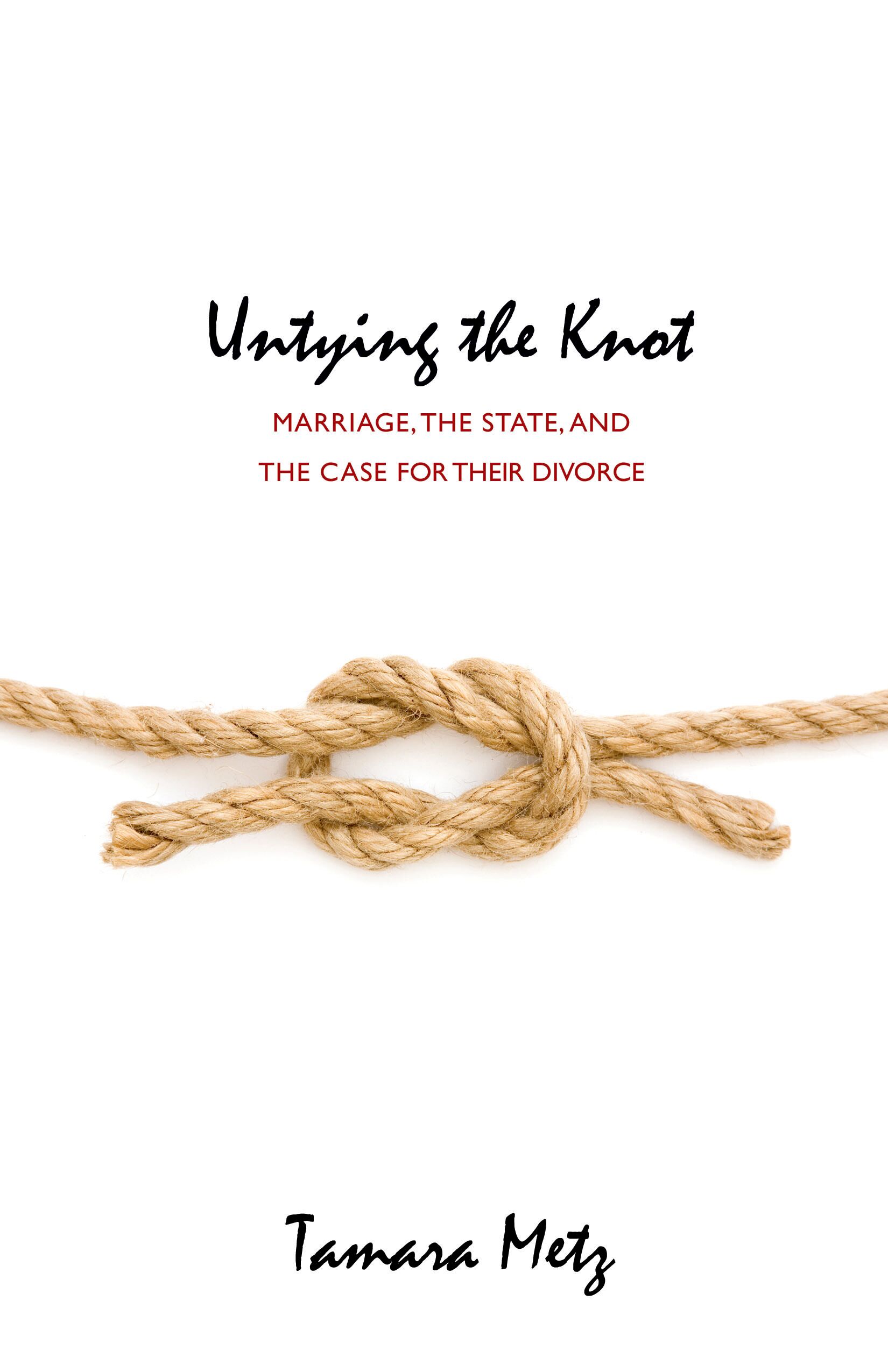
Untying the knot
Marriage is at the center of one of today's fiercest political debates. Activists argue about how to define it, judges and legislators decide who should benefit from it, and scholars consider how the state should protect those who are denied it. Few, however, ask whether the state should have anything to do with marriage in the first place. In Untying the Knot, Tamara Metz addresses this crucial question, making a powerful argument that marriage, like religion, should be separated from the state. Rather than defining or conferring marriage, or relying on it to achieve legitimate public welfare goals, the state should create a narrow legal status that supports all intimate caregiving unions. Marriage itself should be bestowed by those best suited to give it the necessary ethical authority--religious groups and other kinds of communities. Divorcing the state from marriage is dictated by nothing less than basic commitments to freedom and equality.
eBook

A self-made man : the political life of Abraham Lincoln, 1809-1849
\"The first of a multi-volume history of Lincoln as a political genius--from his obscure beginnings to his presidency, assassination, and the overthrow of his post-Civil War dreams of Reconstruction. This first volume traces Lincoln from his painful youth, describing himself as 'a slave,' to his emergence as the man we recognize as Abraham Lincoln. From his youth as a 'newsboy,' a voracious newspaper reader, Lincoln became a free thinker, reading Tom Paine, as well as Shakespeare and the Bible, and studying Euclid to sharpen his arguments as a lawyer. Lincoln's anti-slavery thinking began in his childhood amidst the Primitive Baptist antislavery dissidents in backwoods Kentucky and Indiana, the roots of his repudiation of Southern Christian pro-slavery theology. Intensely ambitious, he held political aspirations from his earliest years. Obsessed with Stephen Douglas, his political rival, he battled him for decades. Successful as a circuit lawyer, Lincoln built his team of loyalists. Blumenthal reveals how Douglas and Jefferson Davis acting together made possible Lincoln's rise. Blumenthal describes a socially awkward suitor who had a nervous breakdown over his inability to deal with the opposite sex. His marriage to the upper class Mary Todd was crucial to his social aspirations and his political career. Blumenthal portrays Mary as an asset to her husband, a rare woman of her day with strong political opinions. He discloses the impact on Lincoln's anti-slavery convictions when handling his wife's legal case to recover her father's fortune in which he discovered her cousin was a slave. Blumenthal's robust portrayal is based on prodigious research of Lincoln's record and of the period and its main players. It reflects both Lincoln's time and the struggle that consumes our own political debate\"-- Provided by publisher.
Book

Marriage (In)equality: The Perspectives of Adolescents and Emerging Adults With Lesbian, Gay, and Bisexual Parents
The debate over whether same-sex couples should be allowed to enter into civil marriages continues in the United States. Forty-nine adolescents and emerging adults (ages 14-29) with lesbian, gay, and bisexual parents were interviewed for the current exploratory study, which examined how individuals perceived themselves and their families as being affected by marriage (in) equality, as well as the factors that shaped their perspectives. More than two thirds of participants voiced unequivocal support for marriage equality, citing numerous legal and symbolic benefits that their families were denied. One quarter of participants articulated critical perspectives of marriage or the fight for marriage equality, while also acknowledging the benefits associated with marriage. As the first study to examine the perspectives of individuals with lesbian, gay, and bisexual parents with regard to marriage (in) equality, this research has important implications for the marriage equality debate and provides a springboard for future studies on this topic.
Journal Article

Cross-border planning for Brazilian families
This article aims to provide an overview of cross-border planning for Brazilian Families, addressing key topics to be taken into consideration, especially those related to marital asset regimes, forced heirship rights, private, corporate, tax and international laws, from a Brazilian perspective. It also addresses the significant impacts of the 2023 Brazilian tax reform, encompassing the taxation of investment funds in Brazil, income derived by individuals resident in the country, controlled entities and trusts abroad, the introduction of CFC rules for individuals and further anti-deferral rules.
Journal Article

On the Legislative Concept and New Rules of the System of Marriage and Family in China's Civil Code
Twenty-four new or revised systems or rules have been incorporated in the Civil Code of the People's Republic of China for the purpose of strengthening the State's protection of marriage and family, promoting development of family civilization, and respecting the autonomy of the parties to marriage and family. Furthermore, they are designed for advancing equal marriage and family status, implementing the principle for the best interests of children, and protecting the rights and interests of the weak in marriage and family. In the Marriage and Family Section of the Civil Code, the Chapter 1 “General” has got the new principle of the State protecting marriage and family, new advisory rule for promoting development of marriage and family civilization, and new principle for protecting the best interest of adoptees. Moreover, it has defined the types of relatives, close relatives and family members. In the Chapter 2 “Marriage,” the lawful circumstances for prohibiting marriage and for invalidating marriage are reduced, the scheme of revoking a marriage is revised and supplemented; the obligation of telling the truth about major diseases, and the right for the innocent party to claim damages for an invalid or revoked marriage, are added. In the Chapter 3 “Family Relations,” the rules of husband and wife’s family agency right and its restriction, the rules of marital common debt determination, the rules of marital common property split, and the rule of litigation for the confirmation and denial of parent-child relationship, are added; in the Chapter 4 “Divorce,” the pre-divorce cooling off period and the time for dissolution of marriage relationship are added, the legal circumstances for divorce in litigation, the rules for dealing with child support during divorce, and the principle of splitting the common property of divorced couples are supplemented, the applicable conditions of divorce financial compensation and divorce financial assistance are modified, and the legal circumstances for divorce damage compensation is increased; in the Chapter 5 “Adoption,” the age of adoptees and the number of adopted children are relaxed, the conditions of adopters are revised, and the adoption evaluation rules are added.
Journal Article