
Catalogue Search | MBRL


Are you sure you want to remove the book from the shelf?

{{itemTitle}}
20
result(s) for
"Civil rights movements -- South Africa -- History -- 20th century"
Sort by:


The Cold War and the color line : American race relations in the global arena
After World War II the United States faced two preeminent challenges: how to administer its responsibilities abroad as the world's strongest power, and how to manage the rising movement at home for racial justice and civil rights. The effort to contain the growing influence of the Soviet Union resulted in the Cold War, a conflict that emphasized the American commitment to freedom. The absence of that freedom for nonwhite American citizens confronted the nation's leaders with an embarrassing contradiction. Racial discrimination after 1945 was a foreign as well as a domestic problem. World War II opened the door to both the U.S. civil rights movement and the struggle of Asians and Africans abroad for independence from colonial rule. America's closest allies against the Soviet Union, however, were colonial powers whose interests had to be balanced against those of the emerging independent Third World in a multiracial, anticommunist alliance. At the same time, U.S. racial reform was essential to preserve the domestic consensus needed to sustain the Cold War struggle. The Cold War and the Color Line is the first comprehensive examination of how the Cold War intersected with the final destruction of global white supremacy. Thomas Borstelmann pays close attention to the two Souths—Southern Africa and the American South—as the primary sites of white authority's last stand. He reveals America's efforts to contain the racial polarization that threatened to unravel the anticommunist western alliance. In so doing, he recasts the history of American race relations in its true international context, one that is meaningful and relevant for our own era of globalization.
eBook


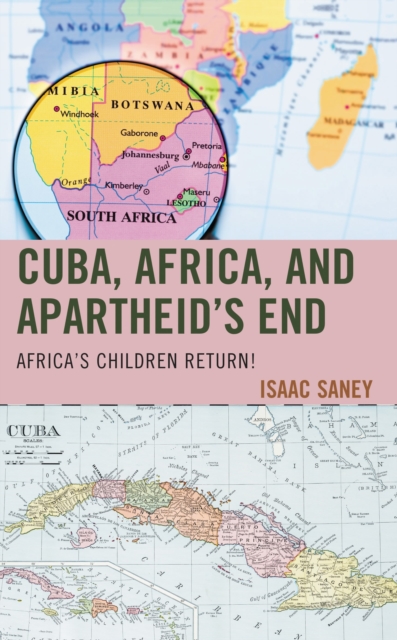
Cuba, Africa, and Apartheid's End
Cuba, Africa, and Apartheid's End: Africa's Children Return! examines the historic dimensions of the Cuban Revolution's solidarity with Africa through the lens of Cuba's role in the battle of Cuito Cuanavale and the southern African national liberation and anti-colonial struggle more broadly.
eBook

Routledge Handbook of Citizenship in the Middle East and North Africa
This comprehensive Handbook gives an overview of the political, social, economic and legal dimensions of citizenship in the Middle East and North Africa from the nineteenth century to the present.
The terms citizen and citizenship are mostly used by researchers in an off-hand, self-evident manner. A citizen is assumed to have standard rights and duties that everyone enjoys. However, citizenship is a complex legal, social, economic, cultural, ethical and religious concept and practice. Since the rise of the modern bureaucratic state, in each country of the Middle East and North Africa, citizenship has developed differently. In addition, rights are highly differentiated within one country, ranging from privileged, underprivileged and discriminated citizens to non-citizens. Through its dual nature as instrument of state control, as well as a source of citizen rights and entitlements, citizenship provides crucial insights into state-citizen relations and the services the state provides, as well as the way citizens respond to these actions.
This volume focuses on five themes that cover the crucial dimensions of citizenship in the region:
Historical trajectory of citizenship since the nineteenth century until independence
Creation of citizenship from above by the state
Different discourses of rights and forms of contestation developed by social movements and society
Mechanisms of inclusion and exclusion
Politics of citizenship, nationality and migration
Covering the main dimensions of citizenship, this multidisciplinary book is a key resource for students and scholars interested in citizenship, politics, economics, history, migration and refugees in the Middle East and North Africa.
eBook

Race for sanctions : African Americans against apartheid, 1946-1994
An important contribution to the political history of this period
[and] a must for those interested in the influence of the great
pan-Africanists. -- Elliott P. Skinner This study traces the
evolution of the anti-apartheid movement from its origins in the 1940s through the
civil rights and black power eras to its maturation in the 1980s as a force that
transformed U.S. foreign policy. The movement initially met resistance and
was soon repressed, only to reemerge during the civil rights era, when it became
radicalized with the coming of the black freedom movement. The book looks at three
important political groups: TransAfrica -- the black lobby for Africa and the
Caribbean; the Free South Africa Movement; and lastly the Congressional Black Caucus
and its role in passing sanctions against South Africa over President Reagan's veto.
It concludes with an assessment of the impact of sanctions on the release of Nelson
Mandela and his eventual election as president of South Africa.
eBook

Liturgy of Change
Original archival research invites new ways of
understanding the rhetorics of the civil rights
movement
In Liturgy of Change , Elizabeth Ellis Miller examines
civil rights mass meetings as a transformative rhetorical, and
religious, experience. Scholars of rhetoric have analyzed
components of the civil rights movement, including sit ins,
marches, and voter registration campaigns, as well as meeting
speeches delivered by well-known figures. The mass meeting itself
still is also a significant site in rhetorical studies. Miller's
\"liturgy of change\" framework brings attention to the pattern of
religious genres-song, prayer, and testimony-that structured the
events, and the ways these genres created rhetorical opportunities
for ordinary people to speak up and develop their activism. To
recover and reconstruct these patterns, Miller analyzes archival
audio recordings of mass meetings held in Greenville and
Hattisburg, Mississippi; Montgomery, Selma, and Birmingham,
Alabama; Savannah, Sumter, and Albany, Georgia; St. Augustine,
Florida; and Danville, Virginia.
eBook
Twilight people
David Houze was twenty-six and living in a single room occupancy hotel in Atlanta when he discovered that three little girls in an old photo he'd seen years earlier were actually his sisters. The girls had been left behind in South Africa when Houze and his mother fled the country in 1966, at the height of apartheid, to start a new life in Meridian, Mississippi, with Houze's American father. This revelation triggers a journey of self-discovery and reconnection that ranges from the shores of South Africa to the dirt roads of Mississippi—and back. Gripping, vivid, and poignant, this deeply personal narrative uses the unraveling mystery of Houze's family and his quest for identity as a prism through which to view the tumultuous events of the civil rights movement in Mississippi and the rise and fall of apartheid in South Africa. Twilight People is a stirring memoir that grapples with issues of family, love, abandonment, and ultimately, forgiveness and reconciliation. It is also a spellbinding detective story—steeped in racial politics and the troubled history of two continents—of one man's search for the truth behind the enigmas of his, and his mother's, lives.
eBook