
Catalogue Search | MBRL


Are you sure you want to remove the book from the shelf?

{{itemTitle}}
66
result(s) for
"Civila samhället"
Sort by:

The Civil Sphere
How do real individuals live together in real societies in the real world? What binds societies together and how can these social orders be structured in a fair way? This book addresses this central paradox of modern life. Feelings for others—the solidarity that is ignored or underplayed by theories of power or self-interest—are at the heart of this novel inquiry into the meeting place between normative theories of what we think we should do and empirical studies of who we actually are. The book demonstrates that solidarity creates inclusive and exclusive social structures, and shows how they can be repaired. It is not perfect, it is not absolute, and the horrors which occur in its lapses have been seen all too frequently in the forms of discrimination, genocide, and war. Despite its worldly flaws and contradictions, however, solidarity and the project of civil society remain our best hope—the antidote to every divisive institution, every unfair distribution, and every abusive and dominating hierarchy. A grand and sweeping statement, the book is a major contribution to our thinking about the real but ideal world in which we all reside.
eBook

Citizenship and the Legitimacy of Governance
Against the background of unease at the increasingly loose and conflictual relationship between citizenship and governance, this book brings together rich, ethnographic studies from EU member states and post-Communist and Middle-Eastern countries in the Mediterranean Region to illustrate the crisis of legitimacy inherent in the weakening link between political responsibility and trust in the exercise of power.
With close attention to the impact of the ambiguities and distortions of governance at the local level and their broader implications at the international level, where a state's legitimacy depends on its democratic credentials, Citizenship and the Legitimacy of Governance initiates a comparative discussion of the relationship between established moralities, politics, law and civil society in a highly diversified region with a strong history of cultural exchange. Demonstrating that a comparative anthropological analysis has much to offer to our understanding, this volume reveals that the city is a crucial arena for the renegotiation of citizenship, democracy and belonging.
eBook

The Golden Chain
The family can be viewed as one of the links in a \"golden chain\" connecting individuals, the private sphere, civil society, and the democratic state; as potentially an important source of energy for social activity; and as the primary institution that socializes and diffuses the values and norms that are of fundamental importance for civil society. Yet much of the literature on civil society pays very little attention to the complex relations between civil society and the family. These two spheres constitute a central element in democratic development and culture and form a counterweight to some of the most distressing aspects of modernity, such as the excessive privatization of home life and the unceasing work-and-spend routines. This volume offers historical perspectives on the role of families and their members in the processes of a liberal and democratic civil society, the question of boundaries and intersections of the private and public domains, and the interventions of state institutions.
eBook

Islam's Predicament with Modernity
Islam's Predicament with Modernity presents an in-depth cultural and political analysis of the issue of political Islam as a potential source of tensions and conflict, and how this might be peacefully resolved.
Looking at the issue of modernity from an Islamic point of view, the author examines the role of culture and religion in Muslim society under conditions of globalisation, and analyses issues such as law, knowledge and human rights. He engages a number of significant studies on political Islam and draws on detailed case studies, rejecting the approaches of both Orientalists and apologists and calling instead for a genuine Islamic pluralism that accepts the equality of others. Situating modernity as a Western product at the crux of his argument, he argues that a separation of religion and politics is required, which presents a challenge to the Islamic worldview.
This critical analysis of value conflicts, tensions and change in the Islamic world will be of interest to scholars and advanced students of international relations, social theory, political science, religion, Islamic studies and Middle Eastern studies.
'Bassam Tibi has written the rarest of books: a book of learning and a daring one as well. One of the most formidable books to appear on modern Islam in a very long time. Arguable the leading singular authority on European Islam, Professor Tibi has looked, unsentimentally, at the modern dilemma of Islam and come forth with a book of startling originality. This is scholarship of the highest level: Professor Tibi neither apologizes for Islam's troubles nor hacks away at the Islamist utopia. In this \"cool\" and authoritative book, we have an unflinching depiction of Islam's modern predicament. An exemplary work.' - Fouad Ajami, Director of Middle East Studies, the Johns Hopkins University
\"[A] wide-ranging and thought-provoking book.\" - Richard Bonney, University of Leicester; The Muslim World Book Review, Volume 31, Number 1, 2010
Bassam Tibi is Professor of International Relations at the University of Goettingen and A.D. White Professor-at-Large at Cornell University
Introduction: Cultural Tensions, Modernity, Globalization, and Conflict 1. The Predicament: The Exposure to Cultural Modernity, and the Need for an Accommodation. Religious Reform and Cultural Change in Islamic Civilization 2. Issue Areas of the Predicament I: Modernity and Knowledge. Torn Between Reason and Islamization 3. Issue Areas of the Predicament II: Cultural Modernity and Law. The Contemporary Reinvention of Shari’a for the Shari’atization of Islam 4. Issue Areas of the Predicament III: Islam, the Principle of Subjectivity and Individual Human Rights 5. Islam’s Predicament as a Source of Conflict. Cultural-Religious Tensions and Identity Politics 6. Cultural Change and Religious Reform I: The Challenge of Secularization in the Shadow of De-Secularization 7. Cultural Change and Religious Reform II: Pluralism of Religions vs. Islamic Supremacism 8. Authenticity and Cultural Legacy. The Revival of the Heritage of Islamic Rationalism: Falsafa/Rational Philosophy vs. Fiqh-Orthodoxy 9. Case Studies I. The Failed Cultural Transformation in Egypt: A Model for the World of Islam? 10. Case Studies II. The Gulf Beyond the Age of Oil: The Envisioned Cultural Project for the Future 11. Conclusions and Future Prospects. Cultural Modernity and the Islamic Dream of Semi-Modernity. Conclusions
eBook
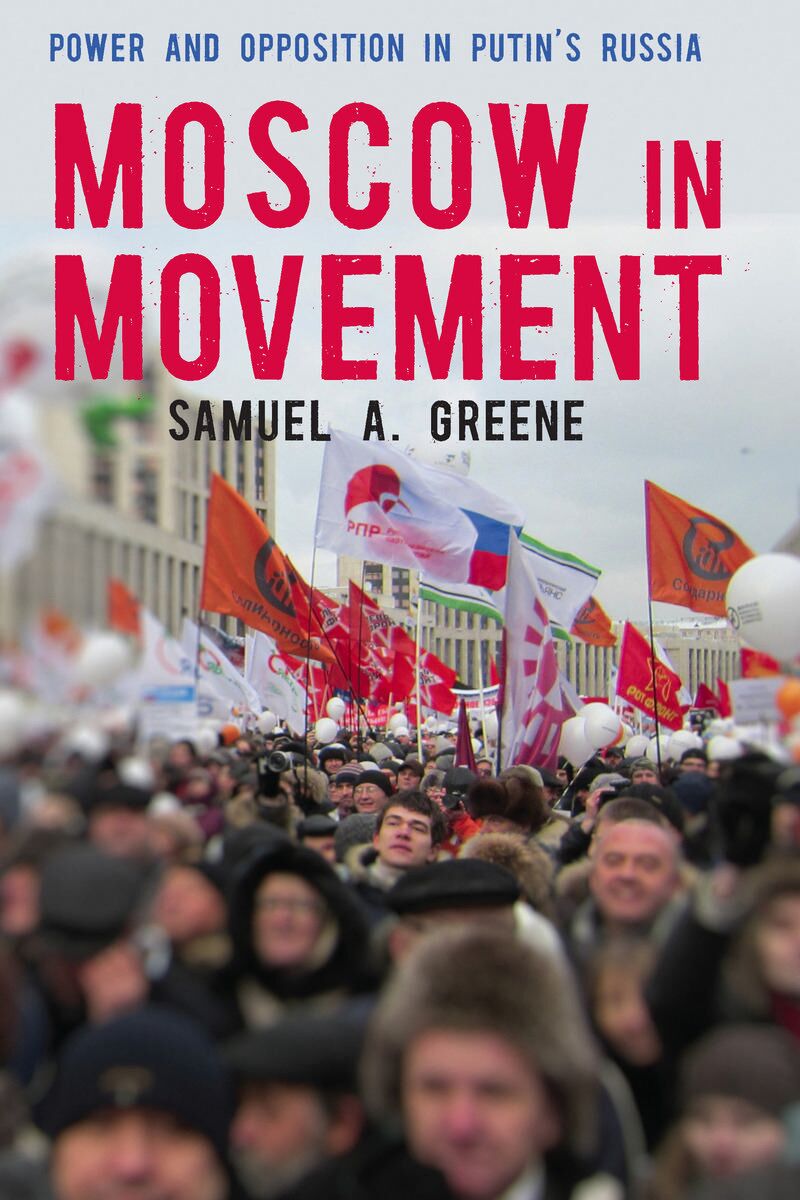
Moscow in movement : power and opposition in Putin's Russia
Moscow in Movement is the first exhaustive study of social movements, protest, and the state-society relationship in Vladimir Putin's Russia. Beginning in 2005 and running through the summer of 2013, the book traces the evolution of the relationship between citizens and their state through a series of in-depth case studies, explaining how Russians mobilized to defend human and civil rights, the environment, and individual and group interests: a process that culminated in the dramatic election protests of 2011–2012 and their aftermath. To understand where this surprising mobilization came from, and what it might mean for Russia's political future, the author looks beyond blanket arguments about the impact of low levels of trust, the weight of the Soviet legacy, or authoritarian repression, and finds an active and boisterous citizenry that nevertheless struggles to gain traction against a ruling elite that would prefer to ignore them.
On a broader level, the core argument of this volume is that political elites, by structuring the political arena, exert a decisive influence on the patterns of collective behavior that make up civil society—and the author seeks to test this theory by applying it to observable facts in historical and comparative perspective.
Moscow in Movement will be of interest to anyone looking for a bottom-up, citizens' eye view of recent Russian history, and especially to scholars and students of contemporary Russian politics and society, comparative politics, and sociology.
eBook

Resisting Gendered Norms
Political scientists have, on occasion, missed subtle but powerful forms of ‘everyday resistance’ and have not been able to show how different representations (pictures, statements, images, practices) have different impacts when negotiating power. Instead they have concentrated on open forms of resistance, organized rebellions and collective actions. Departing from James Scott’s idea that oppression and resistance are in constant change, Resisting Gendered Norms provides us with a compelling account on the nexus between gender, resistance and gender-based violence in Cambodia. To illustrate how resistance is often carried out in the tension between, on the one hand, universal/globalised representations and, on the other, local ‘truths’ and identity constructions, in-depth interviews with civil society representatives, politicians as well as stakeholders within the legal/juridical system were conducted.
eBook

The Social in the Global
How do influential social ideas contribute to global governance? This book takes an original approach to international relations by looking at the way social ideas help to portray the world in a particular way. Jonathan Joseph begins by analysing the role of important concepts such as globalisation, global civil society, social capital, networks and risk; then examines the role these concepts play in the discourse of international organisations. Using the concept of governmentality, he argues that contemporary social theories help justify contemporary forms of governance. By comparing organisations like the EU and the World Bank, Joseph investigates the extent to which these ideas are influential in theory and in practice.
eBook

Investing in Democracy: Engaging Citizens in Collaborative Governance
Discusses how government can serve as a partner and catalyst for collaborative problem solving. Details three success stories and explains what measures were taken and why they succeeded. Distills eight core design principles that characterize effective collaborative governance and concludes with concrete recommendations for federal policy.
eBook
Palestinian Civil Society
Palestinian Civil Society examines the development of civil society in the Arab Middle East and the impact of western donors, with particular reference to the Palestinian case. Looking at the evolution of Palestinian civil society organizations from sociological, historical, legal, and institutional perspectives, the book sheds light on the involvement of donors in Palestine, and the effect that aid has had on Palestinian civil society at a social, political and ideological level.
Drawing on Arabic texts, political theory and a detailed survey of donors and local organizations, this book challenges culturalist views that there cannot be a ‘vibrant civil society’ in the Arab world and examines the issues of depoliticization of civil society, the rise of the Islamist sector, and the gradual defeat of the left in the Occupied Territories. The author looks at how the interaction between donors and NGOs is not only centred on a western model of civil society, but also evolves around institutional mechanisms and disciplinary discourses, affecting the ability of local NGOs to adapt to the institutional requirements set by international donors.
Accessible to non-specialists, this book will be of interest to students and scholars of sociology, Middle Eastern studies and development studies.
\"This book is a masterpiece for understanding the civil society sphere in the Palestinian territory… Benoît Challand presents one of the most important studies in the growing corpus about civil society and NGOs in the Arab World. …. Challand rightly wages a war against culturalist and essentialist discourses, exposing the dominant emphasis on culture and division to explain the supposed civil society deficit in Arab-Islamic areas.\" - Sari Hanafi, American University of Beirut, Lebanon; International Sociology 2011 26
\"Challand’s research is fascinating, and the basic argument is sound. The focus on participation—rather than the devalued and contested concept of \"democratization\"— is innovative and useful beyond the bounds of Palestine... [T]he intelligent and critical Challand has conducted extensive and thoughtful primary research in the Arabic language... the book advances an important and novel argument about foreign donors exacerbating Palestinian heteronomy. He points the way toward a more critical examination of NGOs and civil society, and his fidelity to on-the-ground fieldwork is well worth emulating.\" - Laleh Khalili, School of Oriental and African Studies; Perspectives on Politics, September 2009 | Vol. 7/No. 3
\"Benoît Challand’s book on Palestinian civil society is an important work for two reasons: first, for the admirable understanding he has of the philosophical literature on civil society, and, second, for his attempt to expand the scope of research on civil society in the Arab Middle East to include international actors.\" Kevin Gray, Journal of Palestine Studies 40(3) , 125f.
Benoît Challand is a research fellow at the European University Institute in Florence (Italy) and has taught at the universities of Bologna, Bethlehem, Pavia and Fribourg.
1. Introduction: One Civil Society, Two Palestines Part 1: Clearing the Ground 2. Debating Civil Society: Internationally and in the Arab Middle East 3. Setting the Historical Framework on Palestinian NGOs and International Donors Part 2: Civil Society at Work 4. International Donors and the Professionalization of Civil Society Promotion 5. Managing the Discourse of Civil Society 6. The Exclusionary Dimensions of Civil Society 7. Conclusions: Looking ‘Beyond the Pale’
eBook
State phobia and civil society : the political legacy of Michel Foucault
State Phobia and Civil Society draws extensively upon the work of Michel Foucault to argue for the necessity of the concept of the state in political and social analysis. In so doing, it takes on not only the dominant view in the human sciences that the concept of the state is outmoded, but also the large interpretative literature on Foucault, which claims that he displaces the state for a de-centered analytics of power. Understanding Foucault means understanding all his interlocutors—whether Marxists, Maoists, neoliberals, or social democrats. It requires turning to Foucault's colleagues, including Deleuze and Guattari, François Ewald, and Blandine Kreigel, in relation to whom he carved out a position. And it entails an examination of his legacy in Hardt and Negri, the theorists of Empire, or in Nikolas Rose, the influential English sociologist. Foucault's own view is highly ambiguous: he claims to be concerned with the exercise of political sovereignty, yet his work cannot make visible the concept of the state. Moving beyond Foucault, the authors outline new ways of conceiving the state's role in establishing social order and in mediating between an inequality-producing capitalist economy and the juridical equality and political rights of individuals. Arguing that states and their cooperation remain of vital importance to resolving contemporary crises, they demonstrate the interdependence of state and civil society and the necessity of social forms of governance.
eBook