
Catalogue Search | MBRL


Are you sure you want to remove the book from the shelf?

{{itemTitle}}
4,531
result(s) for
"Civilian war casualties."
Sort by:

Economist video. The Gaza death toll may be higher than reported
The death toll in Gaza may be higher than reported. New research suggests tens of thousands of people may be missing from the official count.
Streaming Video

The bodies in person : an account of civilian casualties in American wars
Presents the story of civilians who have died as a result of America's recent wars, introducing some of those who died in Iraq and Afghanistan, the rescue workers who tried to save them, and the American soldiers coming to terms with their deaths.
Book

Massacres and morality : mass atrocities in an age of civilian immunity
Most cultural and legal codes agree that the intentional killing of civilians, whether in peacetime or war, is prohibited. This is the norm of civilian immunity, widely considered to be a fundamental moral and legal principle. Yet despite this fact, the deliberate killing of large numbers of civilians remains a persistent feature of global political life. What is more, the perpetrators have often avoided criticism and punishment. Examining dozens of episodes of mass killing perpetrated by states since the French Revolution late eighteenth century, this book attempts to explain this paradox. It studies the role that civilian immunity has played in shaping the behaviour of perpetrators and how international society has responded to mass killing. The book argues that although the world has made impressive progress in legislating against the intentional killing of civilians and in constructing institutions to give meaning to that prohibition, the norm's history in practice suggests that the ascendancy of civilian immunity is both more recent and more fragile than might otherwise be thought. In practice, decisions to violate a norm are shaped by factors relating to the norm and the situation at hand, so too is the manner in which international society and individual states respond to norm violations. Responses to norm violations are not simply matters of normative obligation or calculations of self-interest but are instead guided by a combination of these logics as well as perceptions about the situation at hand, existing relations with the actors involved, and power relations between actors holding different accounts of the situation. Thus, whilst civilian immunity has for the time being prevailed over 'anti-civilian ideologies' which seek to justify mass killing, it remains challenged by these ideologies and its implementation shaped by individual circumstances. As a result, whilst it has become much more difficult for states to get away with mass murder, it is still not entirely impossible for them to do so.
eBook

Bugsplat : the politics of collateral damage in western armed conflicts
\"Why do states who are committed to the principle of civilian immunity and the protection of non-combatants end up killing and injuring large numbers of civilians during their military operations? Bugsplat explains this paradox through an in-depth examination of five conflicts fought by Western powers since 1989\"-- Provided by publisher.
Book

Armed group structure and violence in civil wars : the organizational dynamics of civilian killing
This book examines whether differences in the organizational structure of armed groups shape patterns of human rights violations in civil wars. Since the end of World War II, civil wars have been characterized by extremely high numbers of civilian casualties. However, the exact extent of civilian suffering varies across time, conflict, and geographic region. Recently, a new strand of research has emerged, primarily focused on studying the dynamics underlying the variation in civilian abuse by examining the characteristics of the armed groups and how these characteristics influence the armed groups’ behaviour towards the civilian population. With reference to principal-agent theory and data on the organizational structure of more than 70 armed groups active worldwide from 1989 onwards, the author’s analysis functions both on the level of the armed group and on the level of the individual via personal interviews with combatants. Offering a unique insight into how factors such as recruitment methods, hierarchy and organizational commitment may affect the likelihood of civilian abuse by combatants, this book will be of much interest to students of political violence, civil wars, war and conflict studies, security studies and IR in general.
eBook

Saving soldiers or civilians? : casualty aversion versus civilian protection in asymmetric conflicts
\"While the United States has not lost its appetite for war, the way in which its conflicts are being waged has changed dramatically.\"--Provided by publisher.
Book

War without Bodies
Historically the bodies of civilians are the most damaged by the
increasing mechanization and derealization of warfare, but this is
not reflected in the representation of violence in popular media.
In War Without Bodies , author Martin Danahay argues that
the media in the United States in particular constructs a \"war
without bodies\" in which neither the corpses of soldiers or
civilians are shown. War Without Bodies traces the
intertwining of new communications technologies and war from the
Crimean War, when Roger Fenton took the first photographs of the
British army and William Howard Russell used the telegraph to
transmit his dispatches, to the first of three \"video wars\" in the
Gulf region in 1990-91, within the context of a war culture that
made the costs of organized violence acceptable to a wider public.
New modes of communication have paradoxically not made more war
\"real\" but made it more ubiquitous and at the same time
unremarkable as bodies are erased from coverage. Media such as
photography and instantaneous video initially seemed to promise
more realism but were assimilated into existing conventions that
implicitly justified war. These new representations of war were
framed in a way that erased the human cost of violence and replaced
it with images that defused opposition to warfare. Analyzing
poetry, photographs, video and video games the book illustrates the
ways in which war was framed in these different historical
contexts. It examines the cultural assumptions that influenced the
reception of images of war and discusses how death and damage to
bodies was made acceptable to the public. War Without
Bodies aims to heighten awareness of how acceptance of war is
coded into texts and how active resistance to such hidden messages
can help prevent future unnecessary wars.
eBook
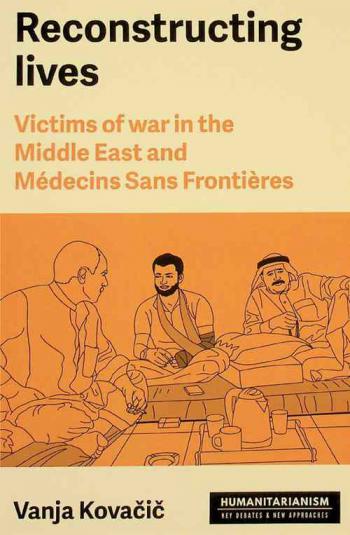
Reconstructing lives : victims of war in the Middle East and Médecins Sans Frontières
\"This book attempts to establish a more holistic approach to the rehabilitation of war-injured civilians, one that adjusts to the patients' long-term needs. Kovačič not only offers an insight into the daily realities of patients during and after rehabilitation, but seeks to develop a new way to perceive, respect and involve them in health care. Based on comprehensive interviews with patients and MSF staff, as well as extended field observations, Reconstructing lives follows Syrian and Iraqi war-injured civilians in their journey to recovery. From their improvised medical treatment in their home countries, to the MSF-run hospital in Amman Jordan, to their return home, Kovačič explores how individuals attempt to pick up the pieces of their previous lives, add new elements from their treatment and travel experiences, and finally establish a new reconstructed reality. The book explores how the interaction between MSF staff and their patients contributes to the immense task of healing that awaits victims of war. The reader visits the intimate medical and domestic spaces that usually remain closed to the outside observer, spaces rich with human contact, perceptions, emotions, conflicts and reconciliations\"--Page 4 of cover.
Book

Counting civilian casualties : an introduction to recording and estimating nonmilitary deaths in conflict
Studies of military casualties and their influence on political will and combat effectiveness are common. Studies of civilian casualties are rare. This book addresses this gap in the literature. As an introduction to the full range of methods for recording and estimating casualties, the set of essays will be a foundation for the nascent field of counting civilian casualties. Collaboration between Carnegie Mellon University and the University of Pittsburgh brought together for first time researchers from a diverse set of disciplines to discuss various methodologies for recording and estimating civilian casualties. The chapters reflect the unique exchange of views among top specialists, many of whom had not previously engaged each other in debate. The book is unusual in its geographical coverage. The chapters include cases from Latin America, South America, Europe, Africa, the Middle East, and Asia. While some of the studies focus on a single country, the majority of them are comparative in nature.
eBook