
Catalogue Search | MBRL


Are you sure you want to remove the book from the shelf?

{{itemTitle}}
3,211
result(s) for
"Civilisation Histoire."
Sort by:

The invention of prehistory : empire, violence, and our obsession with human origins
\"Books about human origins dominate bestseller lists, while national newspapers present breathless accounts of new archaeological findings and speculate about what those findings tell us about our earliest ancestors. We are obsessed with prehistory--and, in this respect, our current era is no different from any other in the last three hundred years. In this coruscating work, acclaimed historian Stefanos Geroulanos demonstrates how claims about the earliest humans not only shaped Western intellectual culture, but gave rise to our modern world. The very idea that there was a human past before recorded history only emerged with the Enlightenment, when European thinkers began to reject faith-based notions of humanity and history in favor of supposedly more empirical ideas about the world. From the \"state of nature\" and Romantic notions of virtuous German barbarians to theories about Neanderthals and a matriarchal paradise where women ruled, Geroulanos captures the sheer variety and strangeness of the claims that animated many of the major thinkers of the eighteenth and nineteenth centuries, including Jean-Jacques Rousseau, Charles Darwin, and Karl Marx. Yet as Geroulanos shows, such ideas became, for the most part, the ideological foundations of repressive regimes and globe-spanning empires. Deeming other peoples \"savages\" allowed for guilt-free violence against them; notions of \"killer apes\" who were our evolutionary predecessors made war seem natural. The emergence of modern science only accelerated the West's imperialism. The Nazi obsession with race was rooted in archaeological claims about prehistoric Indo-Germans; the notion that colonialized peoples could be \"bombed back to the Stone Age\" was made possible by not only the technology of flight, but by the anthropological idea that civilization advanced in stages. As Geroulanos argues, accounts of prehistory tell us more about the moment when they are proposed than anything else--and if we hope to start improving our future, we would be better off setting aside the search for how it all started. A necessary, timely, indelible account of how the quest for understanding the origins of humanity became the handmaiden of war and empire, The Invention of Prehistory will forever change how we think about the deep past.\" -- Provided by publisher.
Book

The Eastern Origins of Western Civilisation
John Hobson challenges the ethnocentric bias of mainstream accounts of the Rise of the West. It is often assumed that since Ancient Greek times Europeans have pioneered their own development, and that the East has been a passive by-stander in the story of progressive world history. Hobson argues that there were two processes that enabled the Rise of the 'Oriental West'. First, each major developmental turning point in Europe was informed in large part by the assimilation of Eastern inventions (e.g. ideas, technologies and institutions) which diffused from the more advanced East across the Eastern-led global economy between 500–1800. Second, the construction of European identity after 1453 led to imperialism, through which Europeans appropriated many Eastern resources (land, labour and markets). Hobson's book thus propels the hitherto marginalised Eastern peoples to the forefront of the story of progress in world history.
eBook

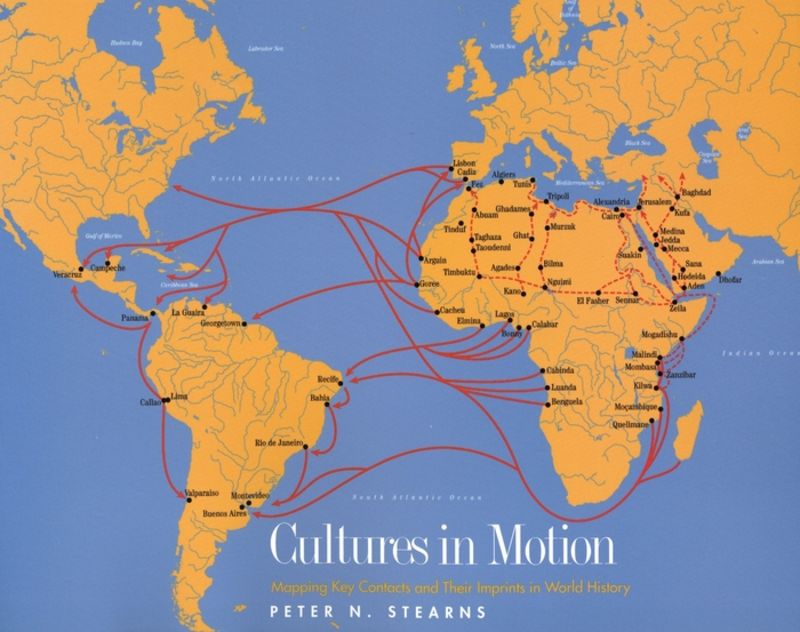
Cultures in Motion
When different cultures come in contact with one another, the impact on the course of history can be dramatic and unexpected. Encounters between separate societies or civilizations have resulted in the spread of major religions, vast migrations, scientific breakthroughs, the dissemination of powerful political notions, and many other transformations. This unique book brings to life key episodes of cultural contact in world history, from the beginnings of civilization to the present. Through a combination of vivid case studies and imaginative color maps, award-winning history professor Peter Stearns shows how we can better understand world history by examining what happens when culture meets culture.One culture's new contact with another can lead to assimilation, rejection, or--most often--a merging of elements from both cultures. Stearns focuses on fourteen important historical examples of intercultural exchange from around the globe. He considers:• the spread of major religions, such as Buddhism and Islam• voluntary and forced migrations, such as the Jewish and African diasporas• the dissemination of modern forces, including nationalism and Marxism• the impact of European colonial rule on gender relations in India and in Africa• recent international diffusion of consumer culture• and much moreFor each example, original maps reveal geographic patterns and provide a clear sense of the impact of that particular meeting of cultures.
eBook

Fifty minerals that changed the course of history
\"A guide to the minerals that have had the greatest impact on human civilization. These are the materials used from the Stone Age to the First and Second Industrial Revolutions to the Nuclear Age and include metals, ores, alloys, salts, rocks, sodium, mercury, steel and uranium. The book includes minerals used as currency, as jewelry and as lay and religious ornamentation when combined with gem minerals like diamonds, amber, coral, and jade.\"-- Provided by publisher.
Book

Brute souls, happy beasts, and evolution
In this provocative inquiry into the status of animals in human society from the fifth century BC to the present, Rod Preece provides a wholly new perspective on the human-animal relationship.
eBook

The dark path : the structure of war and the rise of the West
From an esteemed military historian, a sweeping history of the revolutions in war-fighting that have shaped the modern world Heraclitus wrote that \"war is the father of all\" and it has formed much of the modern world. Although the fundamental nature of war has not altered over the centuries, constant change, innovation, and adaptation have repeatedly reshaped how wars are fought in the West. Revolutions in military practice cannot be separated from larger social developments in areas like logistics, finance and economics, and the culture of military organizations. In The Dark Path, Williamson Murray argues that the history of warfare in the West hinged on five revolutions, which both reflected the social, political, and economic conditions that produced them and in turn influenced how those conditions evolved. These five key turning points are the advent of the modern state, which formed bureaucracies and professional militaries; the Industrial Revolution, which produced the financial and industrial means to sustain and equip large armies; the French Revolution, which provided the ideological basis needed to sustain armies through continent-sized wars; the merging of the Industrial and French Revolutions in the U.S. Civil War; and the accelerating integration of technological advancement, financial capacity, ideology, and government that unleashed the modern capacity for total warfare. An ambitious work of synthesis, this book shows how the world continually re-creates war-and how war, in turn, continually re-creates the world. -- Provided by publisher.
BOOK

Beasts and Beauties
Beasts and Beautiesexamines the relationship between domesticity and power by focusing on the contemporaneous development of the invention of the 'pet' and the delineation of the home as a uniquely private enclosure, where the pater familias ruled over his own secluded world of domesticated wife, children, servants, and animals.
eBook

Venice : the remarkable history of the lagoon city
\"This comprehensive account reveals the adaptations to its geographic setting that have been a constant feature of living on water from Venice's origins to the present. It examines the lives of the women and men, noble and common, rich and poor, Christian, Jew, and Muslim, who built not only the city but also its vast empire that stretched from Northern Italy to the eastern Mediterranean. It details the urban transformations that Venice underwent in response to environmental vulnerability, industrialization, and mass tourism. Alongside the city's commercial prominence has been its dramatically changing political role, including its power as a city-state, regional stronghold, and overseas empire, as well as its impact on the development of fascism. Throughout, Dennis Romano highlights the city's cultural achievements in architecture, painting, and music, particularly opera. This richly illustrated volume offers a stunning portrait of this most singular of cities.\" -- Publisher's description.
Book

Water 4.0
Turn on the faucet, and water pours out. Pull out the drain plug, and the dirty water disappears. Most of us give little thought to the hidden systems that bring us water and take it away when we're done with it. But these underappreciated marvels of engineering face an array of challenges that cannot be solved without a fundamental change to our relationship with water, David Sedlak explains in this enlightening book. To make informed decisions about the future, we need to understand the three revolutions in urban water systems that have occurred over the past 2,500 years and the technologies that will remake the system.
The author starts by describing Water 1.0, the early Roman aqueducts, fountains, and sewers that made dense urban living feasible. He then details the development of drinking water and sewage treatment systems-the second and third revolutions in urban water. He offers an insider's look at current systems that rely on reservoirs, underground pipe networks, treatment plants, and storm sewers to provide water that is safe to drink, before addressing how these water systems will have to be reinvented. For everyone who cares about reliable, clean, abundant water, this book is essential reading.
eBook