
Catalogue Search | MBRL


Are you sure you want to remove the book from the shelf?

{{itemTitle}}
124
result(s) for
"Civilisation viking."
Sort by:

Embers of the hands : hidden histories of the Viking Age
A history of the Viking Age, from mighty leaders to rebellious teenagers, told through their runes and ruins, games and combs, trash and treasure. In imagining a Viking, a certain image springs to mind: a barbaric warrior, leaping ashore from a longboat, and ready to terrorize the hapless local population of a northern European town. Yet while such characters define our imagination of the Viking Age today, they were in the minority. Instead, in the time-stopping soils, water, and ice of the North, Eleanor Barraclough excavates a preserved lost world, one that reimagines a misunderstood society. By examining artifacts of the past--remnants of wooden gaming boards, elegant antler combs, doodles by imaginative children and bored teenagers, and runes that reveal hidden loves, furious curses, and drunken spouses summoned home from the pub. Barraclough illuminates life in the medieval Nordic world as not just a world of rampaging warriors, but as full of globally networked people with recognizable concerns. This is the history of all the people--children, enslaved people, seers, artisans, travelers, writers--who inhabited the medieval Nordic world. Encompassing not just Norway, Denmark, and Sweden, but also Iceland, Greenland, the British Isles, Continental Europe, and Russia, this is a history of a Viking Age filled with real people of different ages, genders, and ethnicities, as told through the traces that they left behind. \"Embers of the hands\" is a poetic kenning from the Viking Age that referred to gold. But no less precious are the embers that Barraclough blows back to life in this book--those of ordinary lives long past-- Publisher description
BOOK

Scandinavia in the Age of Vikings
In Scandinavia in the Age of
Vikings , Jón Viðar Sigurðsson returns to the
Viking homeland, Scandinavia, highlighting such key aspects of
Viking life as power and politics, social and kinship networks,
gifts and feasting, religious beliefs, women's roles, social
classes, and the Viking economy, which included farming, iron
mining and metalworking, and trade.
Drawing of the latest archeological research and on literary
sources, namely the sagas, Sigurðsson depicts a complex and
surprisingly peaceful society that belies the popular image of
Norsemen as bloodthirsty barbarians. Instead, Vikings often acted
out power struggles symbolically, with local chieftains competing
with each other through displays of wealth in the form of great
feasts and gifts, rather than arms. At home, conspicuous
consumption was a Viking leader's most important virtue; the
brutality associated with them was largely wreaked abroad.
Sigurðsson's engaging history of the Vikings at home begins by
highlighting political developments in the region, detailing how
Danish kings assumed ascendency over the region and the ways in
which Viking friendship reinforced regional peace. Scandinavia
in the Age of Vikings then discusses the importance of
religion, first pagan and (beginning around 1000 A.D.)
Christianity; the central role that women played in politics and
war; and how the enormous wealth brought back to Scandinavia
affected the social fabric-shedding new light on Viking
society.
eBook

Beyond the Northlands
In the dying days of the eighth century, the Vikings erupted onto the international stage with brutal raids and slaughter. The medieval Norsemen may be best remembered as monk murderers and village pillagers, but this is far from the whole story. Throughout the Middle Ages, long-ships transported hairy northern voyagers far and wide, where they not only raided but also traded, explored and settled new lands, encountered unfamiliar races, and embarked on pilgrimages and crusades. The Norsemen travelled to all corners of the medieval world and beyond; north to the wastelands of arctic Scandinavia, south to the politically turbulent heartlands of medieval Christendom, west across the wild seas to Greenland and the fringes of the North American continent, and east down the Russian waterways trading silver, skins, and slaves. Beyond the Northlands explores this world through the stories that the Vikings told about themselves in their sagas. But the depiction of the Viking world in the Old Norse-Icelandic sagas goes far beyond historical facts. What emerges from these tales is a mixture of realism and fantasy, quasi-historical adventures, and exotic wonder-tales that rocket far beyond the horizon of reality. On the crackling brown pages of saga manuscripts, trolls, dragons, and outlandish tribes jostle for position with explorers, traders, and kings. To explore the sagas and the world that produced them, Eleanor Rosamund Barraclough now takes her own trip through the dramatic landscapes that they describe. Along the way, she illuminates the rich but often confusing saga accounts with a range of other evidence: archaeological finds, rune-stones, medieval world maps, encyclopaedic manuscripts, and texts from as far away as Byzantium and Baghdad. As her journey across the Old Norse world shows, by situating the sagas against the revealing background of this other evidence, we can begin at least to understand just how the world was experienced, remembered, and imagined by this unique culture from the outermost edge of Europe so many centuries ago.
eBook

The Viking Eastern Baltic
This book demonstrates howcommunication networks over the BalticSea and further east were establishedand how they took different forms in thenorthern and the southern halves of theEastern Baltic. Changes in archaeologicalevidence along relevant trade routessuggest that the inhabitants of present-day Finland and the Baltic States weremore engaged in Viking easternmovement than is generally believed.
eBook

Crafts and Social Networks in Viking Towns
Crafting Communities explores the interface between craft, communication networks, and urbanization in Viking-age Northern Europe. Viking-period towns were the hubs of cross-cultural communication of their age, and innovations in specialized crafts provide archaeologists with some of the best evidence for studying this communication. The integrated results presented in these papers have been made possible through the sustained collaboration of a group of experts with complementary insights into individual crafts. Results emerge from recent scholarly advances in the study of artifacts and production: first, the application of new analytical techniques in artifact studies (e.g. metallographic, isotopic, and biomolecular techniques) and second, the shifted in interpretative focus of medieval artifact studies from a concern with object function to considerations of processes of production, and of the social agency of technology. Furthermore, the introduction of social network theory and actor-network theory has redirected attention toward the process of communication, and highlighted the significance of material culture in the learning and transmission of cultural knowledge, including technology. The volume brings together leading UK and Scandinavian archaeological specialists to explore crafted products and workshop-assemblages from these towns, in order to clarify how such long-range communication worked in pre-modern Northern Europe. Contributors assess the implications for our understanding of early towns and the long-term societal change catalysed by them, including the initial steps towards commercial economies. Results are analyzed in relation to social network theory, social and economic history, and models of communication, setting an agenda for further research. Crafting Communities provides a landmark statement on our knowledge of Viking-Age craft and communication
eBook

A Norse Settlement in the Outer Hebrides
The settlement at Bornais in the Western Isles of Scotland is one of the largest rural settlements known from the Norse period in Britain. It spans the period from the fifth to the fifteenth century AD when the Atlantic seaboard was subject to drastic changes. The islands were systematically ravaged by Viking raiders and then colonised by Norse settlers. In the following centuries the islanders were central to the emergence of the Kingdom of Man and the Isles, played a crucial role in the development of the Lordship of the Isles and were finally assimilated into the Kingdom of Scotland. This volume explores the stratigraphic sequence uncovered by the excavation of Bornais mounds 2 and 2A. The excavation of mound 2 revealed a sequence of high status buildings that span the Norse occupation of the settlement. One of these houses, constructed at the end of the eleventh century AD, was a well preserved bow-walled longhouse and the careful excavation and detailed recording of the floor layers has revealed a wealth of finds that provides invaluable insight into the activities taking place in this building. The final house in this sequence is very different in form and use, and clearly indicates the increasing Scottish influence on the region at the beginning of the thirteenth century. The excavation of mound 2A provides an insight into the less prestigious areas of the settlement and contributes a significant amount of evidence on the settlement economy. The area was initially cultivated before it became a settlement local and throughout its life a focus on agricultural activities, such as grain drying and processing, appears to have been important. In the thirteenth century the mound was occupied by a craftsman who produced composite combs, gaming pieces and simple tools. The evidence presented in this volume makes a major contribution to the understanding of Norse Scotland and the colonisation of the North Atlantic in a period of dramatic transformations.
eBook
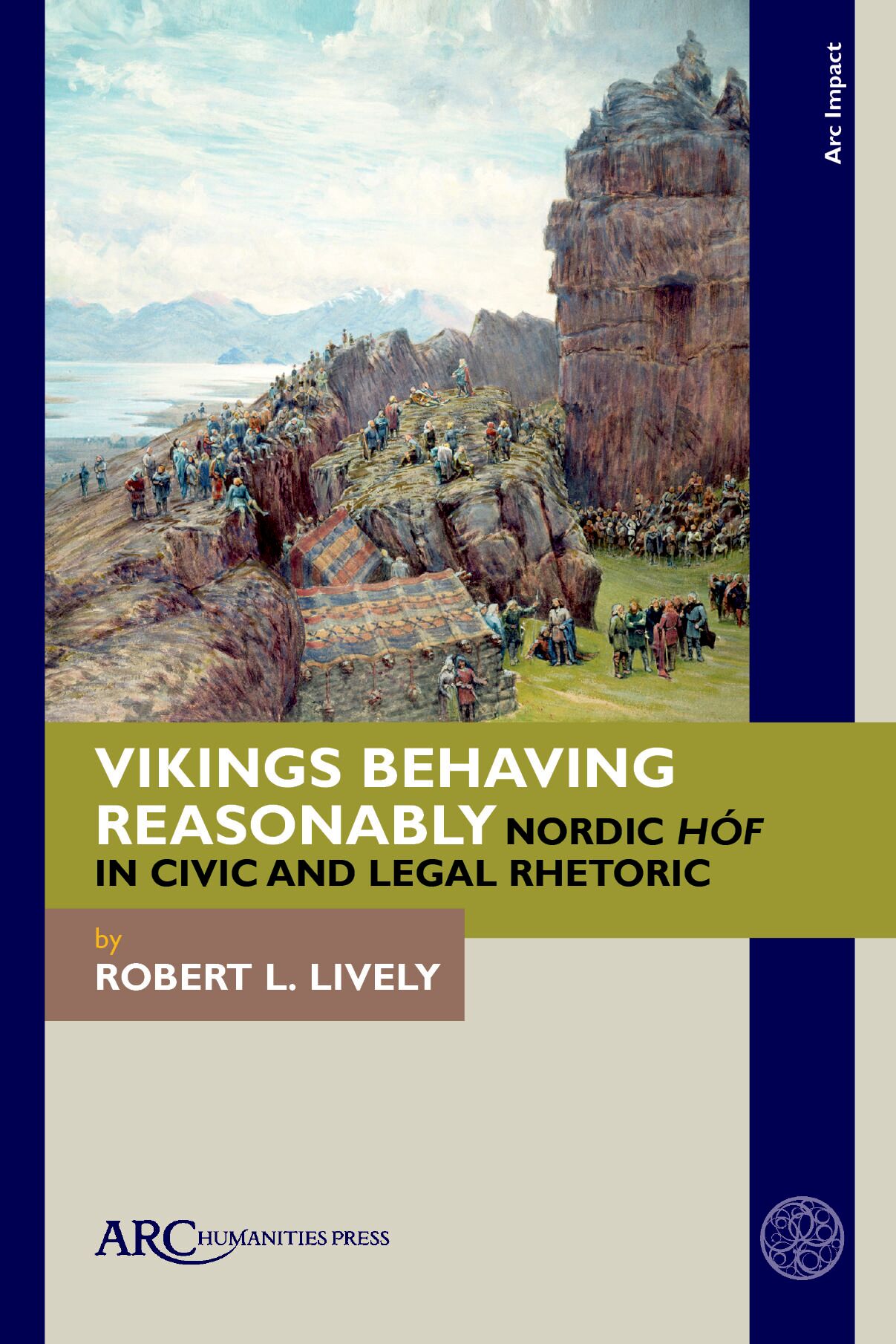
Vikings Behaving Reasonably
Rather than being the lawless barbarian society that history and popular culture have painted it, medieval Scandinavian culture was complex and nuanced. This book fundamentally challenges our stereotypes of the Vikings, and interrogates the use of a “rhetoric of reasonableness” (hóf) in medieval Nordic society to give voice to this hitherto silenced tradition. Civic rhetoric relied heavily on hóf to keep community customs manageable. In small towns and villages without central bureaucracies, reasonableness became important to the peaceful functioning of civil society. Legal rhetoric was also based on hóf. If civic actions became potentially violent, then the courts needed means of redress, and a way to maintain the peace in the locality. The Scandinavian tradition of court cases appears both in the early laws and in several sagas, allowing a picture of the rhetorical stance of hóf to emerge through Nordic legal processes.
eBook

Beowulf and the North before the Vikings
Ever since Tolkien’s famous lecture in 1936, it has been generally accepted that the poem Beowulf is a fantasy, and of no use as a witness to real history. This book challenges that view, and argues that the poem provides a plausible, detailed, and consistent vision of pre-Viking history which is most unlikely to have been the poet’s invention, and which has moreover received strong corroboration from archaeology in recent years. Using the poem as a starting point, historical, archaeological, and legendary sources are combined to form a picture of events in the North in the fifth and sixth centuries: at once a Dark and a Heroic Age, and the time of the formation of nations. Among other things, this helps answer two long-unasked questions: why did the Vikings come as such a shock? And what caused the previous 250 years of security from raiders from the sea?
eBook

Dorestad and Its Networks
Dorestad was the largest town of the Low Countries in the Carolingian era. As a riverine emporium on the northern edge of the Frankish Empire, it functioned as a European junction, connecting the Viking world with the Continent. In 2019, the National Museum of Antiquities in Leiden hosted its quinquennial international congress based around Dorestad, located at present-day Wijk bij Duurstede. This third edition, 'Dorestad and its Networks', coincided with the fiftieth birthday of finding the famous Dorestad brooch in July 1969, and with what would have been the hundredth birthday of prof.dr. Ina Isings, to whom a special session on early-medieval glass was dedicated.The Third Dorestad Congress brought together scholars from the North Sea area to debate Dorestad and its counterparts in Scandinavia, the British Isles and the Rhineland, as well as the material culture, urbanisation and infrastructure of the Early Middle Ages. The contributions in these proceedings are devoted to new research into the Vikings at Dorestad, assemblages of jewellery, playing pieces and weaponry from the town, recent excavations at other Carolingian sites in the Low Countries, and the use and trade of glassware and broadswords in this era. They show the political, economic and cultural networks of Dorestad, the only town to be called 'vicus famosus' in contemporary sources.
eBook
Die skandinavische Besiedlung auf der Isle of Man: Eine archaologische und historische Untersuchung zur fruhen Wikingerzeit in der Irischen See
Ab dem späten 8. Jahrhundert segelten Wikinger in die Irische See, und die Chroniken zeichnen über Jahrzehnte ein eindeutiges Bild von ihnen als Heiden und Piraten. Dass sie auch auf die Isle of Man gelangten und sich dort ansiedelten, belegen reiche archäologische Zeugnisse. In Bezug auf Chronologie und Charakter der skandinavischen Anwesenheit auf Man führen aber in der Forschung zwei unterschiedliche Herangehensweisen zu zwei ebenso unterschiedlichen und unvereinbaren Ergebnissen. So sind zentrale Punkte nicht gesichert: Zum einen, wann der erste Kontakt und wann eine dauerhafte Ansiedlung stattgefunden haben; zum anderen, ob die Insel Opfer von Raubzügen und gewaltsam erobert und besetzt wurde oder ob man sich eher friedlich ansiedeln konnte, und wie in der Folge beide Gruppen mit- oder gegeneinander auf Man lebten. Diesen Fragen wird hier erstmals detailliert nachgegangen: Eine sorgfältige quellenkritische Untersuchung der archäologischen, historischen, literarischen, kunsthistorischen und epigraphischen Zeugnisse stellt das verfügbare Quellenmaterial dar, hinterfragt traditionelle Paradigmen, diskutiert ihre Schlüsse und formuliert eine neue These zur Rekonstruktion der frühen Wikingerzeit auf der Isle of Man.
eBook