
Catalogue Search | MBRL


Are you sure you want to remove the book from the shelf?

{{itemTitle}}
2,557
result(s) for
"Civilization, Classical, in literature."
Sort by:

Ancient ethnography : new approaches
\"By providing a platform for scholars working in a variety of fields, this volume presents cutting-edge research dealing with various aspects of ancient ethnographic thought: its formation and devlopment, its intellectual and cultural milieux, the later reception of ethnographic traditons, and the extent to which these represent major constitutive elements of shifting notions of culture, power and identity\"-- Provided by publisher.
Book

Byron's War
Roderick Beaton re-examines Lord Byron's life and writing through the long trajectory of his relationship with Greece. Beginning with the poet's youthful travels in 1809–1811, Beaton traces his years of fame in London and self-imposed exile in Italy, that culminated in the decision to devote himself to the cause of Greek independence. Then comes Byron's dramatic self-transformation, while in Cephalonia, from Romantic rebel to 'new statesman', subordinating himself for the first time to a defined, political cause, in order to begin laying the foundations, during his 'hundred days' at Missolonghi, for a new kind of polity in Europe – that of the nation-state as we know it today. Byron's War draws extensively on Greek historical sources and other unpublished documents to tell an individual story that also offers a new understanding of the significance that Greece had for Byron, and of Byron's contribution to the origin of the present-day Greek state.
eBook


Alexander the Great in the Early Christian Tradition
What has Alexander the Great to do with Jesus Christ?Or the legendary king's conquest of the Persian Empire (335-23 BCE) to do with the prophecies of the Old Testament?In many ways, the early Christian writings on Alexander and his legacy provide a lens through which it is possible to view the shaping of the literature and thought of the early.
eBook

You win or you die : the ancient world of Game of Thrones
If the Middle Ages form the present-day backdrop to the continents of Westeros and Essos, then antiquity is their resonant past. The Known World is haunted by the remnants of distant and powerful civilizations, without whose presence the novels of George R R Martin and the ever popular HBO show would lose much of their meaning and appeal. Explores the echoes, from the Summer Islands to Storm's End, of a rich antique history. Discusses, the convergence of ancient Rome and the reach, scope and might of the Valyrian Freehold. Sows how the wanderings of Tyrion Lannister replay the journeys of Odysseus and Aeneas. Suggests that the War of the Five Kings resembles the War of the Four Emperors (68-69 AD). Demonstrates just how the Wall and the Wildlings advancing on it connect with Hadrian's bulwark against fierce tribes of Picts. Reveals the remarkable extent to which the entire Game of Thrones universe is animated by its ancient past.
BOOK
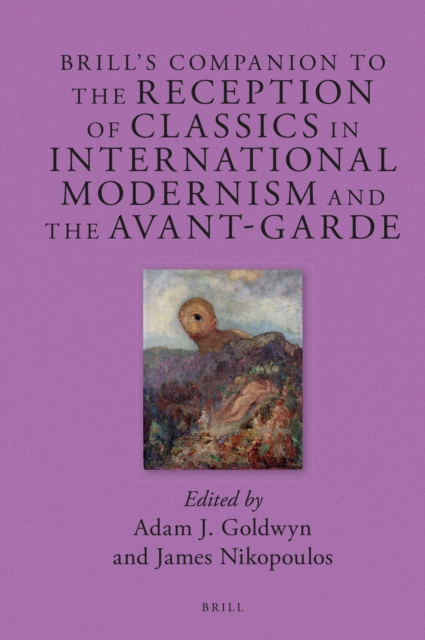
Brill's companion to the reception of classics in international modernism and the avant-garde
Brill's Companion to the Reception of Classics in International Modernism and the Avant-Garde examines the ways in which Ancient Greek and Roman culture were appropriated by a global set of authors from the late nineteenth to early twentieth centuries.
eBook

Enraged : why violent times need ancient Greek myths
\"Millennia ago, Greek myths exposed the dangers of violent rage and the need for empathy and self-restraint. Homer's Iliad, Euripides' Hecuba, and Sophocles' Ajax show that anger and vengeance destroy perpetrators and victims alike. Composed before and during the ancient Greeks' groundbreaking movement away from autocracy toward more inclusive political participation, these stories offer guidelines for modern efforts to create and maintain civil societies. Emily Katz Anhalt reveals how these three masterworks of classical Greek literature can teach us, as they taught the ancient Greeks, to recognize violent revenge as a marker of illogical thinking and poor leadership. These time-honored texts emphasize the costs of our dangerous penchant for glorifying violent rage and those who would indulge in it. By promoting compassion, rational thought, and debate, Greek myths help to arm us against the tyrants we might serve and the tyrants we might become.\"--Amazon
BOOK

Late antique letter collections
Bringing together an international team of historians, classicists, and scholars of religion, this volume provides the first comprehensive overview of the extant Greek and Latin letter collections of late antiquity (ca. 300-600 c.e.). Each chapter addresses a major collection of Greek or Latin literary letters, introducing the social and textual histories of each collection and examining its assembly, publication, and transmission. Contributions also reveal how collections operated as discrete literary genres, with their own conventions and self-presentational agendas. This book will fundamentally change how people both read these texts and use letters to reconstruct the social history of the fourth, fifth, and sixth centuries.
eBook

The ancient world on the Victorian and Edwardian stage
\"The first study of the depictions of the Ancient World on the Victorian and Edwardian stage, this book analyzes plays set in and dramatising the histories of Greece, Rome, Egypt, Babylon and the Holy Land. In doing so, it seeks to locate theatre within the wider culture, tracing its links and interaction with other cultural forms\"--Provided by publisher.
Book
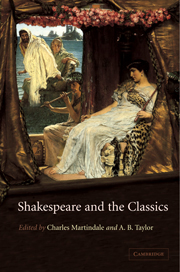
Shakespeare and the Classics
Shakespeare and the Classics demonstrates that the classics are of central importance in Shakespeare's plays and in the structure of his imagination. Written by an international team of Shakespeareans and classicists, this book investigates Shakespeare's classicism and shows how he used a variety of classical books to explore crucial areas of human experience such as love, politics, ethics and history. The book focuses on Shakespeare's favourite classical authors, especially Ovid, Virgil, Seneca, Plautus and Terence, and, in translation only, Plutarch. Attention is also paid to the humanist background and to Shakespeare's knowledge of Greek literature and culture. The final section, from the perspective of reception, examines how Shakespeare's classicism was seen and used by later writers. This accessible book offers a rounded and comprehensive treatment of Shakespeare's classicism and will be a useful first port of call for students and others approaching the subject.
eBook