
Catalogue Search | MBRL


Are you sure you want to remove the book from the shelf?

{{itemTitle}}
237
result(s) for
"Civilization, Classical Influence."
Sort by:

Greeks, Romans, Germans : how the Nazis usurped Europe's classical past
\"Much has been written about the conditions that made possible Hitler's rise and the Nazi takeover of Germany, but when we tell the story of the National Socialist Party, should we not also speak of Julius Caesar and Pericles? Greeks, Romans, Germans argues that to fully understand the racist, violent end of the Nazi regime, we must examine its appropriation of the heroes and lessons of the ancient world. When Hitler told the assembled masses that they were a people with no past, he meant that they had no past following their humiliation in World War I of which to be proud. The Nazis' constant use of classical antiquity--in official speeches, film, state architecture, the press, and state-sponsored festivities--conferred on them the prestige and heritage of Greece and Rome that the modern German people so desperately needed. At the same time, the lessons of antiquity served as a warning: Greece and Rome fell because they were incapable of protecting the purity of their blood against mixing and infiltration. To regain their rightful place in the world, the Nazis had to make all-out war on Germany's enemies, within and without\"--Provided by publisher.
Book

The classical tradition : art, literature, thought
The classical tradition—the legacy of Ancient Greece and Rome—is a large, diverse and important field that continues to shape human endeavour and engender wide public interest. The Classical Tradition: Art, Literature, Thought presents an original, coherent and wide-ranging guide to the afterlife of Greco-Roman antiquity in later Western cultures and a ground-breaking reinterpretation of large aspects of Western culture as a whole – English-speaking, French, German and Italian – from a classical perspective. Encompassing almost two millennia of developments in art, literature, and thought, the authors provide an overview of the field, a concise point of reference, and a critical review of selected examples, from Titian to T. S. Eliot, from the hero to concepts of government. They engage in current theoretical debate on various fronts, from hermeneutics to gender.
Themes explored include the Western languages and their continuing engagement with Latin and Greek; the role of translation; the intricate relationship of pagan and Christian; the ideological implications of the classical tradition; the interplay between the classical tradition and the histories of scholarship and education; the relation between high and low culture; and the myriad complex relationships—comparative, contrastive, and interactive—between art, literature, and thought themselves. Authoritative and accessible, The Classical Tradition: Art, Literature, Thought offers new insights into the powerful legacy of the ancient world from the Middle Ages and the Renaissance to the present day.
eBook


Colonizer or Colonized
Colonizer or Colonizedintroduces two colonial stories into the heart of France's literary and cultural history. The first describes elite France's conflicted relationship to the Ancient World. As much as French intellectuals aligned themselves with the Greco-Romans as an \"us,\" they also resented the Ancients as an imperial \"them,\" haunted by the memory that both the Greeks and Romans had colonized their ancestors, the Gauls. This memory put the elite on the defensive-defending against the legacy of this colonized past and the fear that they were the barbarian other. The second story mirrored the first. Just as the Romans had colonized the Gauls, France would colonize the New World, becoming the \"New Rome\" by creating a \"New France.\" Borrowing the Roman strategy, the French Church and State developed an assimilationist stance towards the Amerindian \"barbarian.\" This policy provided a foundation for what would become the nation's most basic stance towards the other. However, this version of assimilation, unlike its subsequent ones, encouraged the colonized and the colonizer to engage in close forms of contact, such as mixed marriages and communities.
This book weaves these two different stories together in a triangulated dynamic. It asks the Ancients to step aside to include the New World other into a larger narrative in which elite France carved out their nation's emerging cultural identity in relation to both the New World and the Ancient World.
eBook

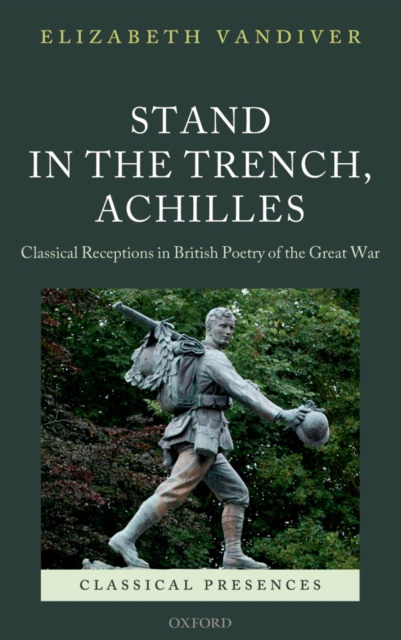
Stand in the trench, Achilles : classical receptions in British poetry of the Great War
A study of the ways in which British poets of the First World War used classical literature, culture, and history as a source of images, ideas, and even phrases for their own poetry. Elizabeth Vandiver offers a new perspective on that poetry and on the history of classics in British culture.
eBook


Caesar in the USA
The figure of Julius Caesar has loomed large in the United States since its very beginning, admired and evoked as a gateway to knowledge of politics, war, and even national life. In this lively and perceptive book, the first to examine Caesar's place in modern American culture, Maria Wyke investigates how his use has intensified in periods of political crisis, when the occurrence of assassination, war, dictatorship, totalitarianism or empire appears to give him fresh relevance. Her fascinating discussion shows how—from the Latin classroom to the Shakespearean stage, from cinema, television and the comic book to the internet—Caesar is mobilized in the U.S. as a resource for acculturation into the American present, as a prediction of America’s future, or as a mode of commercial profit and great entertainment.
eBook

Rome Reborn on Western Shores
Rome Reborn on Western Shoresexamines the literature of the Revolutionary era to explore the ways in which American patriots employed the classics and to assess antiquity's importance to the early political culture of the United States. Where other writers have concentrated on political theory and ideology, Shalev demonstrates that classical discourse constituted a distinct mode of historical thought during the era, tracing the role of the classics from roughly 1760 to 1800 and beyond. His analysis shows how the classics provided a critical perspective on the management of the British Empire, a common fund of legitimizing images and organizing assumptions during the revolutionary conflict, a medium for political discourse in the process of state construction between 1776 and 1787, and a usable past once the Revolution was over.Rome Rebornexamines the extent to which classical antiquity, especially Rome, molded understandings of history, politics, and time, even as the experience of the Revolution reshaped patriots' understanding of the classics. The book studies the historical sensibilities that enabled revolutionaries to imagine themselves continuing a historical process that originated with classical Greece and Rome. In particular, their attitudes toward, and understandings of, time provided revolutionaries with a distinct historical consciousness that connected the classical past to the revolutionary present and shaped their expectations about America's future.
eBook
Apotheosis of the North : the Swedish appropriation of classical antiquity around the Baltic Sea and beyond (1650 to 1800)
Although Antiquity itself has been intensively researched, together with its reception, to date this has largely happened in a compartmentalized fashion. This series presents for the first time an interdisciplinary contextualization of the productive acquisitions and transformations of the arts and sciences of Antiquity in the slow process of the European societies constructing a scientific system and their own cultural identity, a process which started in the Middle Ages and has continued up to the Modern Age. The series is a product of work in the Collaborative Research Centre \"Transformations of Antiquity\" and the \"August Boeckh Centre of Antiquity\" at the Humboldt University of Berlin. Their individual projects examine transformational processes on three levels in particular - the constitutive function of Antiquity in the formation of the European knowledge society, the role of Antiquity in the genesis of modern cultural identities and self-constructions, and the forms of reception in art, literature, translation and media. * new transdisciplinary series * the editors are prominent professors from different disciplines at the Humboldt University of Berlin * strengthens de Gruyter's profile in Classical Studies, Medieval Studies, Intellectual History.
eBook