
Catalogue Search | MBRL


Are you sure you want to remove the book from the shelf?

{{itemTitle}}
184
result(s) for
"Civilization, Medieval Influence."
Sort by:

Whose Middle Ages? : teachable moments for an ill-used past
\"Whose Middle Ages? is an interdisciplinary collection of short, accessible essays intended for the nonspecialist reader and ideal for teaching at an undergraduate level. Each of twenty-two essays takes up an area where digging for meaning in the medieval past has brought something distorted back into the present: in our popular entertainment; in our news, our politics, and our propaganda; and in subtler ways that inform how we think about our histories, our countries, and ourselves. Each author looks to a history that has refused to remain past and uses the tools of the academy to read and re-read familiar stories, objects, symbols, and myths\"-- Provided by publisher.
Book

Manufacturing Middle Ages : entangled history of medievalism in nineteenth-century Europe
Manufacturing Middle Ages explores the entangled history of European national discourses grounded in medievalist and archaic traditions and developed by the emerging disciplines of humanities across the long nineteenth century.
eBook


Black Legacies
Black Legacies looks at color-based prejudice in medieval and modern texts in order to reveal key similarities. Bringing far-removed time periods into startling conversation, this book argues that certain attitudes and practices present in Europe's Middle Ages were foundational in the development of the western concept of race.
Using historical, literary, and artistic sources, Lynn Ramey shows that twelfth- and thirteenth-century discourse was preoccupied with skin color and the coding of black as \"evil\" and white as \"good.\" Ramey demonstrates that fears of miscegenation show up in all medieval European societies. She pinpoints these same ideas in the rhetoric of later centuries. Mapmakers and travel writers of the colonial era used medieval lore of \"monstrous peoples\" to question the humanity of indigenous New World populations, and medieval arguments about humanness were employed to justify the slave trade. Ramey even analyzes how race is explored in films set in medieval Europe, revealing an enduring fascination with the Middle Ages as a touchstone for processing and coping with racial conflict in the West today.
eBook


Love, Work, and Death
Umbria was an important geographical and political entity in Italy during the late Middle Ages and was always linked to the Papal State. This text considers the place of the Jews in the religious, social and economic context of the region and discusses their mentality and family life.
eBook

Medieval Mythography, Volume 3
With this volume, Jane Chance concludes her monumental study of the history of mythography in medieval literature. Her focus here is the advent of hybrid mythography, the transformation of mythological commentary by blending the scholarly with the courtly and the personal.
Chance's in-depth examination of works by the major writers of the period-including Dante, Boccaccio, and Christine de Pizan-demonstrates how they essentially co-opted a thousand-year tradition. Their intricate narratives of identity mixed commentary with poetry; reinterpreted classical gods and heroes to suit personal agendas; and gave rise to innovative techniques such as \"inglossation,\" the use of a mythological figure to comment on the protagonist within an autobiographical allegory. In this manner, through allegorical authorial projection of the self, the poets explored a subjective world and manifested a burgeoning humanism that would eventually come to full fruition in the Renaissance.
No other work examines the mythographic interrelationships between these poets and their unique and personal approaches to mythological commentary.
eBook

Allusions and Reflections
In June 2012, scholars from a number of disciplines and countries gathered in Stockholm to discuss the representation of ancient mythology in Renaissance Europe. This symposium was an opportunity for the participants to cross disciplinary borders and to problematize a well-researched field. The aim was to move beyond a view of mythology as mere propaganda in order to promote an understanding of ancient tales and fables as contemporary means to explain and comprehend the Early Modern world. W.
eBook
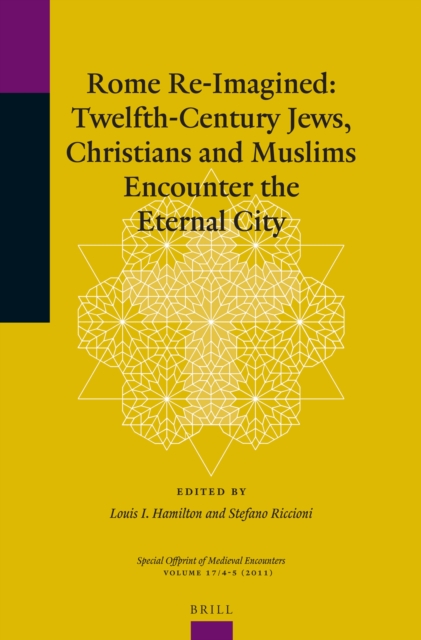
Rome re-imagined : twelfth-century Jews, Christians and Muslims encounter the Eternal City
This collection examines the image of Rome through Arabic, Greek, Hebrew, Latin, and Persian descriptions of the eternal city. Placing the twelfth-century renaissance into a Mediterranean context. The city of Rome is revealed as a multi-vocal object of desire and a contested ideal.
eBook
