
Catalogue Search | MBRL


Are you sure you want to remove the book from the shelf?

{{itemTitle}}
240
result(s) for
"Civilization, Modern 19th century."
Sort by:

An emerging modern world 1750-1870
The long century between 1750 and 1880 was a transformative period in global history. During this time, a world of connected, but essentially still separated large regions, gave way to a globally integrated world. Ever since, different parts of the world were linked not through trade and war alone. Cultural developments, political reform and social change were increasingly entangled across continents and cultures. Emerging Modernity, the fourth volume of the 6-volume series A History of the World, charts this transformative period. How did the modern world economy emerge? Why did industrialization begin in England and not in China, and were there origins of capitalist development outside of the West? What were the roles of slaves and of nomads in this integrating world? Was there a bourgeoisie outside of Euro-America? To what extent did the large empires keep the rise of nation-states in check? Was the emergence of the \"Muslim world\" an effect of globalization? Such issues are at the center of the four large, thematically organized chapters of the present volume.-- Provided by publisher
Book

Italy and the Wider World
Richard Bosworth's overview of Italy's role in European and world politics from 1860 to 1960 is lively and iconclastic. Based on a combination of primary research and secondary material he examines Italian diplomacy, military power, commerce, culture, tourism and ideology. His account challenges many aspects of current Italian historiography and offers an original vision of the place of Italy in modern history.
eBook


The New York Public Library's books of the century
This volume takes readers on a thought-provoking tour of the 20th century, through the medium of the printed word. Here readers will find over 150 pivotal works organized into topical categories, reflecting themes that have informed the century.
eBook


Modernism and Time
In Modernism and Time, Ronald Schleifer analyses the transition from the Enlightenment to post-Enlightenment ways of understanding in Western thought. Schleifer argues that this transition in the late nineteenth and early twentieth century expresses itself centrally in an altered conception of temporality. He examines this period's remarkable breaks with the past in literature, music, and the arts more generally. Whereas Enlightenment thought sees time as a homogenous, neutral medium, in which events and actions take place, post-Enlightenment thought sees time as discontinuous and inexorably bound up with both the subjects and events that seem to inhabit it. This fundamental change of perception, Schleifer argues, takes place across disciplines as varied as physics, economics and philosophy. Schleifer's study engages with the work of writers and thinkers as varied as George Eliot, Walter Benjamin, Einstein and Russell, and offers a powerful reassessment of the politics and culture of modernism.
eBook

Fractured times : culture and society in the twentieth century
\"Eric Hobsbawm, who passed away in 2012, was one of the most brilliant and original historians of our age. Through his work, he observed the great twentieth-century confrontation between bourgeois fin de siecle culture and myriad new movements and ideologies, from communism and extreme nationalism to Dadaism to the emergence of information technology. In Fractured Times, Hobsbawm, with characteristic verve, unpacks a century of cultural fragmentation. Hobsbawm examines the conditions that both created the flowering of the belle epoque and held the seeds of its disintegration: paternalistic capitalism, globalization, and the arrival of a mass consumer society. Passionate but never sentimental, he ranges freely across subjects as diverse as classical music, the fine arts, rock music, and sculpture. He records the passing of the golden age of the \"free intellectual\" and explores the lives of forgotten greats; analyzes the relationship between art and totalitarianism; and dissects phenomena as diverse as surrealism, art nouveau, the emancipation of women, and the myth of the American cowboy. Written with consummate imagination and skill, Fractured Times is the last book from one of our greatest modern-day thinkers.\"-- Provided by publisher.
Book
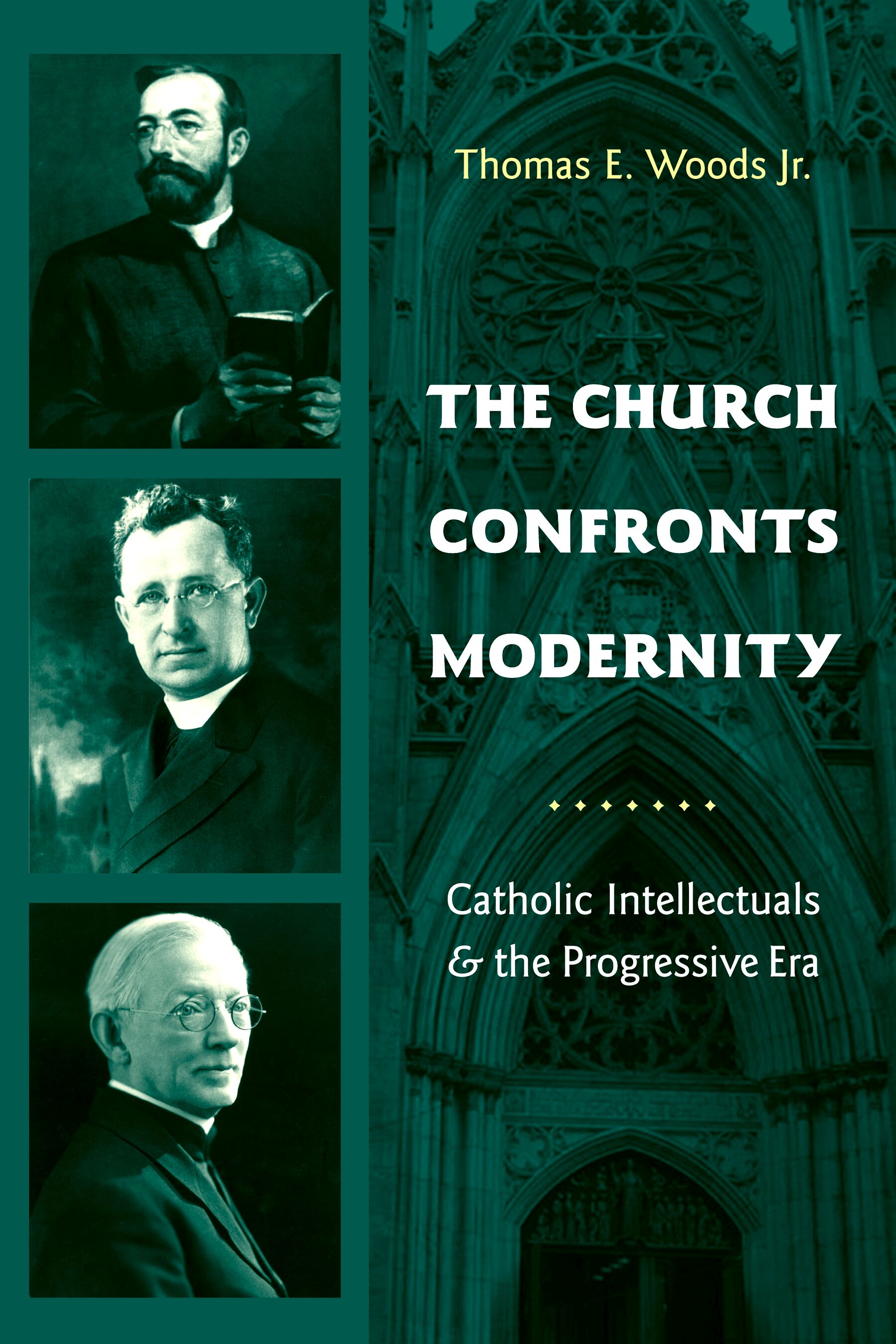
The Church Confronts Modernity
As the twentieth century opened, American intellectuals grew increasingly sympathetic to Pragmatism and empirical methods in the social sciences. The Progressive program as a whole—in the form of Pragmatism, education, modern sociology, and nationalism—seemed to be in agreement on one thing: everything was in flux. The dogma and \"absolute truth\" of the Church were archaisms, unsuited to modern American citizenship and at odds with the new public philosophy being forged by such intellectuals as John Dewey, William James, and the New Republic magazine. Catholics saw this new public philosophy as at least partly an attack on them. Focusing on the Catholic intellectual critique of modernity during the period immediately before and after the turn of the twentieth century, this provocative and original book examines how the Catholic Church attempted to retain its identity in an age of pluralism. It shows a Church fundamentally united on major issues—quite unlike the present-day Catholic Church, which has been the site of a low-intensity civil war since the close of the Second Vatican Council in 1965. Defenders of the faith opposed James, Dewey, and other representatives of Pragmatism as it played out in ethics, education, and nationalism. Their goals were to found an economic and political philosophy based on natural law, to appropriate what good they could find in Progressivism to the benefit of the Church, and to make America a Catholic country. The Church Confronts Modernity explores how the decidedly nonpluralistic institution of Christianity responded to an increasingly pluralistic intellectual environment. In a culture whose chief value was pluralism, they insisted on the uniqueness of the Church and the need for making value judgments based on what they considered a sound philosophy of humanity. In neither capitulating to the new creed nor retreating into a self-righteous isolation, American Catholic intellectuals thus laid the groundwork for a half-century of intellectual vitality.
eBook

European modernity : a global approach
\"Surveys the historiography concerning the concept of modernity and questions how modern Europe is and, conversely, how European modernity is\"--Provided by publisher.
Book

Max Weber : modernisation as passive revolution : a Gramscian analysis
Basing his research on Gramsci's theory of hegemony, Rehmann provides a comprehensive socio-analysis of Max Weber's political and intellectual position in the ideological network of his time. Max Weber: Modernisation as Passive Revolution shows that, even though Weber presents his science as 'value-free', he is best understood as an organic intellectual of the bourgeoisie, who has the mission of providing his class with an intense ethico-political education. Viewed as a whole, his writings present a new model for bourgeois hegemony in the transition to 'Fordism'. Weber is both a sharp critic of a 'passive revolution' in Germany tying the bourgeois class to the interests of the agrarian class, and a proponent of a more modern version of passive revolution, which would foreclose a socialist revolution by the construction of an industrial bloc consisting of the bourgeoisie and labour aristocracy.© 1998 Argument Verlag GmbH, Hamburg. Translated from German \"Max Weber: Modernisierung als passive Revolution. Kontextstudien zu Politik Philosophie und Religion im Übergang zum Fordismus\".
eBook