
Catalogue Search | MBRL


Are you sure you want to remove the book from the shelf?

{{itemTitle}}
47,201
result(s) for
"Civilization -- History"
Sort by:


The Eastern Origins of Western Civilisation
John Hobson challenges the ethnocentric bias of mainstream accounts of the Rise of the West. It is often assumed that since Ancient Greek times Europeans have pioneered their own development, and that the East has been a passive by-stander in the story of progressive world history. Hobson argues that there were two processes that enabled the Rise of the 'Oriental West'. First, each major developmental turning point in Europe was informed in large part by the assimilation of Eastern inventions (e.g. ideas, technologies and institutions) which diffused from the more advanced East across the Eastern-led global economy between 500–1800. Second, the construction of European identity after 1453 led to imperialism, through which Europeans appropriated many Eastern resources (land, labour and markets). Hobson's book thus propels the hitherto marginalised Eastern peoples to the forefront of the story of progress in world history.
eBook

The West : the history of an idea
How did 'the West' come to be used as a collective self-designation signaling political and cultural commonality? When did 'Westerners' begin to refer to themselves in this way? Was the idea handed down from the ancient Greeks, or coined by nineteenth-century imperialists? Neither, writes Georgios Varouxakis in The West, his ambitious and fascinating genealogy of the idea. 'The West' was not used by Plato, Cicero, Locke, Mill, or other canonized figures of what we today call the Western tradition. It was not first wielded by empire-builders. It gradually emerged as of the 1820s and was then, Varouxakis shows, decisively promoted in the 1840s by the French philosopher Auguste Comte (whose political project, incidentally, was passionately anti-imperialist).
BOOK

Medieval Robots
A thousand years before Isaac Asimov set down his Three Laws of Robotics, real and imagined automata appeared in European courts, liturgies, and literary texts. Medieval robots took such forms as talking statues, mechanical animals, and silent metal guardians; some served to entertain or instruct while others performed disciplinary or surveillance functions. Variously ascribed to artisanal genius, inexplicable cosmic forces, or demonic powers, these marvelous fabrications raised fundamental questions about knowledge, nature, and divine purpose in the Middle Ages.
Medieval Robotsrecovers the forgotten history of fantastical, aspirational, and terrifying machines that especially captivated Europe in imagination and reality between the ninth and fourteenth centuries. E. R. Truitt traces the different forms of self-moving or self-sustaining manufactured objects from their earliest appearances in the Latin West through centuries of mechanical and literary invention. Chronicled in romances and song as well as histories and encyclopedias, medieval automata were powerful cultural objects that probed the limits of natural philosophy, illuminated and challenged definitions of life and death, and epitomized the transformative and threatening potential of foreign knowledge and culture. This original and wide-ranging study reveals the convergence of science, technology, and imagination in medieval culture and demonstrates the striking similarities between medieval and modern robotic and cybernetic visions.
eBook

World history : from the ancient world to the information age
Discover the events that have shaped our world, from the dawn of prehistoric civilization to the digital age, brought to life with contemporary photographs, maps, paintings, and artifacts that place each event in a wider social and historical context.
BOOK

The Power of Knowledge
Information is power. For more than five hundred years the success or failure of nations has been determined by a country's ability to acquire knowledge and technical skill and transform them into strength and prosperity. Leading historian Jeremy Black approaches global history from a distinctive perspective, focusing on the relationship between information and society and demonstrating how the understanding and use of information have been the primary factors in the development and character of the modern age.
Black suggests that the West's ascension was a direct result of its institutions and social practices for acquiring, employing, and retaining information and the technology that was ultimately produced. His cogent and well-reasoned analysis looks at cartography and the hardware of communication, armaments and sea power, mercantilism and imperialism, science and astronomy, as well as bureaucracy and the management of information, linking the history of technology with the history of global power while providing important indicators for the future of our world.
eBook

Europa : how Europe shaped the modern world
European history is deeply embedded in the global civilization that has emerged in the 21st century. More than two thirds of today's nations were once European colonies or protectorates. Europe's legacy is evident in the trajectory of the United States and has influenced aspiring hegemonic powers like China. For centuries, Europe was the heart and soul of the West, and European powers enjoyed unprecedented global hegemony, not only by military and economic means, but also through their influence on politics and culture.
Book

The Black campus movement : Black students and the racial reconstitution of higher education, 1965-1972
This book provides the first national study of this intense and challenging struggle which disrupted and refashioned institutions in almost every state. It also illuminates the context for one of the most transformative educational movements in American history through a history of black higher education and black student activism before 1965.
eBook

Millennium : from religion to revolution : how civilization has changed over a thousand years
\"History's greatest tour guide--Ian Mortimer--takes us on an eye-opening and expansive journey through the last millennium of human innovation. We are an astonishing species. Over the past millennium of plagues and exploration, revolution and scientific discovery, women's rights and technological advances, human society has changed beyond recognition. ln Millennium, bestselling historian Ian Mortimer takes the reader on a whirlwind tour of the last ten centuries of Western history. It is a journey into a past vividly brought to life--and bursting with ideas--that pits one century against another in his quest to measure which century saw the greatest change. We journey from a time when there was a fair chance of your village being burned to the ground by invaders--and dried human dung was a recommended cure for cancer--to a world in which explorers sailed into the unknown and civilizations came into conflict with each other on an epic scale. Here is a story of brilliant scientists, fearless adventurers, cold-hearted entrepreneurs, and strong-minded women--a story of discovery, invention, revolution, and cataclysmic shifts in perspective. Millennium is a journey into the past like no other. Our understanding of human development will never be the same again\"--Jacket.
Book
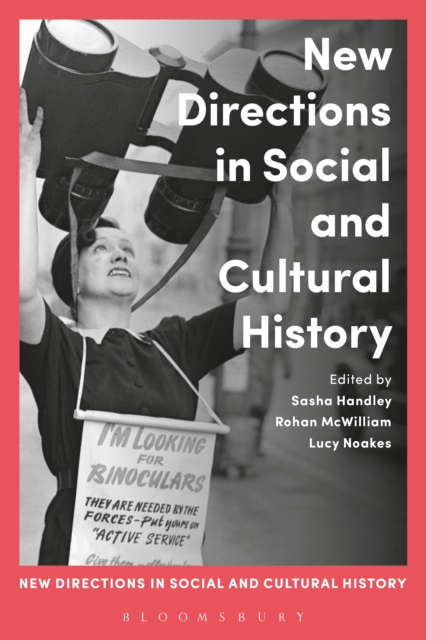
New directions in social and cultural history
What does it mean to be a social and cultural historian today?In the wake of the 'cultural turn', and in an age of digital and public history, what challenges and opportunities await historians in the early 21st century?.
eBook