
Catalogue Search | MBRL


Are you sure you want to remove the book from the shelf?

{{itemTitle}}
610
result(s) for
"Classical literature Influence."
Sort by:


Receptions of the classics in the African diaspora of the hispanophone and lusophone worlds
Atlantis Otherwise expands the study of the African diaspora by focusing on postcolonial literary expressions from Latin America and Africa.The book studies the presence of classical references in texts written by writers (black and non-black) who are committed to the articulation of the fragmented history of the African experience.
eBook

Seamus Heaney and the classics : Bann Valley muses
The death of Seamus Heaney in 2013 is an appropriate point to honour the Irish poet’s contribution to classical reception in modern poetry in English; this is the first volume dedicated to that subject, though occasional essays have appeared in the past. The volume comprises literary criticism by scholars of classical reception and literature in English, and has some input from critics who are also poets and from theatre practitioners on their interpretations and productions of Heaney’s versions of Greek drama; it combines well-known names with early-career contributors, and friends and collaborators of Heaney with those who admired him from afar. The papers focus on two main areas: Heaney’s fascination with Greek drama and myth, shown primarily in his two Sophoclean versions but also in his engagement with Hesiod, with Aeschylus’ Agamemnon, and with myths such as that of Antaeus, and his interest in Latin poetry, primarily in Virgil but also in Horace. A number of the papers cover the same material, but from different angles; for example, Heaney’s interest in Virgil is linked with the traditions of Irish poetry, his capacity as a translator, and his annotations in his own text of a standard translation, as well as being investigated in its long development over his poetic career, while his Greek dramas are considered as verbal poetry, as comments on Irish politics, and as stage-plays with concomitant issues of production and interpretation. Heaney’s posthumous translation of Aeneid VI comes in for considerable attention, and this will be the first volume to study this major work.
eBook

Classical humanism and the challenge of modernity : debates on classical education in 19th-century Germany
This book challenges the common view that classical education in 19th-century Germany was dominated by a progressive ideal called 'neohumanism'. The prevailing ideal of education at the German Gymnasien was emphatically traditional and is best described as classical humanism. Moreover, this 19th-century classical humanism dynamically related to modern society and should therefore be seen as the continuation of a living tradition.
Book

Barbarous Antiquity
In the late sixteenth century, English merchants and diplomats ventured into the eastern Mediterranean to trade directly with the Turks, the keepers of an important emerging empire in the Western Hemisphere, and these initial exchanges had a profound effect on English literature. While the theater investigated representations of religious and ethnic identity in its portrayals of Turks and Muslims, poetry, Miriam Jacobson argues, explored East-West exchanges primarily through language and the material text. Just as English markets were flooded with exotic goods, so was the English language awash in freshly imported words describing items such as sugar, jewels, plants, spices, paints, and dyes, as well as technological advancements such as the use of Arabic numerals in arithmetic and the concept of zero.Even as these Eastern words and imports found their way into English poetry, poets wrestled with paying homage to classical authors and styles. In Barbarous Antiquity, Jacobson reveals how poems adapted from Latin or Greek sources and set in the ancient classical world were now reoriented to reflect a contemporary, mercantile Ottoman landscape. As Renaissance English writers including Shakespeare, Jonson, Marlowe, and Chapman weighed their reliance on classical poetic models against contemporary cultural exchanges, a new form of poetry developed, positioned at the crossroads of East and West, ancient and modern. Building each chapter around the intersection of an Eastern import and a classical model, Jacobson shows how Renaissance English poetry not only reconstructed the classical past but offered a critique of that very enterprise with a new set of words and metaphors imported from the East.
eBook

How the classics made Shakespeare
Ben Jonson famously accused Shakespeare of having \"small Latin and less Greek.\" But he was exaggerating. Shakespeare was steeped in the classics. Shaped by his grammar school education in Roman literature, history, and rhetoric, he moved to London, a city that modeled itself on ancient Rome. He worked in a theatrical profession that had inherited the conventions and forms of classical drama, and he read deeply in Ovid, Virgil, and Seneca. In a book of extraordinary range, acclaimed literary critic and biographer Jonathan Bate, one of the world's leading authorities on Shakespeare, offers groundbreaking insights into how, perhaps more than any other influence, the classics made Shakespeare the writer he became. Revealing in new depth the influence of Cicero and Horace on Shakespeare and finding new links between him and classical traditions, ranging from myths and magic to monuments and politics, Bate offers striking new readings of a wide array of the plays and poems. At the heart of the book is an argument that Shakespeare's supreme valuation of the force of imagination was honed by the classical tradition and designed as a defense of poetry and theater in a hostile world of emergent Puritanism. Rounded off with a fascinating account of how Shakespeare became our modern classic and has ended up playing much the same role for us as the Greek and Roman classics did for him, How the Classics Made Shakespeare combines stylistic brilliance, accessibility, and scholarship, demonstrating why Jonathan Bate is one of our most eminent and readable literary critics.
Book

The Ebony Column
In
The Ebony Column , Eric Ashley Hairston begins a new
thread in the ongoing conversation about the influence of Greek
and Roman antiquity on U.S. civilization and education. While
that discussion has yielded many exceptional insights into
antiquity and the American experience, it has so regularly elided
the African American component that all classical influence on
black writing and thought seems to vanish. That omission,
Hairston contends, is disturbing not least because of its
longevity— from an early period of overt stereotyping and
institutionalized racism right up to the contemporary and, one
would hope, more cosmopolitan and enlightened era. Challenging
and correcting that persistent shortsightedness, Hairston
examines several prominent black writers’ and
scholars’ deep investment in the classics as individuals,
as well as the broader cultural investment in the classics and
the values of the ancient world. Beginning with the
late-eighteenth-century verse of Phillis Wheatley, whose
classically inspired poems functioned as a kind of Trojan horse
to defeat white oppression, Hairston goes on to consider the
oratory of Frederick Douglass, whose rhetoric and ideas of virtue
were much influenced by Cicero, and the writings of educator Anna
Julia Cooper, whose classical training was a key source of her
vibrant feminism. Finally, he offers a fresh examination of W. E.
B. DuBois’s seminal
The Souls of Black Folk (1903) and its debt to
antiquity, which volumes of commentary have largely overlooked.
The first book to appear in a new series, Classicism in American
Culture,
The Ebony
Column passionately demonstrates how the myths,
cultures, and ideals of antiquity helped African Americans
reconceptualize their role in a Euro-American world determined to
make them mere economic commodities and emblems of moral and
intellectual decay. To figures such as Wheatley, Douglass,
Cooper, and DuBois, classical literature offered striking moral,
intellectual, and philosophical alternatives to a viciously
exclusionary vision of humanity, Africanity, the life of the
citizen, and the life of the mind.
eBook

Son of Classics and Comics
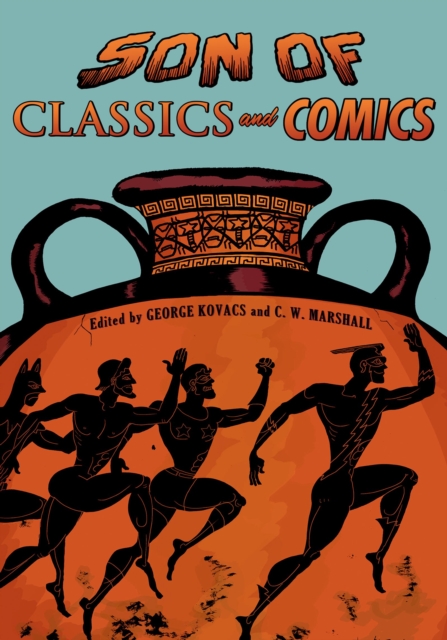
Son of Classics and Comics presents thirteen original studies of representations of the ancient world in the medium of comics. Building on the foundation established by their groundbreaking Classics and Comics, Kovacs and Marshall have gathered a wide range of studies with a new, global perspective.
eBook