
Catalogue Search | MBRL


Are you sure you want to remove the book from the shelf?

{{itemTitle}}
30
result(s) for
"Classicism Great Britain."
Sort by:

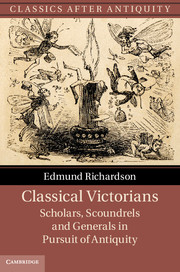
Classical Victorians
Victorian Britain set out to make the ancient world its own. This is the story of how it failed. It is the story of the headmaster who bludgeoned his wife to death, then calmly sat down to his Latin. It is the story of the embittered classical prodigy who turned to gin and opium – and the virtuoso forger who fooled the greatest scholars of the age. It is a history of hope: a general who longed to be an Homeric hero, a bankrupt poet who longed to start a revolution. Victorian classicism was defined by hope – but shaped by uncertainty. Packed with forgotten characters and texts, with the roar of the burlesque-stage and the mud of the battlefield, this book offers a rich insight into nineteenth-century culture and society. It explores just how difficult it is to stake a claim on the past.
eBook

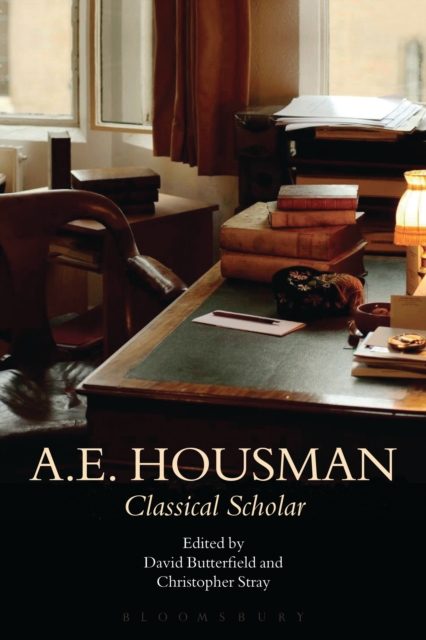
A.E. Housman
A.E. Housman (1859-1936) was a man of many apparent contradictions, most of which remain unresolved 150 years after his birth. At once a deeply emotive lyric poet and a precise and dedicated classical scholar, he achieved fame in both of these diverse disciplines. Although his poetic legacy has received much scholarly analysis, and yet more attention has been devoted to reconstructing his private life, no previous work has focused on Housman the classical scholar; yet it is upon scholarship that Housman most wished to leave his mark. This timely collection of papers by leading scholars reassesses the breadth and significance of Housman's contribution to classical scholarship in both his published and unpublished writings, and discusses how his mantle has been passed on to later generations of classicists.
eBook


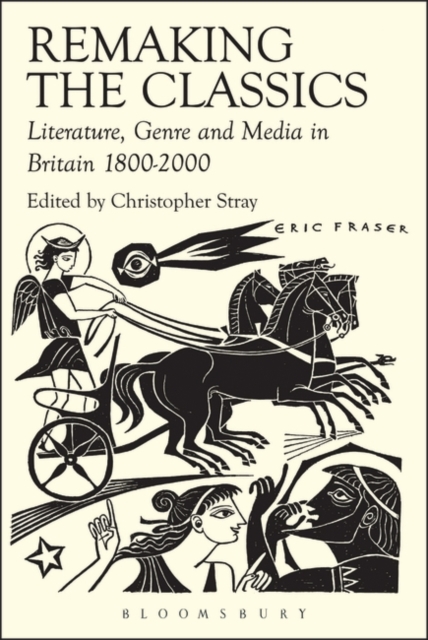
Remaking the classics : literature, genre and media in Britain 1800-2000
This important collection of essays both contributes to the expanding field of classical reception studies and seeks to extend it. Focusing on nineteenth- and twentieth-century Britain, it looks at a range of different genres (epic, novel, lyric, tragedy, political pamphlet). Within the published texts considered, the usual range of genres dealt with elsewhere is extended by chapters on books for children, and those in which childhood and memories of childhood are informed by antiquity; and also by a multi-genre case study of a highly unusual subject, Spartacus. \"Remaking the Classics\" also goes beyond books to dramatic performance, and beyond the theatre to radio - a medium of enormous power and influence from the 1920s to the 1960s, whose role in the reception of classics is largely unexplored. The variety of genres and of media considered in the book is balanced both by the focus on Britain in a specific time period, and by an overlap of subject-matter between chapters: the three chapters on twentieth-century drama, for example, range from performance strategies to post-colonial contexts.The book thus combines the consolidation of a field with an attempt to push it in new and exciting directions.
eBook

Women writers and the dark side of late-Victorian Hellenism
\"This book examines the highly complex relationship of women writers to Hellenism in the late-nineteenth century, arguing that the proliferation of Greek subjects in women's literature from the middle of the century suggest a collective movement into the classical tradition by women writers and scholars rather than comprehensive exclusion from it\"--Provided by publisher.
Book

Classical Tradition in Operation
In these five essays Niall Rudd presents an eclectic set of comparisons between certain ancient authors and later English writers ranging from Chaucer to Pound. He shows how five English writers consciously used and adapted classical works, and in so doing he illuminates both the classical authors and their English imitators and admirers. Readable translations and summaries of the Latin sources make these stimulating studies accessible even to scholars and students with little or no Latin.
The first essay compares Chaucer's treatment of Dido in The House of Fame and The Legend of Good Women with Virgil's presentation of Dido in the Aeneid , and Ovid's in Heroides 7 . The second essay, comparing Shakespeare's The Comedy of Errors with Plautus' Menaechmi , demonstrates how Shakespeare, weaving Roman farce into the framework of Hellenistic romance, developed both genres into something richer and more complex. The third essay on Pope's Epistle to Augustus shows his conversion of Horace's praise of Augustus into an anti-royalist attack on George II. In the fourth essay, Rudd discusses how much of Tennyson's Lucretius is invented and imported by Tennyson as a way of externalizing the inner conflicts he experienced in the age of doubt. The final essay, on Pound and Propertius, looks at Pound's representation of the Latin poet in Homage to Sextus Propertius , specifically in the areas of imperial politics, love, and language.
In his preface Rudd writes: 'Everyone knows of the Classical Tradition - comprehending it is another matter.' This book brings it closer to our understanding.
eBook